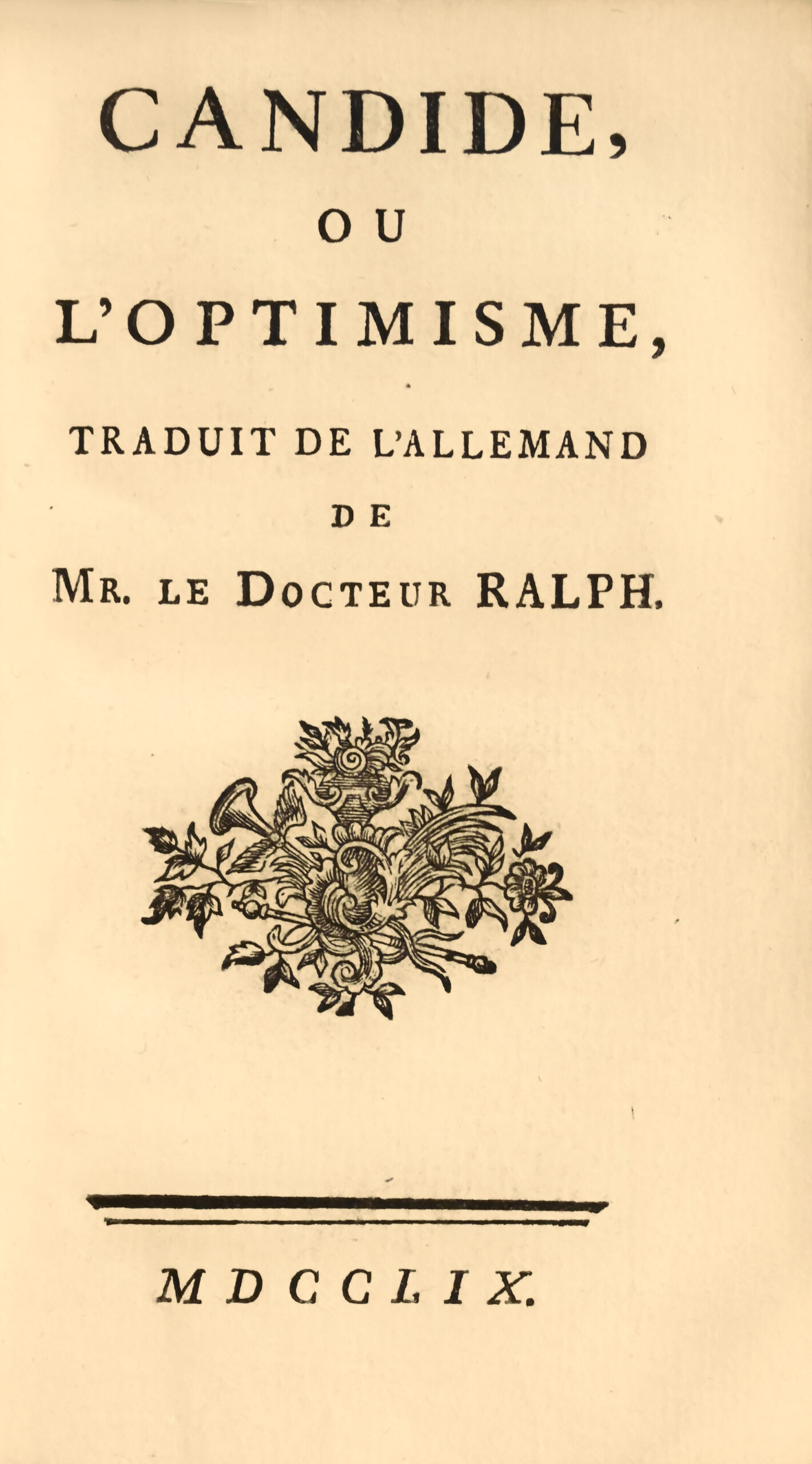
N.p. (Genève, Cramer), 1759.
12mo of 299 pages. Signatures A-N4.
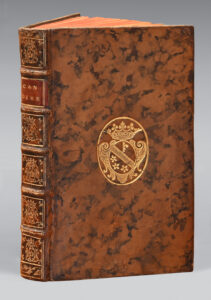
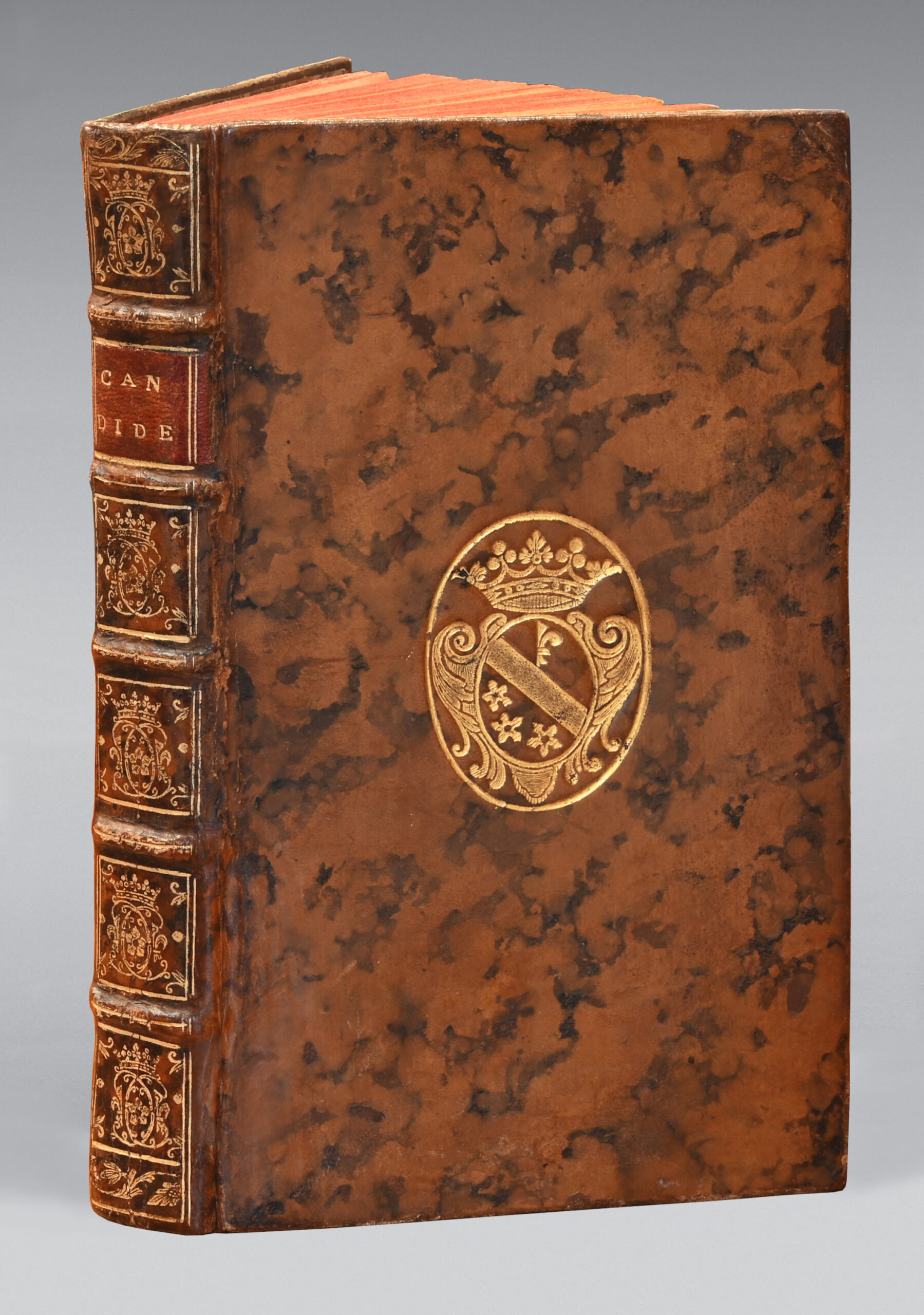
Full marbled calf, coat of arms gilt-stamped in the center of the covers, spine decorated with crowned coat of arms repeated five times, red edges. Contemporary armorial calf binding.
159 x 93 mm.
“Very rare and much sought after” original edition.
“There are eight different editions of Candide, published in 1759 without the name of the city or the printer, all printed in the same format, and all having an identical title. Of these eight editions, this is the first.” (Bengesco, B.n.F. En Français dans le texte).
“Raised in a baron’s castle, a certain young man named Candide leads the most pleasant life in the company of his tutor, Dr. Pangloss. And for good reason: he takes from the latter that the world is absolutely good, since any cause brings the best end in an inescapable way, until the day when the squire disturbs this quietude: having surprised the dear Candide on the breast of his daughter Cunégonde, he sends him on the hour to all the devils of a great kick in the butt. Reduced to rolling his hump, the young man travels to various countries that will show him that this world does not respond very well to the wonderful teaching of the good man Pangloss. Whether he finds himself in England, France or Italy, he is forced to note that evil prevails over good in the most savage way.”
“It is certain that Voltaire is the master of ironic pessimism. Eugène Marsan observes in this respect: “Of all his veins, it is this one that has suffered the least from time. What he had of caduc in his poetry, of dry in his history, of short in his philosophy ended up repulsing, instead of the pessimism of Candide seducing more and more “.
This original edition of Candide is rare and very rare in fine condition.
A copy of mediocre quality, in rubbed calf, was sold for 100 000 € (90 000 $ at the time) by American booksellers exhibiting at the Salon de la Mutualité in May 2001, 25 years ago.
A copy in simple roan with arms was sold for 150 000 € in 2009, 17 years ago.
A precious and beautiful copy – the only one to appear on the market in contemporary marbled calf with arms for half a century – bound with the arms and pieces of arms of the marquis de Caraman (1731-1806).
Marie-Jean-Louis de Riquet, known as the marquis de Caraman, fourth son of Victor-Pierre-François, comte de Caraman, and Louise-Madeleine-Antoinette Portail, born on November 26, 1731, became a knight of the order of Saint-Louis in 1760 and a brigadier of the king’s armies on April 20, 1768; he died in 1806; he had married on August 21, 1763 Marie-Charlotte-Eugénie de Bernard de Montessus de Rully.
Voltaire and the marquis de Caraman were frequenting each other at the court of Stanislas.
In 1738, the treaty of Vienna put an end to the war of Polish Succession. The king Stanislas Leszczynski was exiled. As Louis XV’s father-in-law, he was given Lorraine and Barrois, which were then erected as kingdoms. He was fond of Lunéville, where the court, led by a “puppet sovereign”, attracted brilliant minds with its great freedom. The whole of intellectual Europe met there, in particular Voltaire and Madame Du Châtelet. Stanislas took a liking for this couple that he received with all the honors. Voltaire appreciated the relaxed and tolerant atmosphere of Lunéville, where he found refuge when he published disturbing works. The two men continued to correspond and remained linked until Stanislas’ accidental death in 1766.
Among the main guests who came successively to charm and entertain the court of Lunéville, we must mention the Prince of Conti, the Crown Prince of Hesse-Darmstadt, Miss Charolais; the Bishop of Toul, Mgr Drouas de Boussey; the count and the marquis de caraman, the count of Stainville, the marshal of Bercheny, an old friend of Stanislas, who lives near Châlons; Mgr de Choiseul-Beaupré, the marshal of Maillebois and his son, etc., etc.
His tolerance was the same for all; he welcomed as liberally the philosophers who fled the Bastille as the Jesuits who fled the wrath of the Parliament. At his court, everyone had complete freedom of conscience: his first doctors and his treasurer were Protestants.
For Stanislaus, the greatest pleasure of all was to talk with people whose minds were as lively and cultured as his own; he didn’t care about their opinions, he loved to discuss.
The men of letters as well as the philosophers were not without appreciating the rare honor which their royal fellow-member made to them, so good, so familiar, so accessible; they pleased themselves infinitely in this peaceful court where they were admired as they deserved to be and where they enjoyed in peace the fruit of their work, far from the envy and the cabals. Voltaire did not live happier years than those he spent in Lunéville.