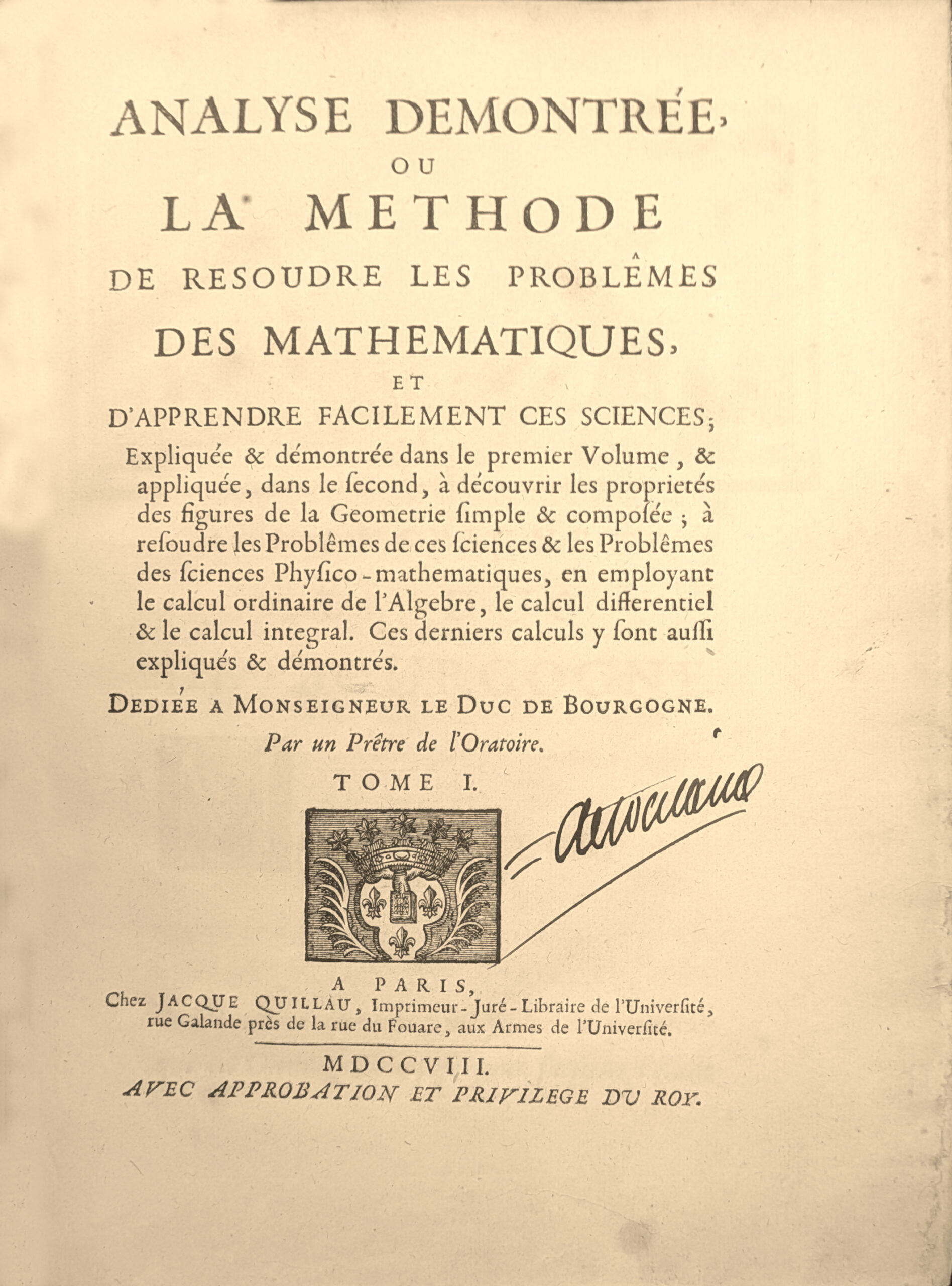
Paris, Jacque Quillau, 1708.
2 4to [261 x 192 mm] volumes of: I/ 1 bl. l., (3) ll., xxiv pp., 486 pp., (1) l. and 1 folded chart; II/ xxviii pp., pp. 487 to 912, (2) ll., 5 folded engraved plates out of text. A few browned ll., a few foxing on the plates.
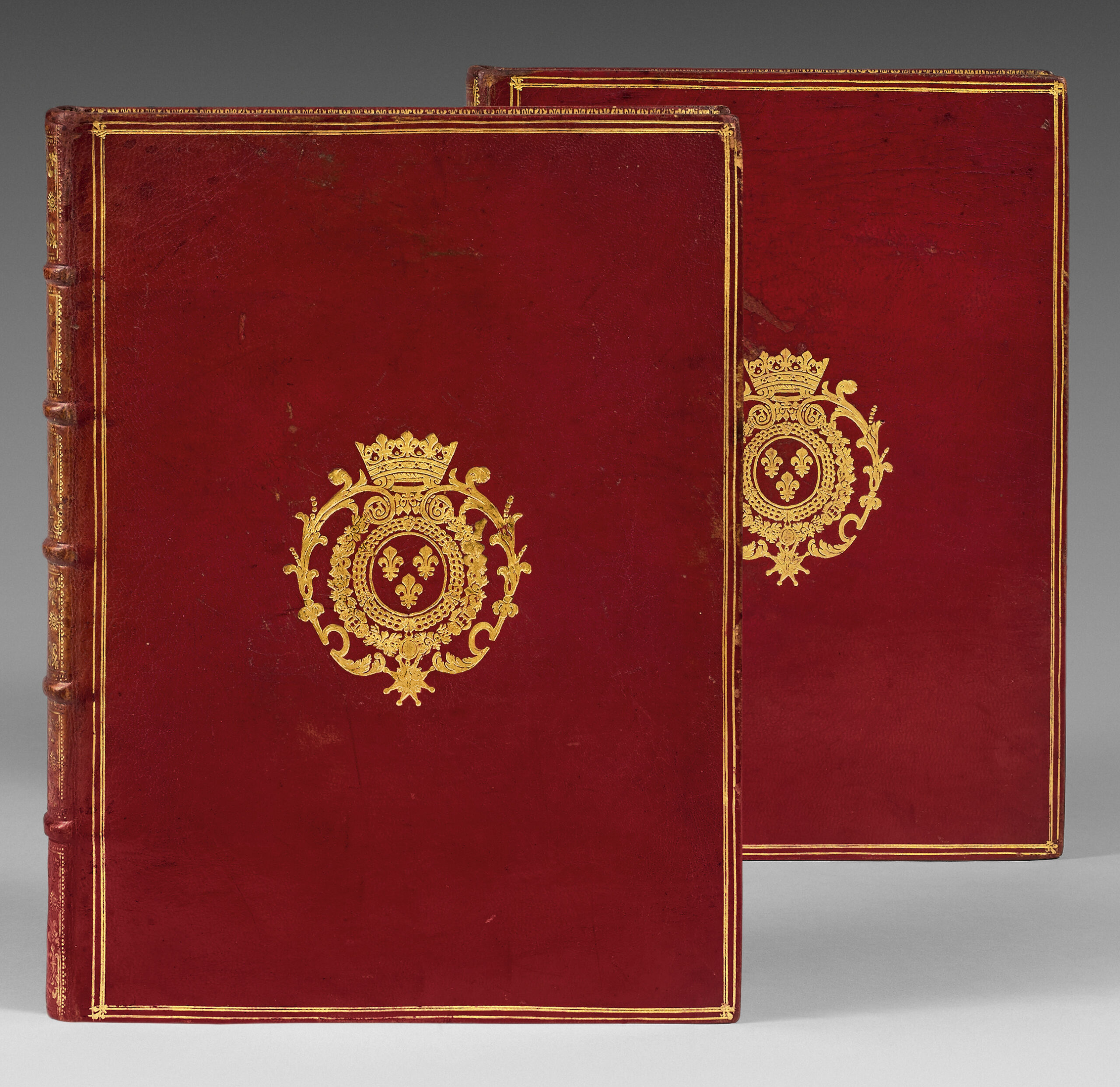
Red morocco, triple fillets surrounding the covers, stamped arms in the center, spine ribbed decorated with fleur-de-lys and small suns in the squares, marbled endpaper, inner border, gilt edges on marbling. Contemporary binding.
First edition.
Important analytical method composed by mathematician Charles Reyneau (1656-1728) at the request of Malebranche, who had been charged with the illustration of the progress made in the mathematics field at the beginning of the 18th century.
“The author gathered in this work the main theories spreaded in the works of Descartes, Leibnitz, Newton, Bernoullis, etc., and demonstrated several methods that haven’t been yet.” (Quérard).
« Charles Reyneau, skilled surveyor, was born in 1656 at Brissac, in Anjou, and, after having finished studying, entered the congregation of the Oratory, in Paris. He taught philosophy in Toulon, Pézenas, and then mathematics at the college of Angers, for twenty-two years, with such success that the academy of the city, newly created, rushed to partner with him, an honor that it never gave afterwards to any member of any congregation. His life, said Fontenelle, was as simple and consistent as possible: study, prayer, and two mathematical works as its only events. He was only involved in encouraging working and leading when necessary, young people he found talented for mathematics; and he only was visited by those he was not loosing time with, because they needed him. His main friends were Malebranche, from who he endorsed all the principles, and Chancelor d’Aguesseau. Prof. Reyneau died in Paris on the 24th of February 1728. »
« Reyneau’s most notable contribution to mathematical education was “Analyse démontrée” (1708). It was from the second edition of this work that d’Alembert learned the fundamentals of the subject. » (DSB).
D’Alembert learned the differential and integral calculus in L’Analyse démontrée by Charles-René Reyneau. A large part of this treatise is dedicated to algebra and its geometrical applications. The elements of the differential calculus are progressively introduced, with a clear educational will. The integral calculus methods are only limited yet, but are illustrated with a lot of geometrical and physical-mathematical examples, including problems related to the transcendental curves. The treatise explicitly states the area of mathematics that has been realized with Leibniz. We can pinpoint a few of the seminal problems of the analytical methods from the 18th century.
The treatise of Reyneau gives a significant image of the work of a generation of cartesians converted to Leibniz calculus and of whom Malebranche could be the enthusiastic spokesman : « the invention of the differential calculus gave to analysis an unlimited extense as to speak. » As much as a discipline with its own tools, analysis for Reyneau, is a method that needs you to directly take in charge the geometrical and physical situations. A non-negligible part of the treatise is dedicated to algebraic geometry, it sometimes takes the shape of a propaedeutic with a differential calculus. This calculus operates on geometrical objects, while its concepts still have an uncertain relationship with mechanic. The multiplicity of covered examples explicitly states an extension of the mathematics field and an increased efficiency in the latter. The methods of integral calculus are not much developed then, they remain tightly linked to an inverted reading of the formulations of differentiation and the frequent reliance to undetermined coefficients give those a limited reach. But, with the place accorded to transcendentals and expansions, the treatise of Reyneau is a vector of fruitful problematics.
Precious dedicated copy in morocco with the arms of Louis of France (1682-1712), Duke of Burgundy, son of the Grand Dauphin and of Marie-Anne Victoire de Bavière.
Louis of France, Duke of Burgundy, then Dauphin of France, eldest son of Louis, the Grand Dauphin, and of Marie-Anne-Christine-Victoire de Bavière, and grand-son of Louis XIV, was born into the Castle of Versailles on the 6th of August 1682; he has as a tutor Fénelon who transformed a terrible child into a young man gifted with high qualities; on the 7th of December 1697, he married Marie-Adélaïde de Savoie, who gave him three sons, the latter being Louis XV. The Duke of Burgundy was gifted a role of leader in the armies and initiated to the affairs by Louis XIV, who had a penchant for him. He became dauphin, after the death of his father, on the 14th of April 1711, but he died on the 18th of February 1712 in the Castle of Marly from measles that killed his wife six days before.
Copies bound in morocco with the arms of the Dauphins of France are rare and particularly wanted.
In his sale from the 7th of June 1990 Jacques Guérin presented two similar volumes: n° 41 : Lacepède. La Poétique de la musique, 1785. 2 volumes 8vo with the arms of the Dauphin Louis-Joseph-François-Xavier of France, eldest son of Louis XVI, sold 190 000 FF (28 500 €) 28 years ago; n° 42: Messance: Essais sur l’arithmétique religieuse, 1792. 1 volume 8vo with the arms of Louis-Charles of France, second son of Louis XVI, sold 280 000 FF (43 000 €) 28 years ago.