![Apocalypsis cù[m] figuris.](https://www.camillesourget.com/wp-content/uploads/2026/03/Planche-5-resize.jpg)
![Apocalypsis cù[m] figuris. - Image 2](https://www.camillesourget.com/wp-content/uploads/2026/03/Titre-resize.jpeg)
![Apocalypsis cù[m] figuris. - Image 3](https://www.camillesourget.com/wp-content/uploads/2026/03/Reliure-fond-gris-resize.jpg)
![Apocalypsis cù[m] figuris. - Image 4](https://www.camillesourget.com/wp-content/uploads/2026/03/Planche-4-resize.jpg)
![Apocalypsis cù[m] figuris. - Image 5](https://www.camillesourget.com/wp-content/uploads/2026/03/Planche-3-resize.jpg)
![Apocalypsis cù[m] figuris. - Image 6](https://www.camillesourget.com/wp-content/uploads/2026/03/Planche-2-resize.jpg)
![Apocalypsis cù[m] figuris. - Image 7](https://www.camillesourget.com/wp-content/uploads/2026/03/Planche-1-resize.jpg)
Nuremberg, Albrecht Durer, 1511.
Folio (431 x 300 mm).
Title a little soiled and very slightly shorter in the outer margin, two small holes filled in the outer margin. One plate remargined (martyrdom of St. John) with very discreet small hole affecting the engraving. One leaf slightly shorter in the lower margin (The seven-headed dragon). Slight foxing. Slipcase and case a little rubbed.
Ebony morocco, flat spine, inner gilt fillets (G. Cretté successor of Marius Michel), blue cloth folder and case.
One of the masterpieces of engraving and the first large book illustrated by Durer.
16 woodcuts by Durer including the title, text in Latin on the reverse. All the engravings, except the title, bear the artist’s monogram.
It is between 1496 and 1498 that Durer begins this series of 15 xylographs of the Apocalypse during his trip to Italy. In 1498, a Latin and a German edition were published simultaneously. A few years later, in 1511, he published a new printing with the Latin text for which he conceived a title.
“The Apocalypse is the first large illustrated book designed by Durer. The first book to be exclusively designed and published by an artist, without recourse to the financial support of a publisher, it is a resolutely innovative and ambitious undertaking” (Albrecht Dürer, Gravure et Renaissance, château de Chantilly, dossier de presse, p. 25).
Detail of the engravings:
– (Title) St. John at Patmos (watermark: crowned tower surmounted by a finial; Meder, 259).
– The Martyrdom of Saint John the Evangelist (watermark: triangle with flower).
– The Vision of the Seven Candlesticks (no watermark).
– St. John before the lord and the elders (watermark: crowned tower surmounted by a finial; Meder, 259).
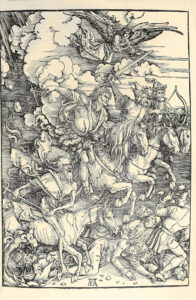
– The Four Horsemen of the Apocalypse (no watermark).
– The Opening of the fifth and sixth seals (watermark: crowned tower surmounted by a finial; Meder, 259).
– The Four Angels holding the four winds of the earth (no watermark).
– The Seven Trumpets (no watermark).
– The Four Avenging Angels (no watermark).
– Saint John devouring the Book of Life (watermark: triangle with six-leaf flower; Meder, 127).
– The Woman of the Apocalypse and the seven-headed dragon (no watermark).
– Saint Michael slaying the dragon (watermark: triangle with six-leaf; Meder 127).
– The seven-headed dragon and the beast with lamb’s horns (no watermark).
– The Adoration of the Lamb (no watermark).
– The Whore of Babylon (without watermark).
– The Angel holding the key to the abyss (watermark: triangle with six leaves; Meder 127).
“Durer himself was very sensitive to the signs of the ‘approach of the accursed times’ and, like no other artist before him, brought to life the phantasmagorical visions of the Apocalypse” (Albrecht Dürer, Œuvre gravé, p. 49).
The Apocalypse, properly Apocalypse with Pictures (Latin: Apocalipsis cum figuris), is a series of fifteen woodcuts by Albrecht Durer published in 1498 depicting various scenes from the Book of Revelation, which rapidly brought him fame across Europe. These woodcuts likely drew on theological advice, particularly from Johannes Pirckheimer, the father of Durer’s friend Willibald Pirckheimer.
Work on the series started during Durer’s first trip to Italy (1494–95), and the set was published simultaneously as a book with 15 pages of biblical text facing the 15 illustrations in Latin and German at Nuremberg in 1498, at a time when much of secular Europe feared an invasion of the Ottoman Empire and Christian Europe anticipated a possible Last Judgment in the year 1500. Durer was the publisher and seller of this series, and became the first artist to publish a book and create a copyright. Considering the 15 woodcuts, The Four Horsemen of the Apocalypse (c. 1497-98), referring to Revelation 6:1-8, is often viewed as the most famous piece. The overall layout of the cycle has the illustrations on the recto (right) and the text on the verso (left). This would suggest the importance of illustration over text.
In 1511, Durer published the second edition of Apocalypse in a combined edition with his Life of the Virgin and Large Passion ; single impressions were also produced and sold.
En 1511, Dürer publie une deuxième édition de la version latine, qui diffère principalement par la page de titre, dans une édition combinée avec sa Vie de la Vierge et la Grande Passion. Après 1511, la série fait l’objet d’une ultime réimpression, de nouveau sans texte au verso.
The frontispieces of the first two editions show only the letter without the xylography of The Virgin Appearing to Saint John the Evangelist. This plate was added in 1511 for the publication of the second Latin edition.
With this book, woodcutting achieves an unprecedented level of technical virtuosity, rarely equaled in later years. Never before had the network of woodcuts been so complex; the combination of different sizes enabled the artist to achieve totally new effects of light and volume. Black lines harmoniously rub shoulders with areas where the paper has been left white, creating subtle chiaroscuro effects hitherto reserved for the burin. In this way, Durer succeeded in offering the reader striking images that, by a veritable tour de force, give substance to St. John’s visions, making them almost real, without detracting from their supernatural, phantasmagorical character.
Most of the suites from 1498 or 1511 were cut up and sold as individual sheets in the art trade. They can be found in collections and museums all over the world.
The 1498 edition has disappeared from the market. Only seven copies are known to exist, four in the US (National Gallery of Art in Washington, Saint Louis Museum of Art, Houghton Library at Harvard University and Museum of Fine Arts (Boston)). The British Museum in London, the Staatliche Kunsthalle Karlsruhe and the Staatliche Graphische Sammlung in Munich also own a copy, but in German. A fine copy is currently estimated at three million dollars.
A fine complete copy of the 1511 edition is found every fifteen years, and its value continues to rise.
A very fine copy of the 1511 edition of Durer’s Apocalypse.