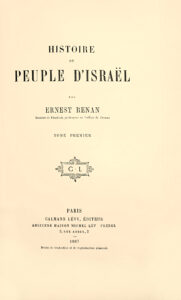
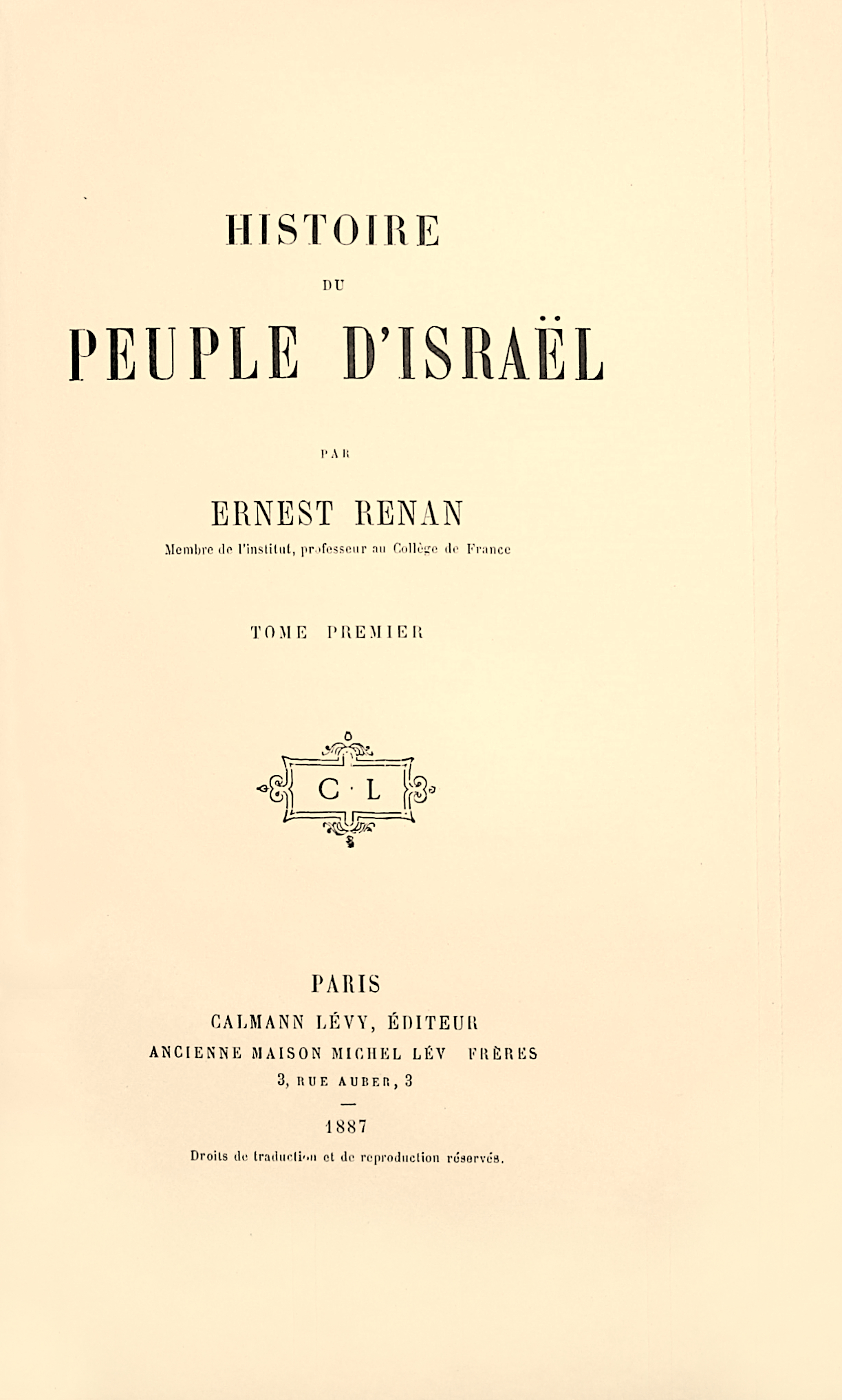
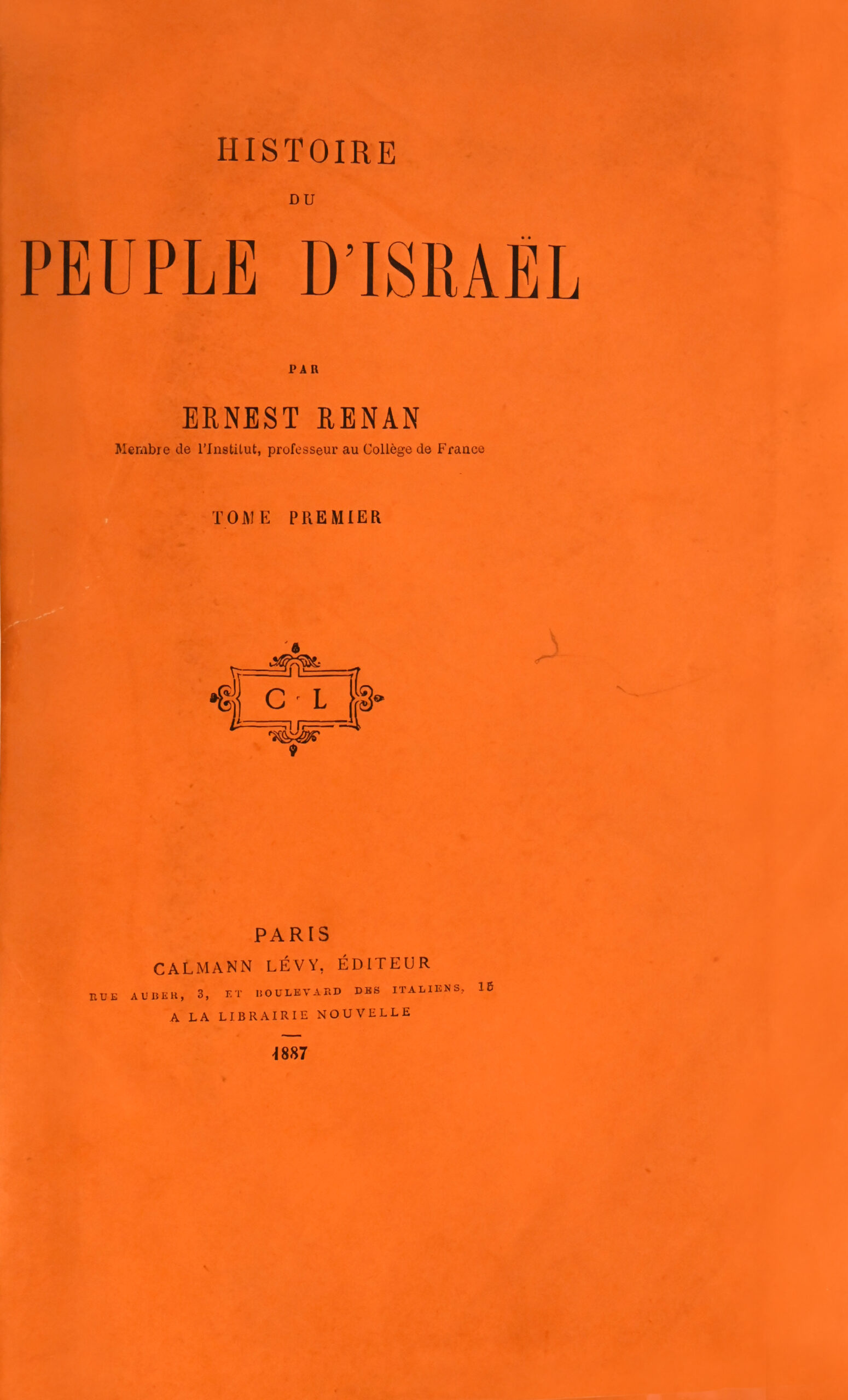
Paris, Calmann Lévy, 1887-1893.
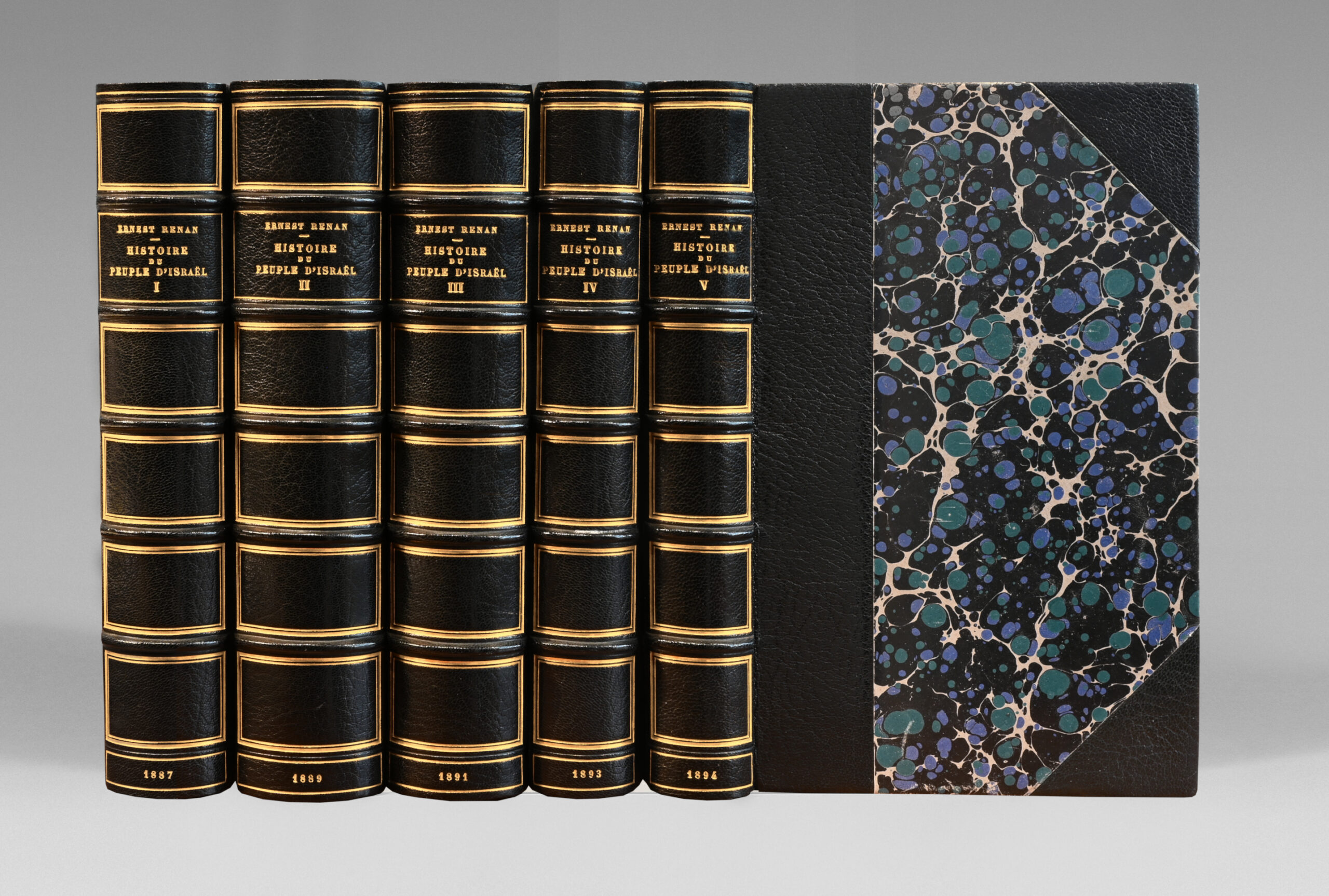
5 volumes 8vo: I/ (1) bl. l., (2) ll, xxix pp., 455 pp. ; II/ (2) ll., iv pp., 545 pp., (3) bl. pp. ; III/ vii pp., 527 pp. ; IV/ (2) ll, 411 pp. ; V/ (2) ll., 427 pp., large Japanese paper, blue quarter morocco, top edge gilt, original orange wrappers and spines bound in. Binding signed P. L. Martin.
242 x 153 mm.
First edition “important. Sought after on large paper” (M. Clouzot).
Precious and superb deluxe copy, one of 30 printed on Imperial Japanese paper, bearing n°15.
“Mr. Renan’s Histoire du peuple d’Israël has not disappointed the expectations of friends of fine literature. Never has the admirable writer, to whom we owe so many charming pages, shown himself more fully master of all the resources of our language, never has a subject, with the exception of the Vie de Jésus, allowed him to display more freely the so diverse gifts of artist and stove which, in this privileged nature, almost make us forget the scholar and the thinker. Here we find Mr. Renan in his entirety, – with his faults, no doubt, i.e. the abuse of pointless irony in thought and pointless anachronism in expression, here and there traits that a severe taste would disapprove of, and quips that resemble gageures – but also with his ever youthful qualities of suppleness, verve and light, with his depth without pedantry and his grace without affectation, and above all, with that je ne sais quoi “light and winged” that makes us involuntarily think of Plato. You may not open Histoire d’Israël, but once you do, I defy anyone to close it without having read it all the way through. One is sometimes annoyed or shocked, more often moved, – almost always drawn in and seduced. And how many pages leave an indelible imprint on the memory, from the opening chapters in which the existence of the nomads of the Syrian desert is revived in the freshness of an idyll painted from nature, to the vivid portraits of Saul, David and their rugged companions, – from that almost disturbing vision of the Sinai massif, to the parallel, in short, as apt as it is eloquent, between the Greek language, “a lute with seven strings, which knows how to vibrate in unison with all that is human”, and the Hebrew, “a quiver of steel arrows, a cable with powerful twists, a brass trombone breaking the air with two or three high notes! ” The secret of Mr. Renan’s style seems to lie in the alliance of a vocabulary romantic in its strength, richness and color, with a classical turn of phrase, that is, noble, simple and French. What a good fortune such a book is in a century where erudition turns its back on literature, while literature turns its back on scientific or naturalist jargon!”
“Strictly speaking, ‘L’Histoire du Peuple d’Israël’ is no more than a long preface to the great work that secures Mr. Renan a unique place in modern religious history and in our French literature. To show the religious development of the people of Israel, to bring out the principles which have combined to form the soul of Israel, to assign to this astonishing people its true place in the collective work of human civilization – this is the real aim pursued by Mr. Renan, and one which must not be lost sight of in judging his work […] It is singularly more important to bring out the human history of Israel than to painstakingly link together a series of monographs on secondary subjects. On every page, so to speak, the erudite reader encounters assertions which, to him as a man of his trade, are far less certain than Mr. Renan’s account would imply. But it would be wrong to reproach the learned historian. If he states them, it’s because they express the conclusion reached by his long research into these matters. And if at times we are entitled to find too great a reliance on intuition or a kind of divination in the assessment of dates or texts, he could still reply that in such matters, literary instinct, taste – I would willingly say the flair of a man who combines great artistic delicacy with a very strong scientific culture – are sometimes better guides than the dry reason of the critic who dissects texts whose life he is incapable of grasping.
In this volume, there are three distinct elements, which the author has blended into a harmonious, continuous narrative: a secular history of the Israelites from the advent of David to the destruction of the northern kingdom by the Assyrians; a literary history of the earliest documents found by analysis in the Old Testament, such as the book of the Patriarchal Legends, the work of a storyteller from Bethel or Shechem, the book of the Wars of Jahveh and that of the Iasar, composed of popular songs and heroic traditions around the 10th century, in the kingdom of Israel ; a double holy history, that of the north, known as Jehovist, with the ‘Book of the Covenant’ and that of Jerusalem, known as Elohist, with the ‘Decalogue’ and finally the most ancient prophetic writings; thirdly, a history of Israel’s religious development which we may not admit, but whose masterly execution it is impossible to dispute. And all this is interwoven with an abundance of fine observations and general views, reflecting a thorough knowledge of the country and a keen intuition of Eastern life […].
It’s worth noting that the author’s exquisite literary tact enables him to sense and convey to his reader the spontaneity and freshness of writing of certain fragments, betraying their ancient origin and relative authenticity. When you have once felt this impression, the finest reasoning in the world will not make you admit that these fragments are the late compositions of some scribe, eager to support a priestly thesis at the expense of characters and peoples who have long since disappeared from the theater of history […] (Maurice Vernes, Revue de l’histoire des religions, 1889, vol. 19, p. 230).
A sumptuous deluxe copy of this sougth-after work, bound in blue quarter morocco by Pierre-Lucien Martin.