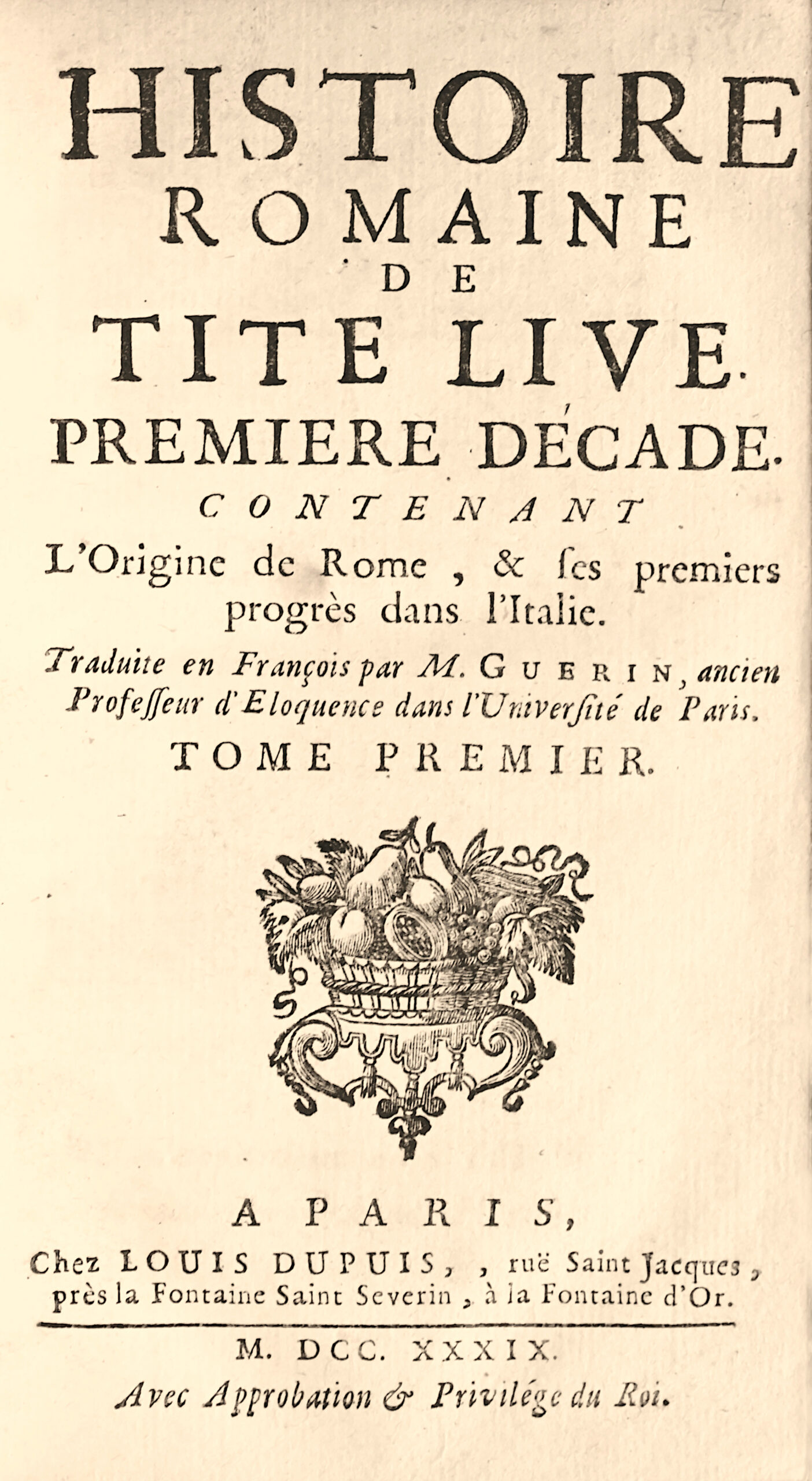
Paris, Louis Dupuis, 1738-1740.
11 volumes in 11 in-12 volumes of: I/ (1) l., viii pp., (2), xi, 596, (2); II/ (2) ll., 176 pp., 442, (2); III/ (2) ll., 462 pp., (2) pp.; IV/ (1) l., 359 pp.; V/ (1) l., 288 pp.; VI/ (2) ll., 628 pp., (2) pp.; VII/ (1) l., 496 pp., (2) pp.; VIII/ (1) l., 428 pp., (4) pp.; IX/ (2) ll., 642 pp.; X/ (1) l., 729 pp.; XI/ (1) l., 627 pp.
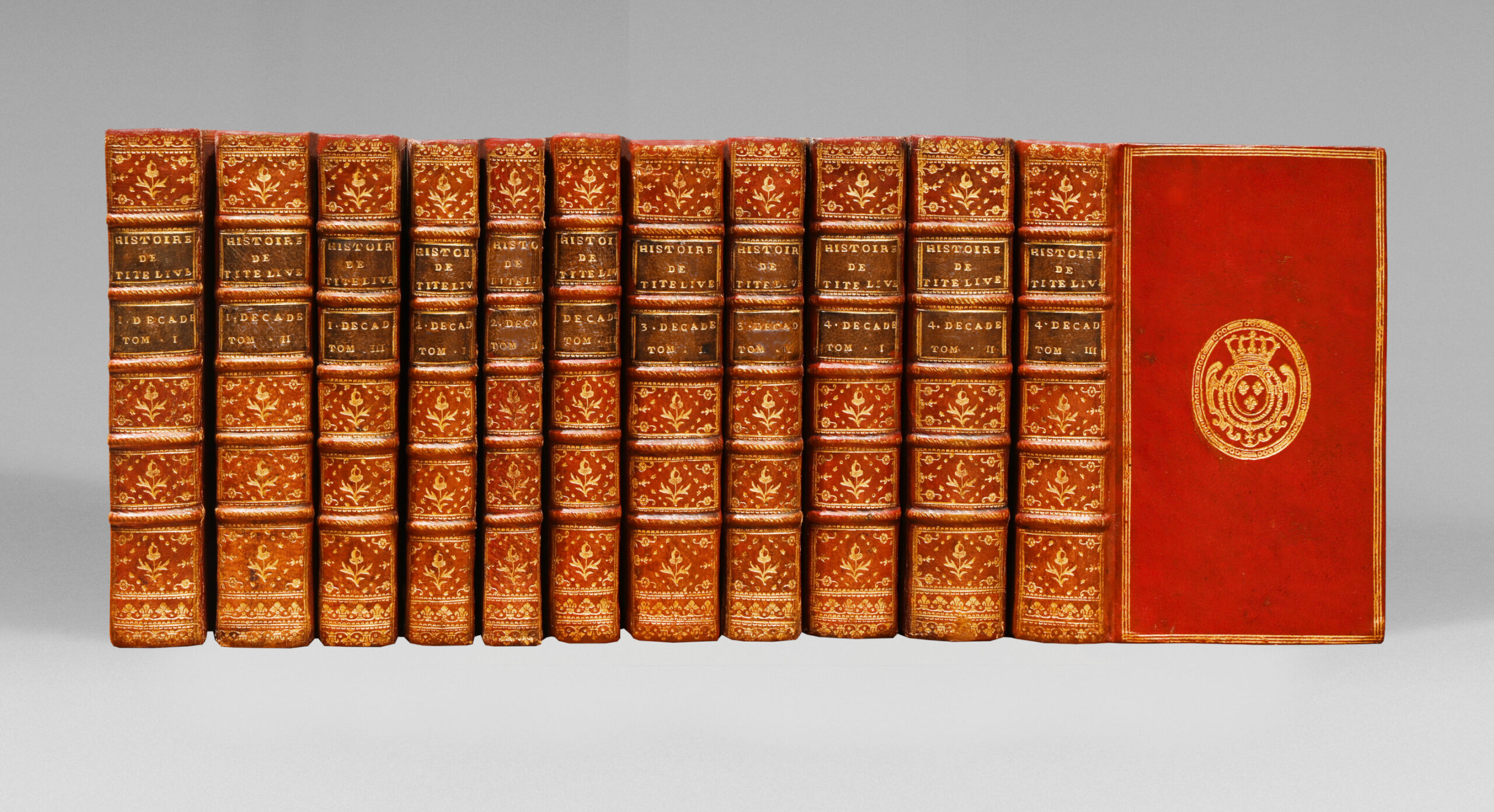
Red morocco, triple gilt fillet around the boards, arms stamped at the center, raised-band spine decorated, fleur-de-lys rolls at head and tail, title and volume labels in olive morocco, gilt fillet on edges, gilt inner roll, gilt edges on marbling. Contemporary armorial binding.
162 x 90 mm.
Rare Edition Of The Roman History Of Tite-Live Translated Into French By Guérin, Former Professor Of Eloquence At The Université De Paris.
Dedicated to Monseigneur le Dauphin, it was printed in 11 in-12 volumes in Paris between 1738 and 1740.
“On the day after the Battle of Actium, which brought back peace and concord to the Roman Empire after a century of civil wars, Tite-Live (69 BC – AD 17) set out to narrate the history of Rome in a work that, through the breadth of its design, the elevation of its inspiration, and the nobility of its form, might be worthy of the grandeur of its subject—something that could not be said of the narrations of the various annalists of the era of Cicéron.
Already in 27 or 26 BC, Tite-Live published the first books of his work, which earned him universal admiration. Throughout his life he continued his gigantic enterprise; he managed to compose 142 books—that is, the most voluminous work in Latin literature; from the origins of Rome, the narrative reached up to the death of Drusus (9 BC).
His harmonious and free style knows how to avoid monotony effortlessly, adapting to the most diverse situations: at times lively and dramatic, at other times solemn, evocative and almost sculptural, or again abundant, colorful and picturesque.
The work of Tite-Live was truly worthy of the greatness of Rome, both through the religious sentiment and the moral sense that permeate it, and through the artistic qualities and probity that the historian displays.”
“Tite-Live presents himself to us as the most ‘modern’ of ancient historians. Let us see in him a passionate educator.
What Tite-Live wanted to give his readers—what they expected of him, what could be politically and morally necessary for them—was a work which, by the brilliance of its form and the grandeur of its subject, would revive national dignity after the trials and humiliations of a period of turmoil and civil wars. Tite-Live is considered the most literary of Roman historians.” (Dictionnaire des auteurs, IV, pp. 511–513).
Superb Copy Preserved In Its Contemporary Red Morocco Binding With The Arms Of King Louis XV.
Olivier pl. 2496 – tool no. 12.
Provenance: The Society of Writers to the Signet; H. P. Kraus.
See less information