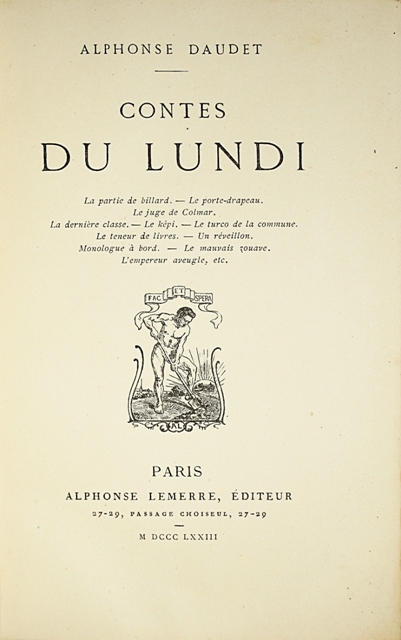
DAUDET, Alphonse. Contes du lundi. Paris, Alphonse Lemerre, 1873.
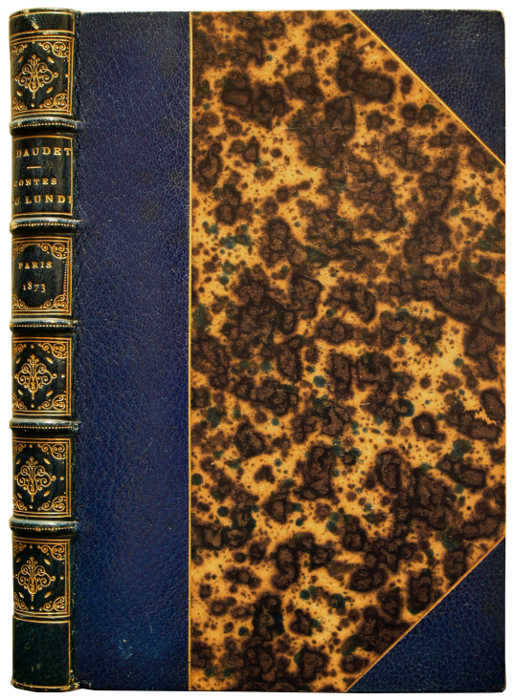
12mo [185 x 116 mm] of (1) bl. l., (4) ll., 258 pp., (1) bl. l. Bound in blue straight-grained quarter-morocco, spine ribbed and finely decorated, top edge gilt over untrimmed edges. Contemporary binding signed David.
First edition of this “very rare work of Alphonse Daudet containing 31 tales from the author’s best inspiration” (Carteret, I, 194). Clouzot, 81 ; Vicaire, III, 41 ; Rahir, La Bibliothèque de l’amateur, 391 ; Talvart, IV, 16.
Carteret mentions 4 copies on China not reported by Talvart.
“Remarkable work by Alphonse Daudet, published in 1873 and which, without making one forget the ‘Letters from my windmill’, made as much for the author’s glory as all his novels. This compilation contains around 40 tales, which, for most of them, recall the short and terrible war of 1870: the Invasion, the Siege of Paris and the Commune. Only things that he saw, in a way. Less realistic than impressionistic, Daudet takes pleasure in small pictures. No one knew, as he did, capture in a few pages a heart-rending, unfortunate or fully comical situation. He excels in bringing out the weak side of human beings. Yet, he’s careful not to judge: his taste for truth, his compassion, his imaginativeness forbid him any behavior of this kind. In this field, Daudet remains inimitable…These tales with a historical background are really of a good nature, as we used to say in former times. Daudet seems to have written them as the thoughts came into his head. It’s as if they were made all by themselves. Naturalness, freshness and simplicity: Daudet brings in his style the energy of the Provencal narrators. In addition, we like that, to so much pathos he associated such a feeling of discretion. Here is probably what explains the appeal that the ‘Contes’ have always had on many readers“. (Dictionnaire des Œuvres, II, 64).
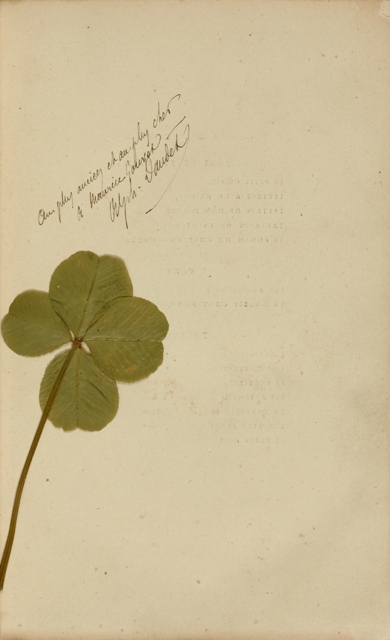
A precious copy offered by the author to his childhood friend Louis-Maurice Gouvet, with this signed dedication at the beginning of the volume: “To the oldest and the dearest, to Maurice Gouvet. Alph. Daudet“.
Louis-Maurice Gouvet is Alphonse’s (1840-1897) childhood friend with whom he lived for a while in 1864-1865. What’s more this is this intimate friend that Daudet chose to be his duel witness that opposed him to Albert Delpit in 1883.Thus, on the 24th of April 1883, Jules Sandeau dies, leaving an empty chair at the French Academy. His friends, especially Eugène Labiche, and also Zola, Goncourt and others urge Daudet, once more, to apply, but, as always, he refuses, because he hates to be enchained to any society. Albert Delpit, a candidate to Sandeau’s chair, doesn’t believe in Daudet’s refusal and writes an insulting article for him. The latter reacts immediately by sending him his witnesses, two old friends, Louis-Maurice Gouvet and Paul Arène. It’s on the 27th of May that the duel takes places, in a garden in the Vésinet. Daudet, who has been fencing for a long time, is more dexterous and hurts his opponent.