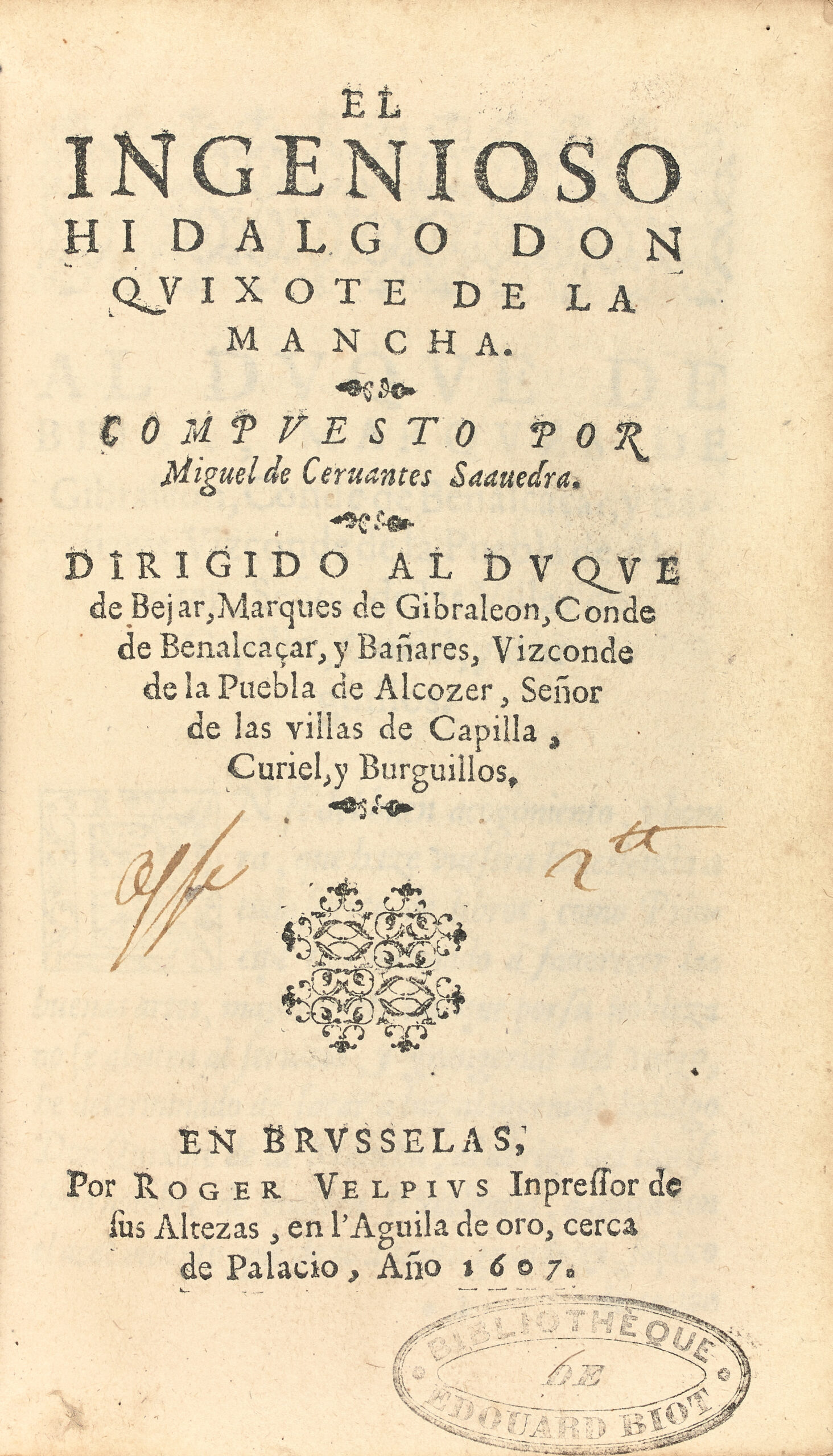
En Brusselas, por Roger Velpius, Año 1607.
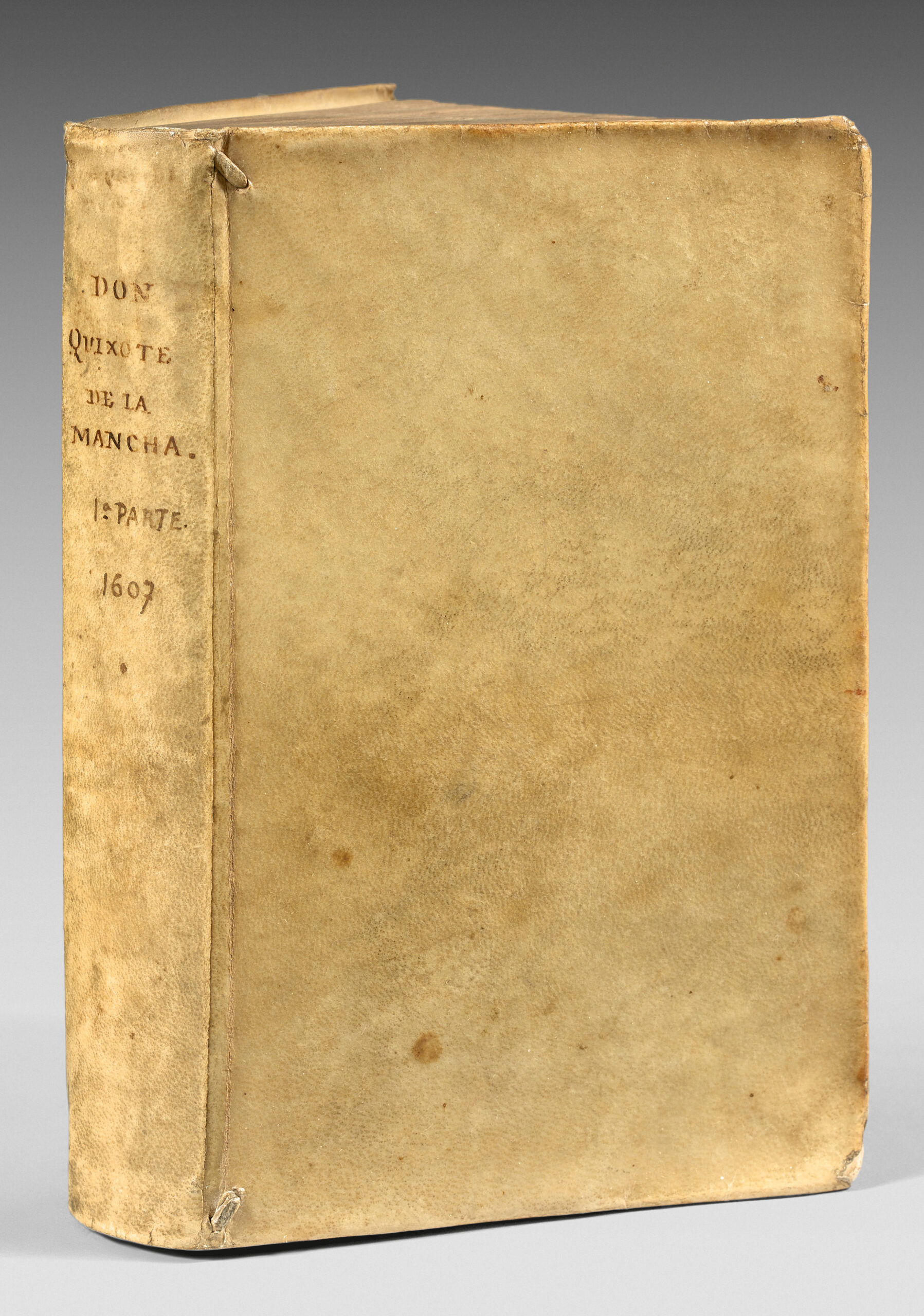
8vo. Collation: **8, **4, A-Oo8, Pp4. (3) bl. ll., (12) ll. (title, dedication, prologue), 592 pp., (8) pp. and (3) bl. ll. Vellum, flat spine, title and author’s name handwritten in brown ink. Contemporary binding.
173 x 105 mm.
Precious edition of Don Quixote printed in 1607, the first from Brussels, published two years after the first from Madrid. The second part appeared in Madrid eight years later, in 1615.
References: Brunet, I, 1748; Ford-Lansing, p. 5; Peeters-Fontainas, pp. 226 and 228; Salvà, n° 1548; PMM, 111 (“one of those universal works which are read by all ages at all times”).
The first edition of the first part was printed in Madrid by Jean de la Cuesta in 1605. It is so rare that the leading bibliographer, Léopold Ruis, lists only eight copies, all in the public domain; six in Spanish libraries and two outside Spain: the British Museum and B.n.F.
In the last 60 years, however, 1 copy has come onto the market. In a modern binding, it sold for $1,650,000 in New York 38 years ago. Its value today is €5,000,000.
The two parts of Don Quixote have always been sold separately. Just look at Salva, Ricardo Heredia or, more simply, Brunet and Deschamps. This can be explained by the 10 years separating the publication of the two parts, and by their low print run.
Don Quixote, a masterpiece of world literature, was probably written between 1598 and 1604.
As Cervantes tells us himself in the Prologue of Part I, his aim was to write a novel of chivalry, capable of standing out from all the others in widespread use at the time.
“The novel was originally inspired by a polemic against the books of chivalry, whose counterpoint it was simply to imitate; but it gradually evolved into a poetic and sincere representation of an increasingly vast and complex world, in which a force is at work analogous to that which explains individual and universal life, human history and its perpetual becoming. For Cervantes, this force manifests itself essentially in three aspects, facets of the same prism: on the one hand, the generosity and moral grandeur of Don Quixote; on the other, the realism and practical egoism of Sancho Pança; but these two modes of action, apparently irreconcilable, profoundly contradictory, give way to the mysterious attraction of an ideal of beauty which, if it does not triumph, at least survives disappointment, giving constant denial to distressing reality. But what is this ideal? The answer can only be obscure; except that, deeply rooted in man, he has been given the power to surpass himself; and more particularly in the case of Cervantes, this surpassing is realized in the work of art, where he finds a field of action suitable for the exercise of his talent. Faced with this poetic universe that his imagination installs in reality, Cervantes is led to experience a feeling of charity that adheres, with benevolent indulgence, to all the forms in which love is realized: a kind of inspiration of a natural kind that draws all men into his village. And even in the midst of his anguished haste, it is to a contemplative life that he leads us. And so, thanks to this sense of charity, we all enter the luminous wake of Don Quixote’s incredible adventures: the entire work is as if enveloped in an immaterial, translucent smile, secretly revealing an inexhaustible wealth of humanity and truly lived experience. The magic of this smile, by giving the story an inimitable character, ensured Cervantes’ triumphant fame.”
Don Quixote’s original edition is, along with Shakespeare’s, the most sought-after original in world literature.
In November 1989 in New York, these two originals, bound in 19th century morocco, were sold for $1,650,000 and $2,000,000 respectively. For Cervantes, this price was for the first part alone, published in 1605.
A second copy of Shakespeare’s original was sold for more than €5,000,000 in 2000, as its binding was worn. As for the second part alone of Don Quixote, printed in Madrid in 1615, in contemporary vellum, it was sold for €600,000 on December 7, 2000 by Sotheby’s.
The present complete volume is composed as follows:
First Brussels edition published two years after the Madrid original, which was followed the same year by a new edition from its publisher, Juan de la Cuesta, two reprints in Lisbon, one in Madrid again, and two in Valencia ; and our own, which follows de la Cuesta’s text, adding numerous wise corrections, in particular those that appeared in chapters XXIII and XXV (Sancho’s passage on his donkey, after Pasamonte had stolen it from him), as well as the very happy transposition of the paragraphs in chapters XXXV and XXXVI, inverted in de la Cuesta’s editions.
A very fine, wide-margined copy in contemporary vellum (height: 173 mm), 10 mm taller than Charles de Valois’ (1573-1650) copy.
Provenance: handwritten purchase note on title “2 II”; J. Baer (handwritten note “120 marks. Catal. J. Baer” possibly the bookseller of Joseph Baer, who owned a bookshop in Paris and one in Frankfurt); Edouard Biot (stamp on the title); probably Edouard Biot (1803-1850), French engineer and eminent sinologist.