Southern Netherlands, Bruges or Ghent, c. 1500.
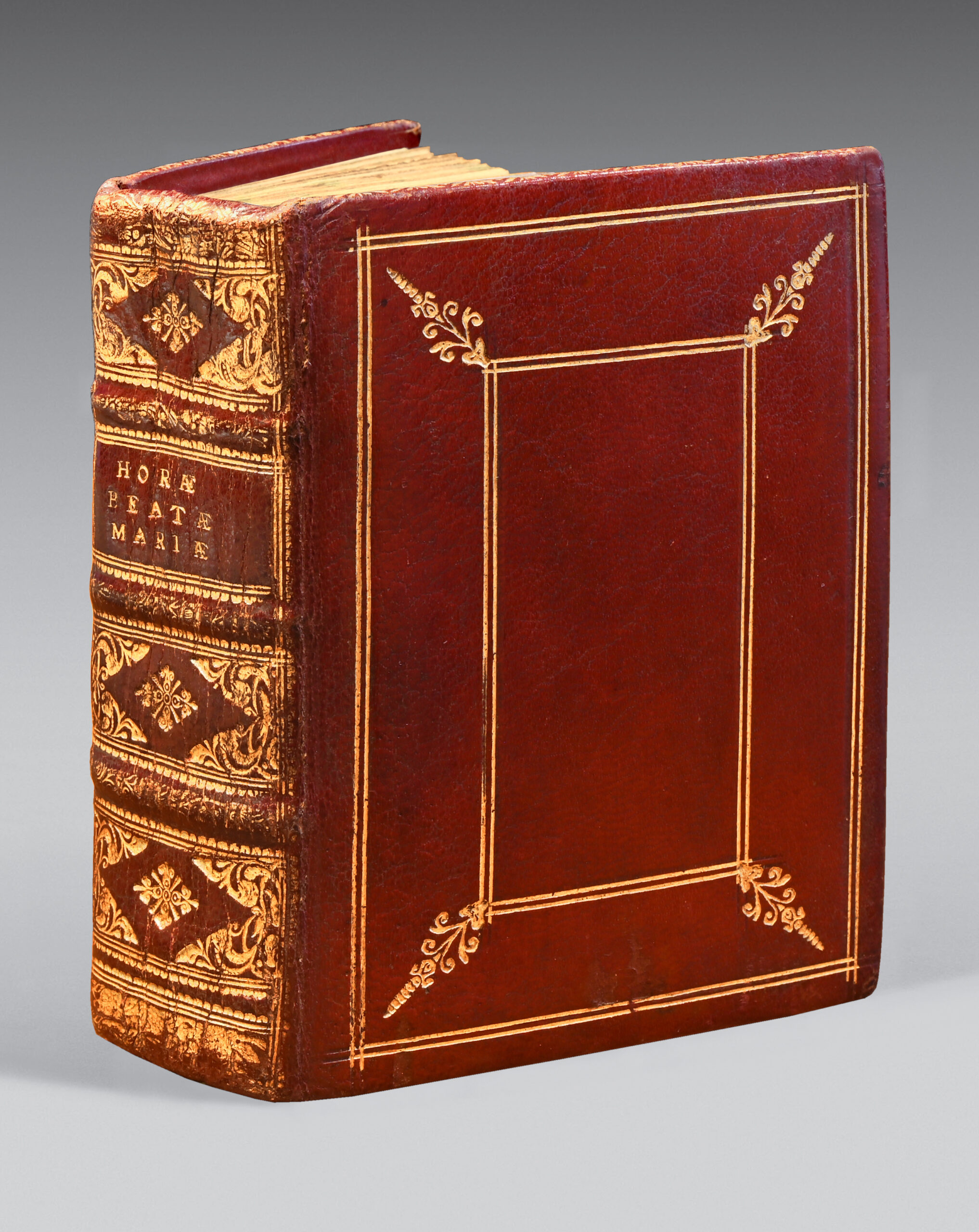
235 leaves, collation: 1¹⁰ (in eights, i and ii inserted miniatures), 2⁹ (in eights, ii an inserted miniature), 3⁹ (in eights, ii an inserted miniature), 4⁸, 5⁹ (in eights, ii an inserted miniature), 6–17⁸, 18⁷ (in eights, viii a blank leaf), 19⁹ (in eights, i an inserted miniature), 20–21⁸, 22⁹ (in eights, v an inserted miniature), 23–28⁸, 29⁵ (in eights, iv–v missing, viii blank); sporadic pencil foliation; 15 lines, ruled area: 77 × 50 mm; rubrics in red, capitals in yellow, one- or two-line initials, 20 small miniatures or historiated initials, 15 of them with three-quarter illuminated borders in the Ghent/Bruges style, with naturalistic flowers and fruit scattered among trompe-l’œil motifs; 7 full-page miniatures within full borders in the same style (f. 1 probably originally bound before f. 136; probably lacking 2 leaves of text after f. 233 and perhaps a Calendar at the beginning; otherwise complete; some slight marginal trimming). Decorated red morocco of the early 18th century. In a brown morocco case.
117 × 87 mm.
A rich and engaging example of Ghent-Bruges illumination at the height of the Flemish Renaissance, with iconographically unusual miniatures by an associate of the Master of Sir George Talbot.
Contents: Hours of the Cross ff. 3-11; Hours of the Holy Spirit ff. 13-20; Mass of the Virgin ff. 22-29v; Gospel pericopes ff. 30-37; Hours of the Virgin, use of Rome, ff. 39-135: matins f. 39, lauds f. 62, prime f. 77, terce f. 84, sext f. 91, none f. 97, vespers f. 103, compline f. 113; Advent office and other seasonal variants f. 122; hymn to the Virgin based on the ‘Salve regina’, with the rubric ‘Has videas laudes / qui sacra virgine gaudes […]’, beginning ‘Salue virgo virginum Stella matutina’ ff. 135v-145; a prayer for use during the elevation of the Host, with a grant of 2,000 years’ indulgence, f. 145v-148v; Penitential Psalms and litany ff. 150-177; Office of the Dead, use of Rome, f. 179-235v.
Illumination :
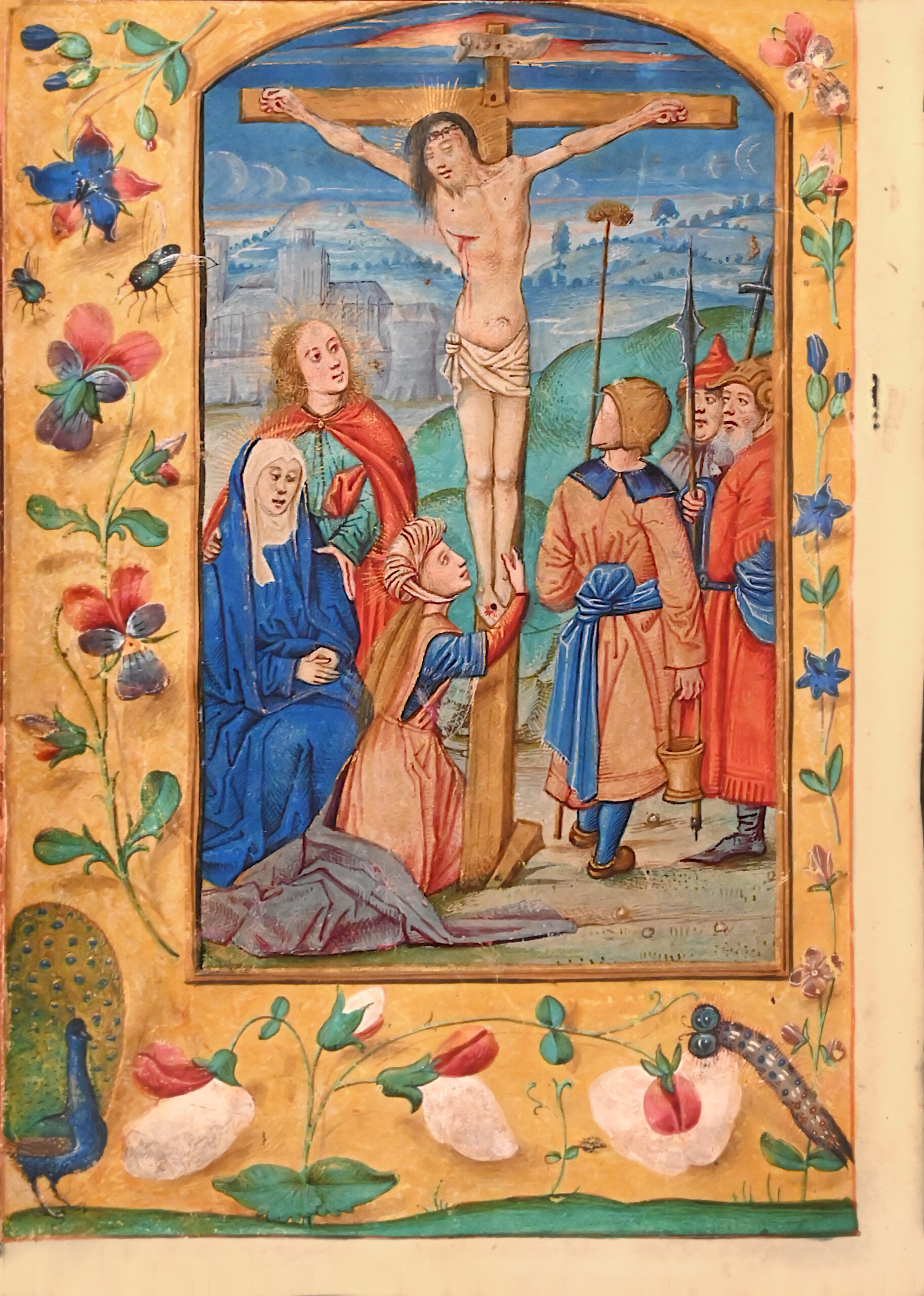
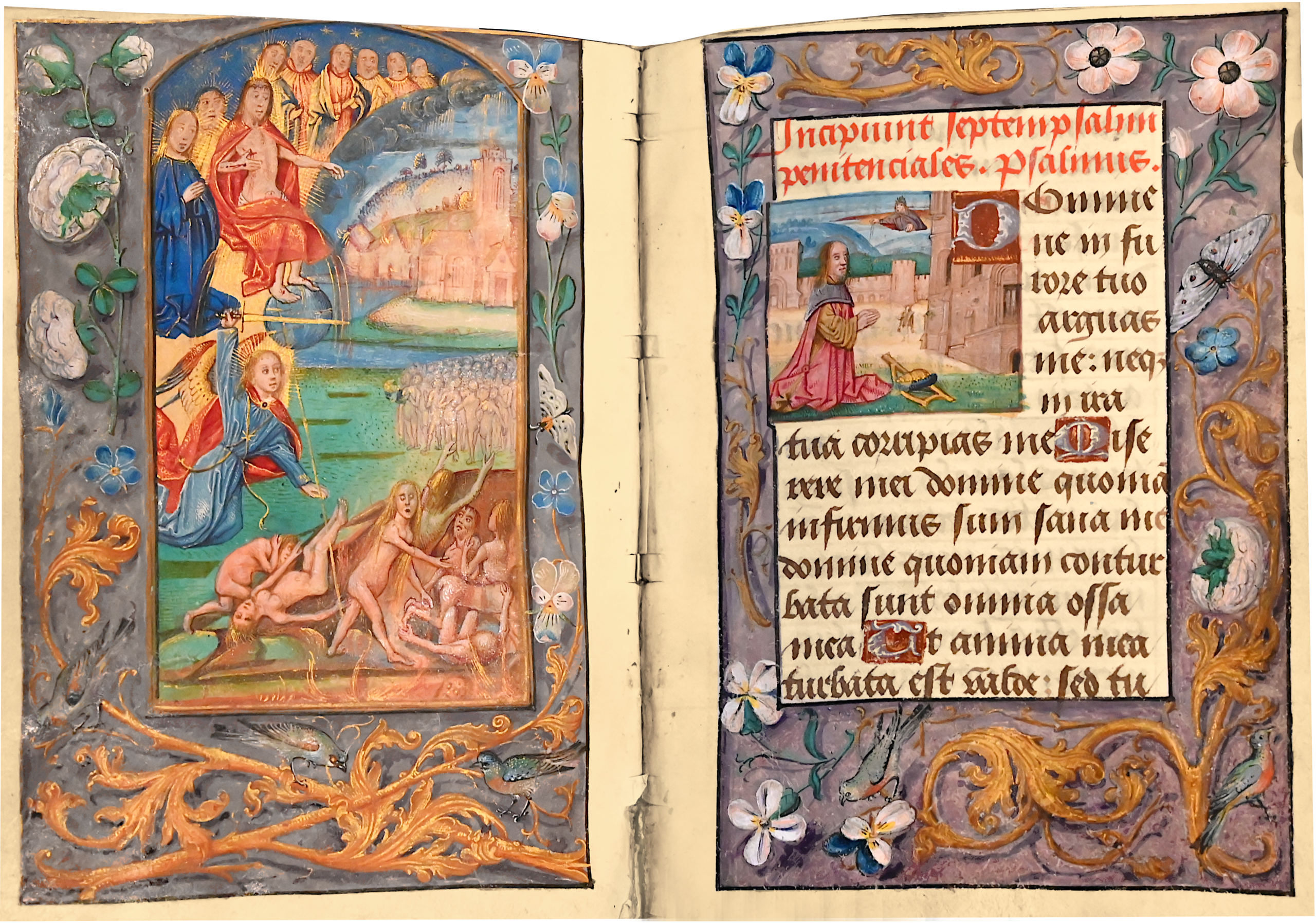
This attractive and lavishly illuminated Book of Hours appears to be the work of a single illuminator associated with the Master of Sir George Talbot, named after a Book of Hours made for the Earl of Shrewsbury around 1500 (Oxford, Bodleian Library, Ms Gough Liturg.7). Small round heads on compact, composed figures are a consistent feature of the miniatures. The palette is varied, and the use of colour often inventive and striking. The borders are mainly of the “Ghent-Bruges” type, with scattered naturalistic flowers, trompe-l’œil borders and architectural surrounds. This is an attractive and distinctive style, and the compositions and features of the decoration show the illuminator’s familiarity with the principal currents of Flemish illumination in the early decades of the 16the century—particularly the work of the Master of the Prayer Books of around 1500, the Master of Mary of Burgundy and Alexander Bening. The dramatic Last Judgement (f.149v) draws on comparable scenes in the Hours of Mary of Burgundy in Berlin and the Hours of Engelbert of Nassau in Oxford, while the full-length portrait of Christ on f.1v comes from the repertoire of the Master of the Older Prayer Book and probably from a lost panel by Jan van Eyck.
The most inventive and unusual miniature in the present manuscript is the scene set in the bedroom of a man who has just died (f.178v), opening the Office of the Dead—a marked departure from the usual depictions of funerals and burials, or struggles for the soul taking place in a cemetery. Here the setting is intimate and familiar: the deceased (perhaps a relative of the first owners of these Hours) lies on a mat in the foreground, with the implements needed to wash him and prepare him for burial, and his slippers set aside. Above him, a man sits on a chair beside the bed, while two women converse on a bench. At the top of the miniature, an angel and a web-winged devil struggle over the dead man’s soul. The border includes bones and skulls wearing the hats of a pope, a bishop, an emperor, a cardinal and a king. Comparable versions are described by B. Brinkmann, Offizium der Madonna, Der Codex Vat. Lat. 10293, Kommentarband, 1992, pp. 27-32. The border, with serpents among skulls wearing the hats of rulers, all made equal by death, has an Italian parallel in the Hours of Mirandola (British Library, Add. MS 50002, f.85).
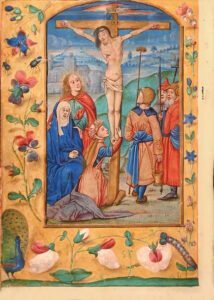
The subjects of the full-page miniatures are: Christ as Salvator Mundi f. 1v; the Crucifixion f. 2v; Pentecost f. 12v; the Virgin and Child in the crescent moon, the Ara Coeli, f. 21v; the Annunciation f. 38v; the Last Judgement f. 149v; a deathbed scene, set in the bedroom of a man who has just died, f. 178v.
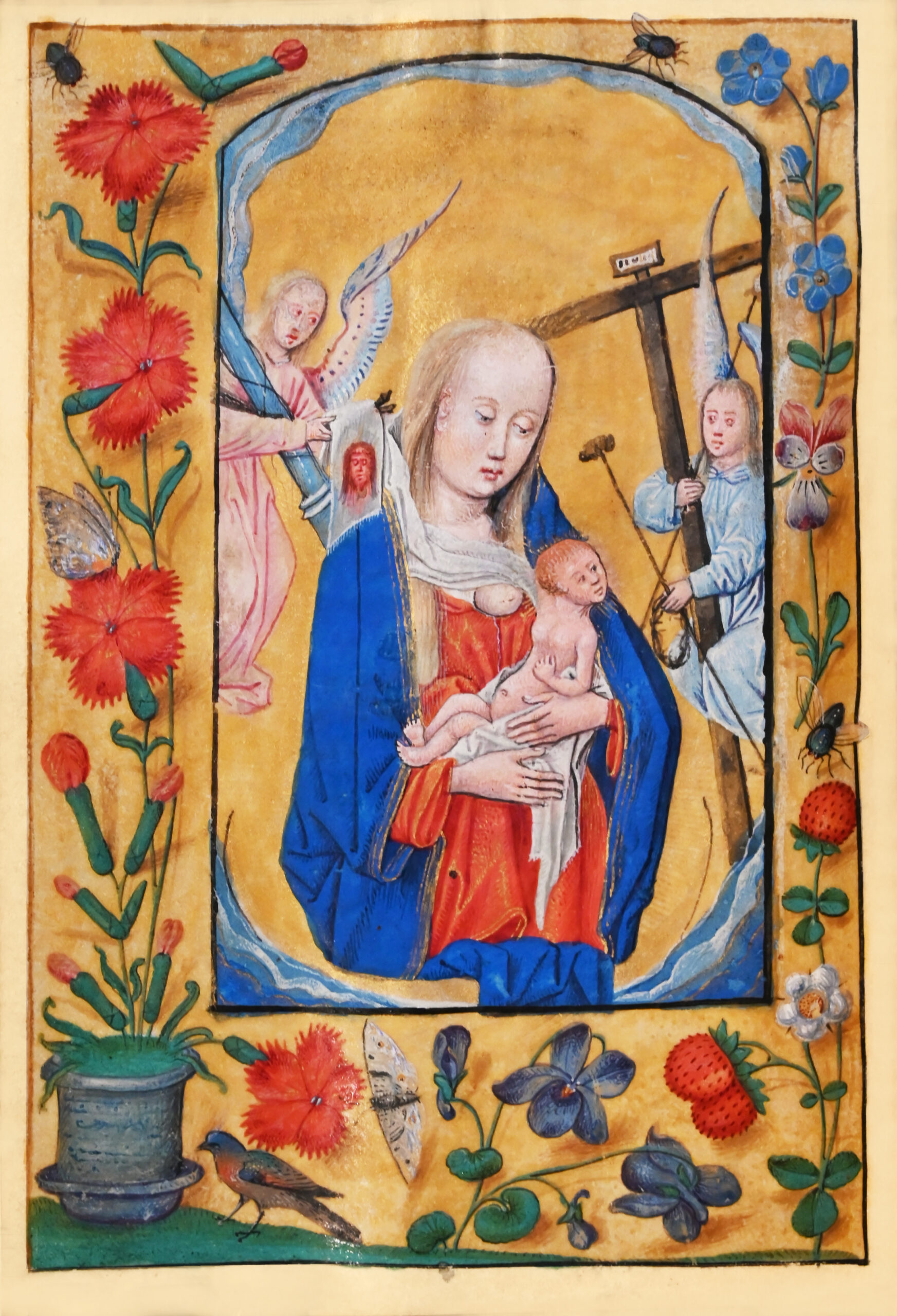
The subjects of the smaller miniatures are: the Descent from the Cross (f.3); the Ascension (f.13); the Mass of Saint Gregory (f.22); Saint John on Patmos (f.30); Saint Luke painting (f.32); Saint Matthew (f.34); Saint Mark (f.36); the Visitation (f.39); the Meeting at the Golden Gate (f.62); the Nativity (f.77); the Annunciation to the Shepherds (f.84); the Adoration of the Magi (f.91); the Presentation in the Temple (f.97); the Massacre of the Innocents (f.103); the Flight into Egypt (f.113); the Coronation of the Virgin (f.122); the Virgin and Child with an angel holding the Cross and nails (f.136); a monstrance with the Host (f.145v); David at prayer (f.150); the Three Living and the Three Dead (f.179).
Provenance :
(1) The litany includes Saint Bavo (Ghent) and Saint Donatian (Bruges). The 1995 Sotheby’s catalogue suggests that the script is very close to the hand of the Dominican scribe Johann de Bomalia, who is recorded as a member of the Bruges illuminators’ guild of SS. John and Luke in 1489 and signed manuscripts such as Meermanno-Westreenianum MS. 10.E.3, illuminated by Simon Bening; the Hours of James IV of Scotland and his wife Margaret Tudor, now Vienna, ONB, cod. lat. 1897; and a Book of Hours sold at Christie’s on 6 June 2007, lot 40 (see W.H.J. Weale, ” Documents Inédits sur les enlumineurs de Bruges, Le Beffroi, IV, 1872-3, pp. 318, 322, 329 and 332).
(2) Sotheby’s Parke-Bernet, New York, 7 March 1967, lot 122.
(3) Paul Francis Webster (1907-1984): his bookplate; his sale at Sotheby’s New York, 24 April 1985, lot 103.
(4) Sotheby’s, 5 December 1995, lot 55, sold for $56,100.