Paris–Rouen, circa 1500.
Octavo, 142 leaves of vellum. Ruled; Latin text in dark brown ink, in a single column of 20 lines; calendar in French, in blue, red and gold ink.
Contents: Calendar (fol. 1), Gospel passages (13), Obsecro te (17v), O intemerata (20), Office of the Virgin (23), Hours of the Holy Cross (73), Hours of the Holy Spirit (76), Penitential Psalms and Litanies (80), Office of the Dead (95), Doulce Dame and Doulce Dieu (97), one blank page, continuation of the Office of the Dead (105), suffrages (136–142).
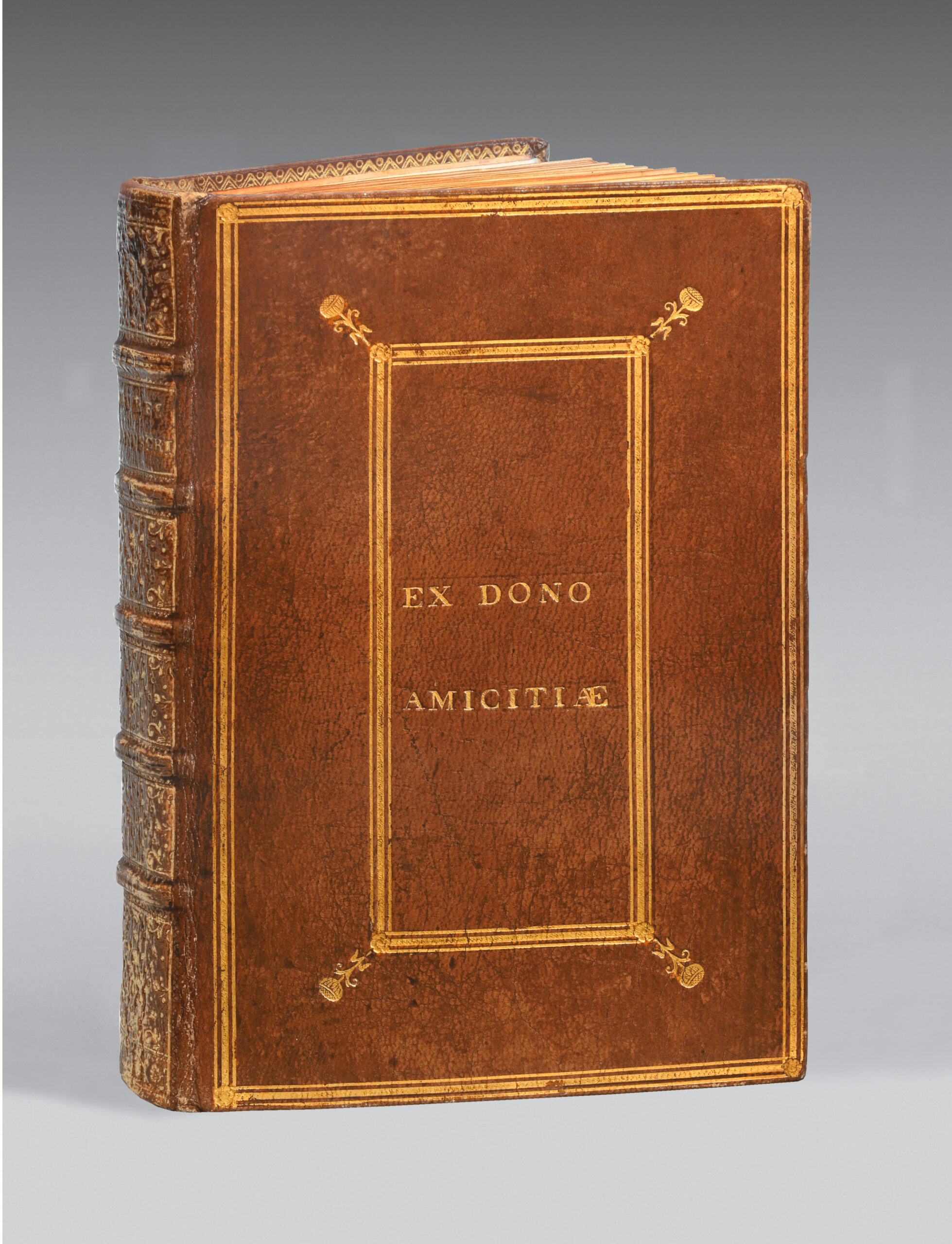
Eighteenth-century morocco binding with double gilt fillet borders and corner ornaments on the covers; central panel with the gilt inscription “Ex dono amicitiae” on each cover; finely decorated raised-band spine, decorated board edges, gilt inner roll, and gilt edges throughout. French eighteenth-century binding.
168 × 114 mm.
Magnificent example of Parisian and Rouen illumination around 1500.
A vibrant illuminated manuscript characteristic of the so-called Rouen school, whose artists worked closely with Parisian illuminators. Thus, the workshop of the highly talented border painter Jean Serpin in Rouen, the Master of the Chronique scandaleuse, active in Paris, and another master from Jean Pichore’s circle in Paris worked hand in hand on this manuscript. The latter painted the calendar illustrations and most of the small miniatures, as well as the two large miniatures of The Nativity and The Flight into Egypt. All the other miniatures were painted by the Master of the Chronique scandaleuse.
“Stylistically, the Master of the Chronique scandaleuse, like Pichore, drew his most important inspiration from Tours, particularly from Jean Poyer. He can be recognized, among other things, by his palette, which varies from one work to another following Poyer’s example, ranging from restrained pastel tones to vivid colors built on the harmony of red and blue with an intense blue-green. Like the painters of the Pichore group, he defines the outlines of his figures with fine black or gold lines …
His painting style is also often sketchy, and he uses similar types of figures. These, however, are more graceful than Pichore’s, and their distinctive faces make them unique. The eyes contribute particularly to this effect: always half-closed in the same way and outlined above by a strong black line with a slight bulge toward the pupil, so that the white beneath shines intensely“. (Zöhl, p. 45)
Calendar in French according to the liturgical use of Paris, fully decorated, with entries alternating in blue and red and principal feasts in gold, including: Geneviève (Jan. 3), Vincent (Jan. 22), Peter (June 29 and Feb. 22, Cathedra Petri), Mary Magdalene (July 23), James and Christopher (July 26), Louis (Aug. 25), Leu and Giles (Sept. 1), Denis (Oct. 9), Martin (Nov. 11 and July 4, Translatio), Clement (Nov. 23), Catherine (Nov. 25), and Nicholas (Dec. 6). Office of the Virgin and Office of the Dead according to the use of Paris.
It is adorned with 18 large paintings of superb workmanship, including 3 full-page miniatures :
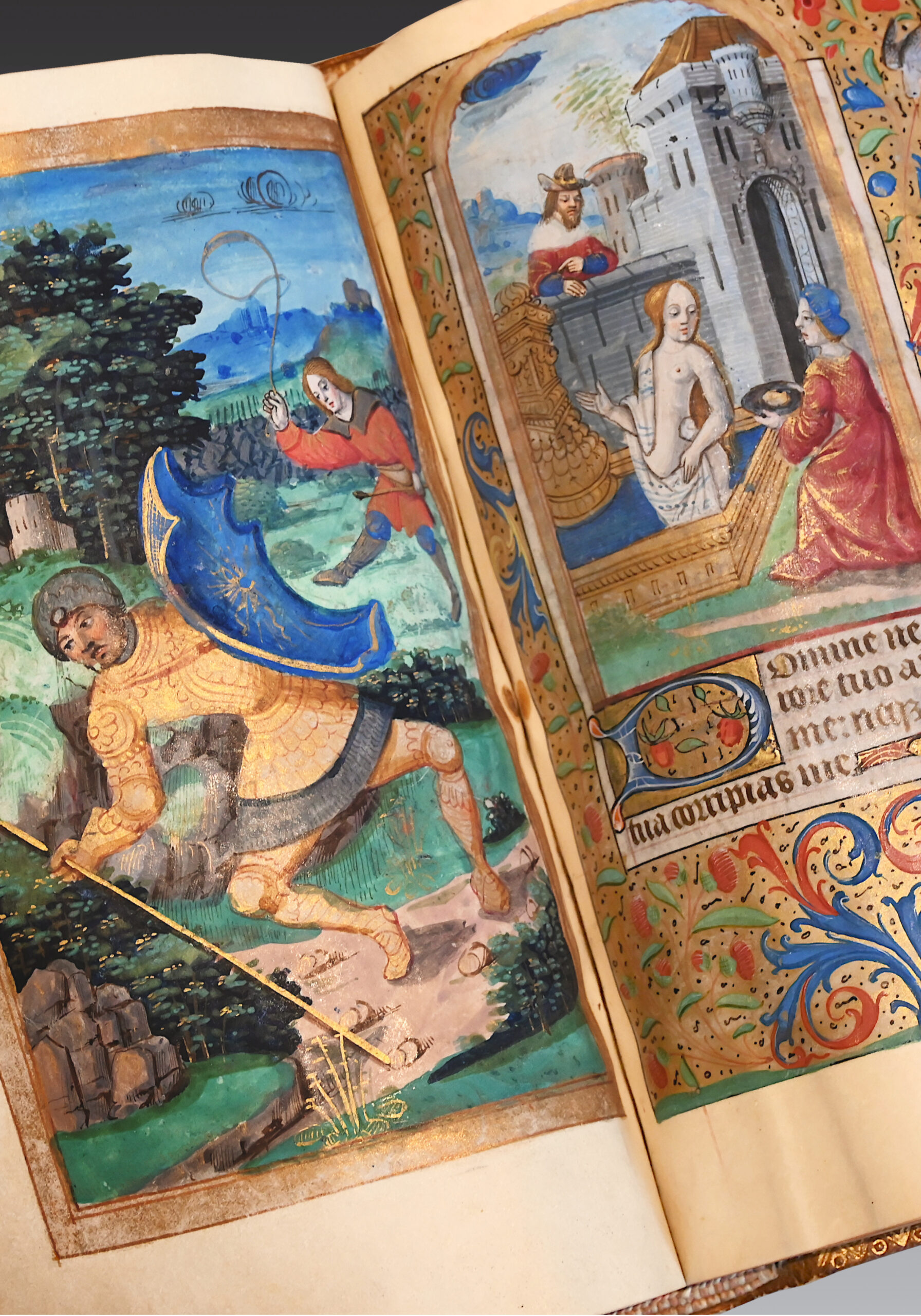
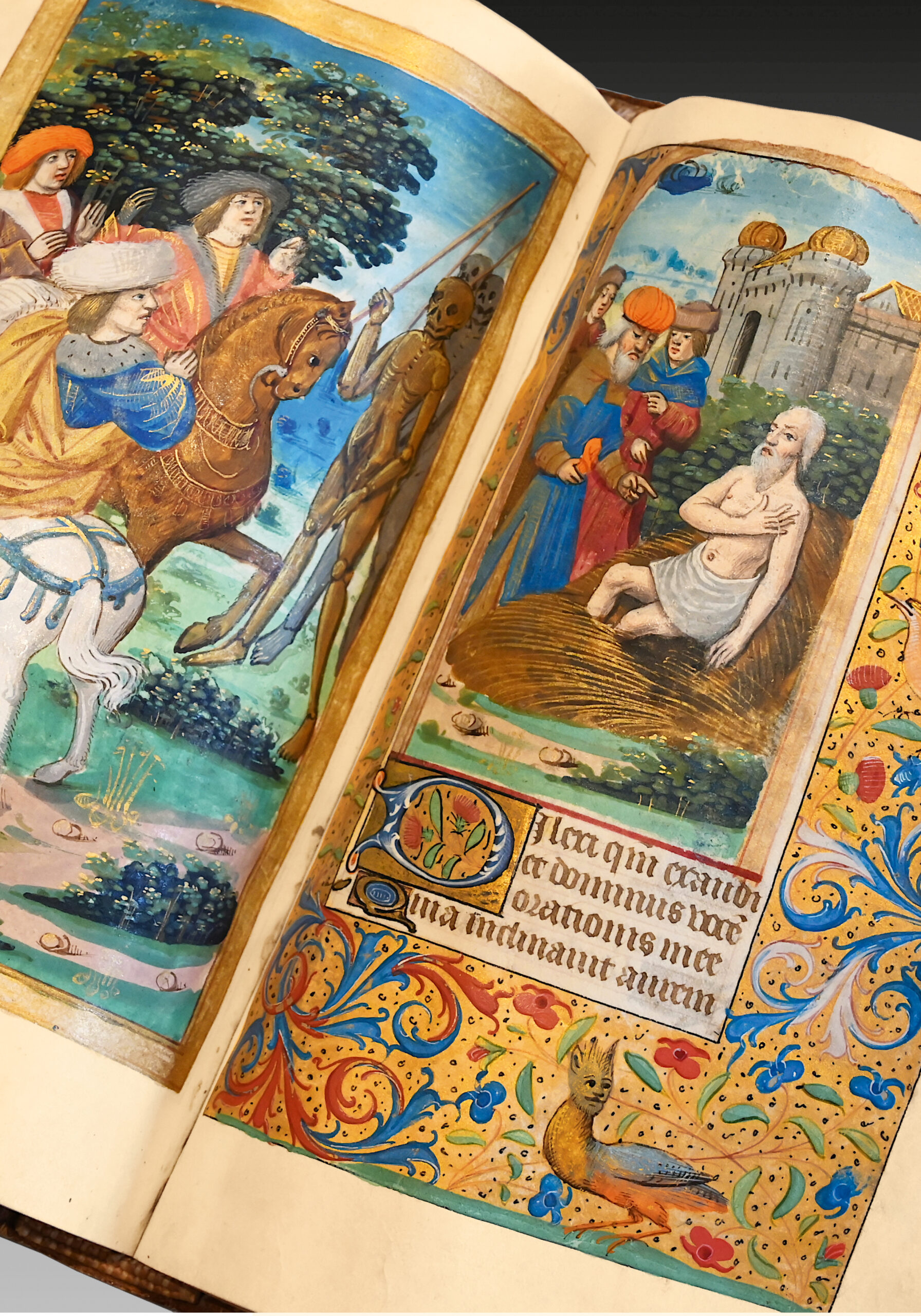
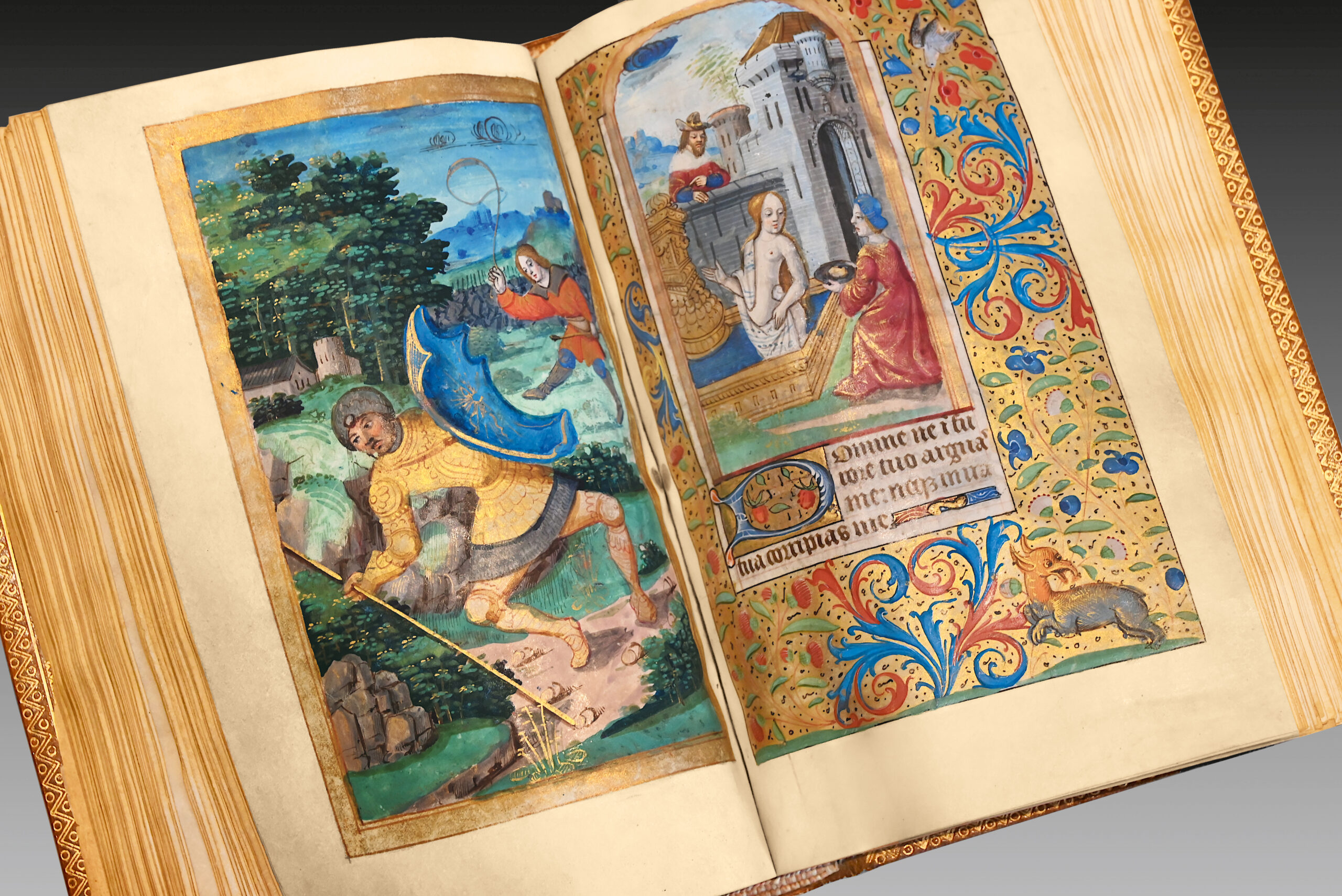
– Full-page miniatures: Christ Carrying the Cross (fol. 72). David Slaying Goliath (79). The Three Dead and the Three Living (94).
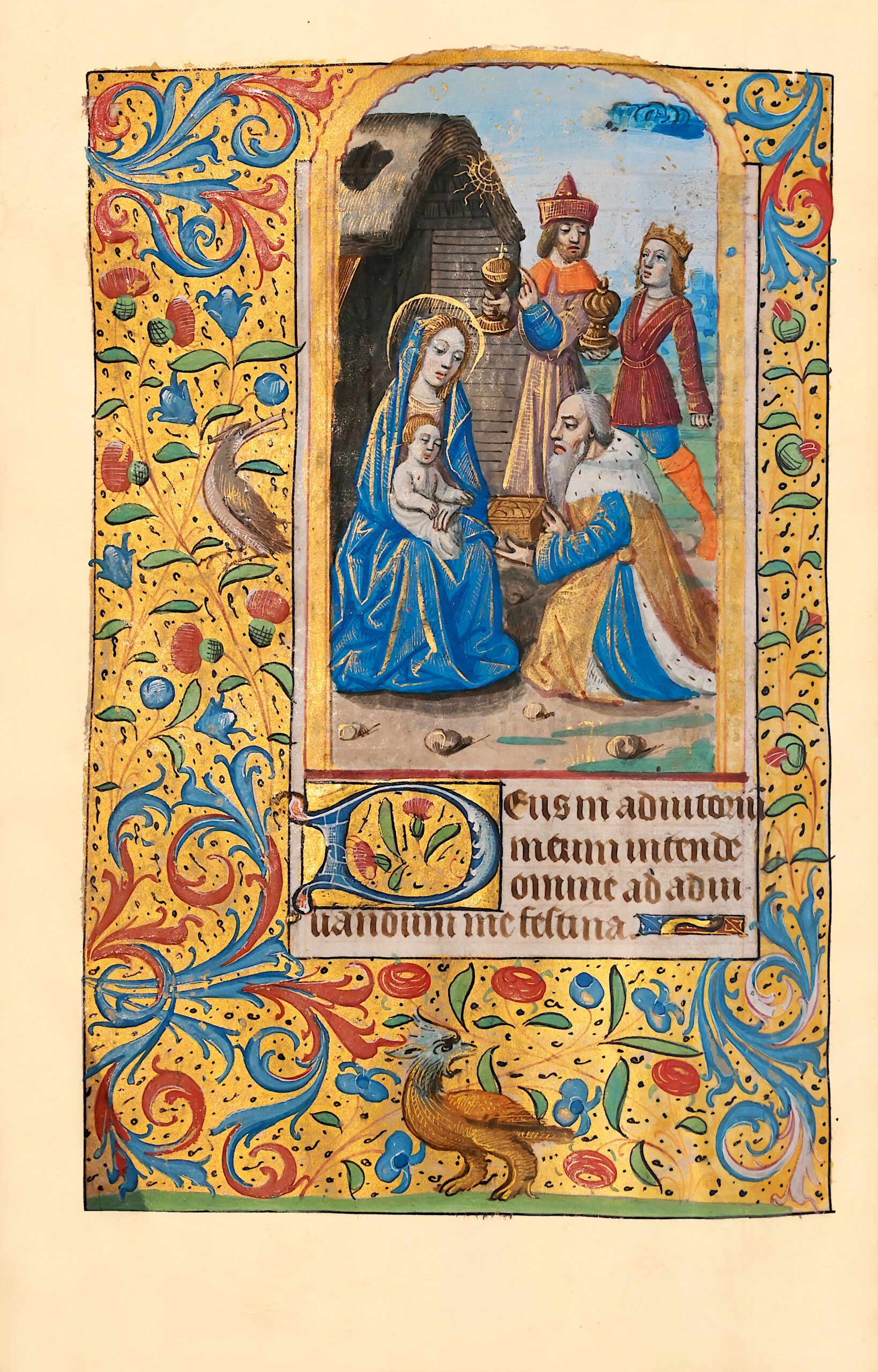
– Large miniatures: Saint John on Patmos (13). Annunciation (23). Visitation (39v). Nativity (48). Annunciation to the Shepherds (53). Adoration of the Magi (56v). Presentation in the Temple (59v). Flight into Egypt (63). Coronation of the Virgin (68). Crucifixion (73). Pentecost (76). David and Bathsheba (80). Job on the Dung Heap (95). The Virgin and Child Enthroned (97). God the Father Displaying Christ’s Wounds (101).
– Small miniatures: Luke, Matthew, Mark, the Virgin in a Mandorla, the Virgin and Child Enthroned, God the Father with the Crucified Christ, Michael, John the Baptist, John the Evangelist, Sebastian, Nicholas, Anthony, Anne Teaching the Virgin, Mary Magdalene, Catherine, Margaret, Geneviève, Avia. Calendar miniatures depicting the 12 signs of the zodiac and the 12 labors of the months.
With 3 large full-page miniatures, 15 large miniatures set within Gothic frames with full borders, 18 small miniatures in the text, and 24 miniatures decorating the calendar. The full borders on gold grounds are adorned with blue and red or blue and mauve acanthus, various flowers, birds, dragons, and fabulous creatures. Pages with small miniatures each have a three-sided border with varying geometric compartments on grounds of changing colors, adorned with acanthus leaves, flowers, and fruit, as well as various birds and butterflies. All text pages feature a wide outer border in the same style, but with exclusively floral motifs. The miniature pages are decorated with a three-line blue initial on a gold ground; the letterforms are embellished with white, and the interiors are filled with colorful scrollwork. The text pages are adorned with numerous two-line blue initials on gold grounds, as well as one-line gold initials on blue and red grounds and line fillers of similar workmanship.
Highlights of this manuscript:
– It features exceptionally rich illumination, with miniatures by the Master of the Chronique scandaleuse and another master from Jean Pichore’s circle.
– The border decoration is magnificent, with mythical creatures and grotesques in the style of Jean Serpin.
– The manuscript is very well preserved, with miniatures in particularly fresh colors.
Condition: Colors are very fresh and clean; a few small miniatures show negligible loss of white pigment. Otherwise clean, with very fresh colors. One gathering (leaves 97–103, containing Doulce Dame & Doulce Dieu) is misbound. A magnificent manuscript in excellent condition.
Provenance: The second flyleaf bears a meticulously written summary of the book of hours, signed “Acheson, Harrow 1823“, identifying Archibald Acheson (1806–1869), the future third Earl of Gosford. His gilt, crowned bookplate (a rooster atop a trumpet, motto “Vigilantibus”) is on the front pastedown. In a private German collection for several decades.
Literature: Caroline Zöhl, Jean Pichore. Enlumineur et éditeur à Paris vers 1500 . Turnhout 2004; Eberhard König, Große Buchmalerei zwischen Rouen und Paris : Der Froissart des Kardinal Georges d’Amboise. In: Leuchtendes Mittelalter IV, cat. XXIX Antiquariat Tenschert, Rotthalmünster 1992.
Superb, richly illuminated book of hours of the Rouen school, with miniatures by the Master of the Chronique scandaleuse and an unidentified master from Jean Pichore’s circle, as well as border decoration featuring birds, dragons, and mythical creatures in the style of Jean Serpin.