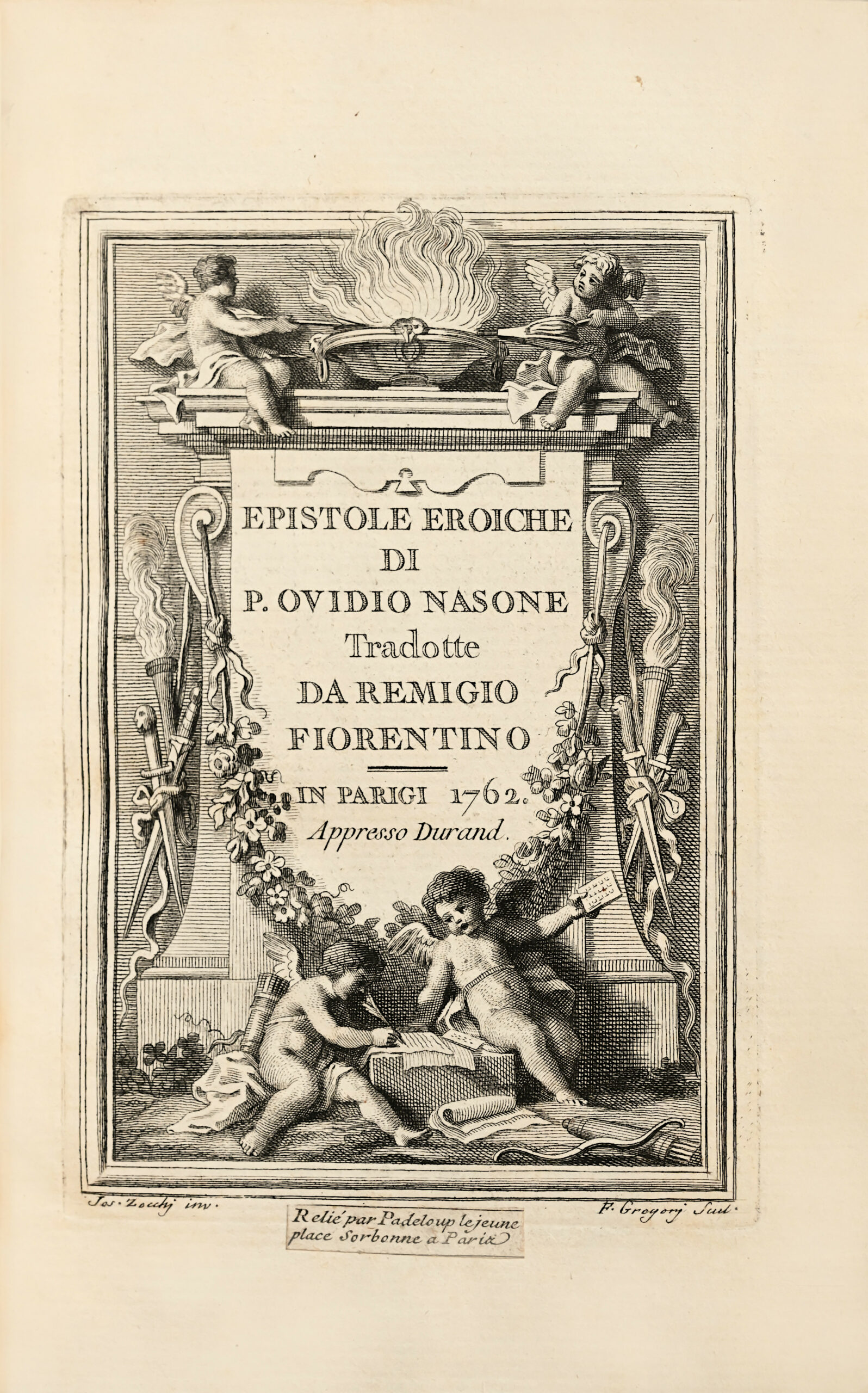
Parigi 1762. Appresso Durand.
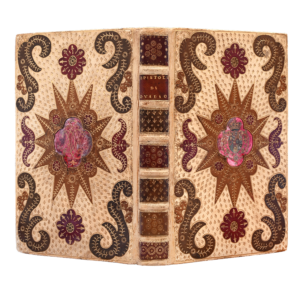
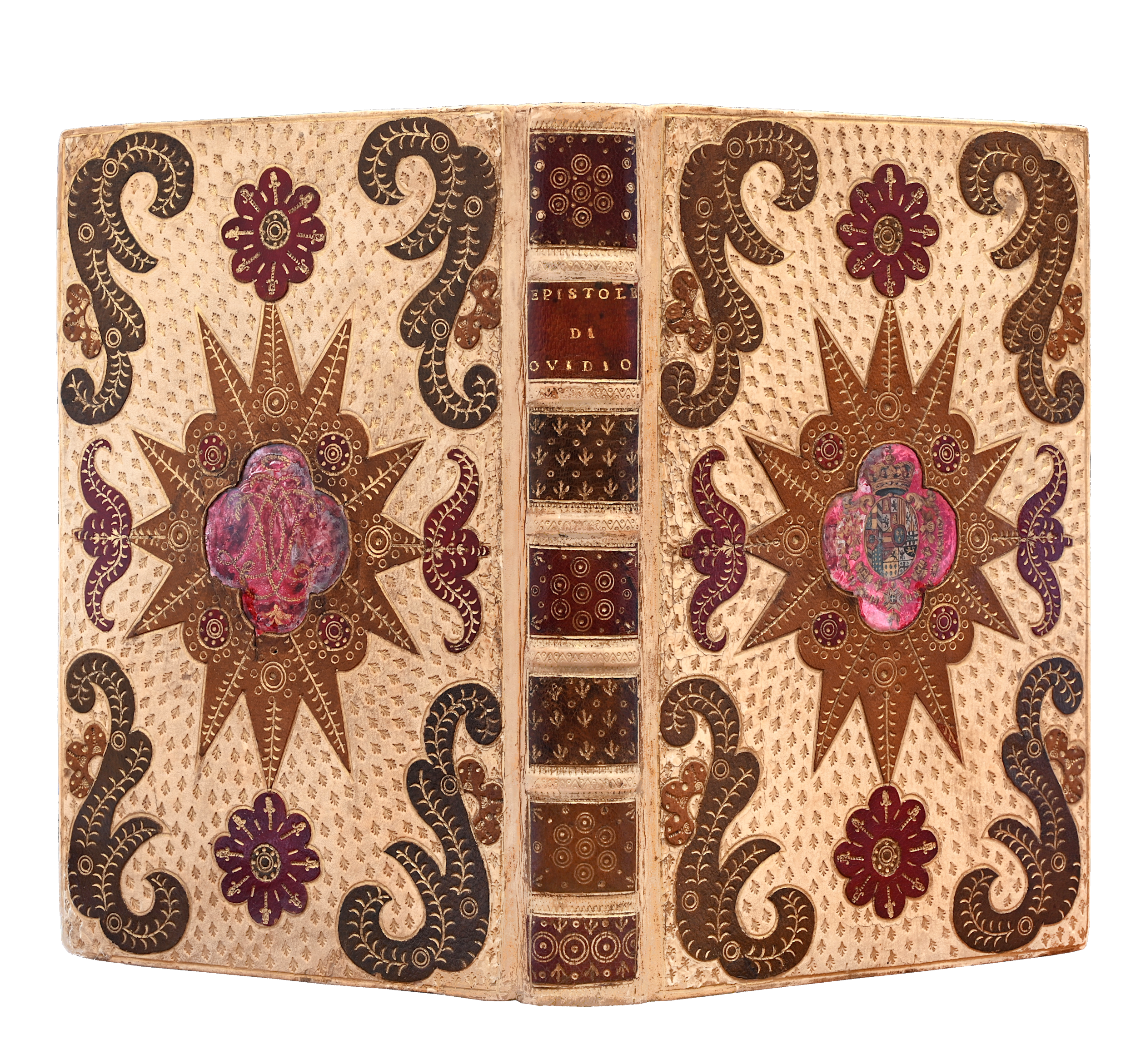
8vo [202 x 132 mm]. White calf, watercoloured coat of arms on a background of pink paillons under mica, on the front cover, interlaced and gilt-stamped figure on a background of pink paillons under mica on the back cover, with a seeded pattern of gilt flowers and pieces of red, brown and havana morocco, spine with false ribs adorned with pieces of lemon, brown and green morocco, decorated edges, lining and endpapers of blue tabis, gilt edges. Contemporary binding by Louis-François Lemonnier received master in 1737 became guard of the community in 1756.
Sumptuous mosaic binding made for the king of Spain Charles III (1716-1788), second son of Philippe v, by the famous Parisian bookbinder Louis-François Lemonnier who enhanced the colour effect by adding paillons under mica.
A very Special and highly luxurious technique, mosaics was in Fashion from 1718 until the end of the seventies, with a few rare examples in the last decade of the century.
It was mainly used for dedication copies and, from 1755 to 1772, attempts were even made to enhance the colour effect by adding paillons under mica.
Louis-François Lemonnier was received as a master in 1737 and became a guardian of the community in 1756.
“Thoinan and, after him, E. Dacier rightly remark that the quality of the gilding indicates the work of several hands. It is nonetheless true that certain particularities of style and execution indicate that all these bindings come from a single workshop to which a certain number of unsigned bindings can also be attributed with certainty.
Among these particularities, the following should be noted in particular: frequent use of white calf for the backgrounds; decoration drawn entirely with fillets without the addition of iron; light parallel lines of gold to bring out the contrasting colours; in the flowers, fishbone veins drawn with small elements of straight and curved fillets and hearts dotted with gold”.
“From the point of view of decoration, all his bindings can be divided into three main series. The first one is part of the taste that was established in the middle of the century for chinoiseries. The second series is more simply decorated with flowers.
The third series, with the “Doctrinal” from Aix-en-Provence (no. 12), the “New Testament” from Vienna (no. 11), the “Roman de Merlin” from the former Ashburnham collection (no. 17), the “Mystere de la Passion” from Chantilly (no. 32), the “Baccius” from the former Wilmerding collection (no. 72), the “Curio” from the former W. Haff collection (no. 88), is formed of very elegant light morocco bindings adorned only with a frame on a pointile background with mosaic leaves, rosaces and flowers.” Louis-Marie Michon. The mosaic bindings of the 18th century.
The volume is labelled “bound by Padeloup le jeune Place Sorbonne à Paris” like some of the masterpieces of 18th century mosaic bookbinding after Padeloup’s death in 1758 as a tribute to the most illustrious bookbinder of the century.
Antoine-Michel Padeloup was the first bookbinder to use engraved labels to sign his bindings. These labels are glued either on the flyleaves, the title page or the final leaf of the book. This first label (label A) reads: “Bound by Padeloup le jeune / Place Sorbonne à Paris“; dimensions: L. 31 x h. 6 mm. When he was appointed bookbinder to the king in August 1733, Padeloup had a second label (label B) made with this title: “Relié par Padeloup Relieur du / Roy, place Sorbonne à Paris”; dimensions: L. 31 x h. 6 mm.
Masterpiece of a mosaic binding which appeared at the 1949 exhibition with this label: « Ce livre a figure à l’exposition « Dix siècles de livres français » (Lucerne 9 juillet – 2 octobre 1949) sous le n° 383 du catalogue. »
From the Émile Rossignol library with ex-libris sold for 345,000 FF (52,750 €) on 5 June 1998, 28 years ago (Ref: Manuscrit et Livres précieux, No. 185).