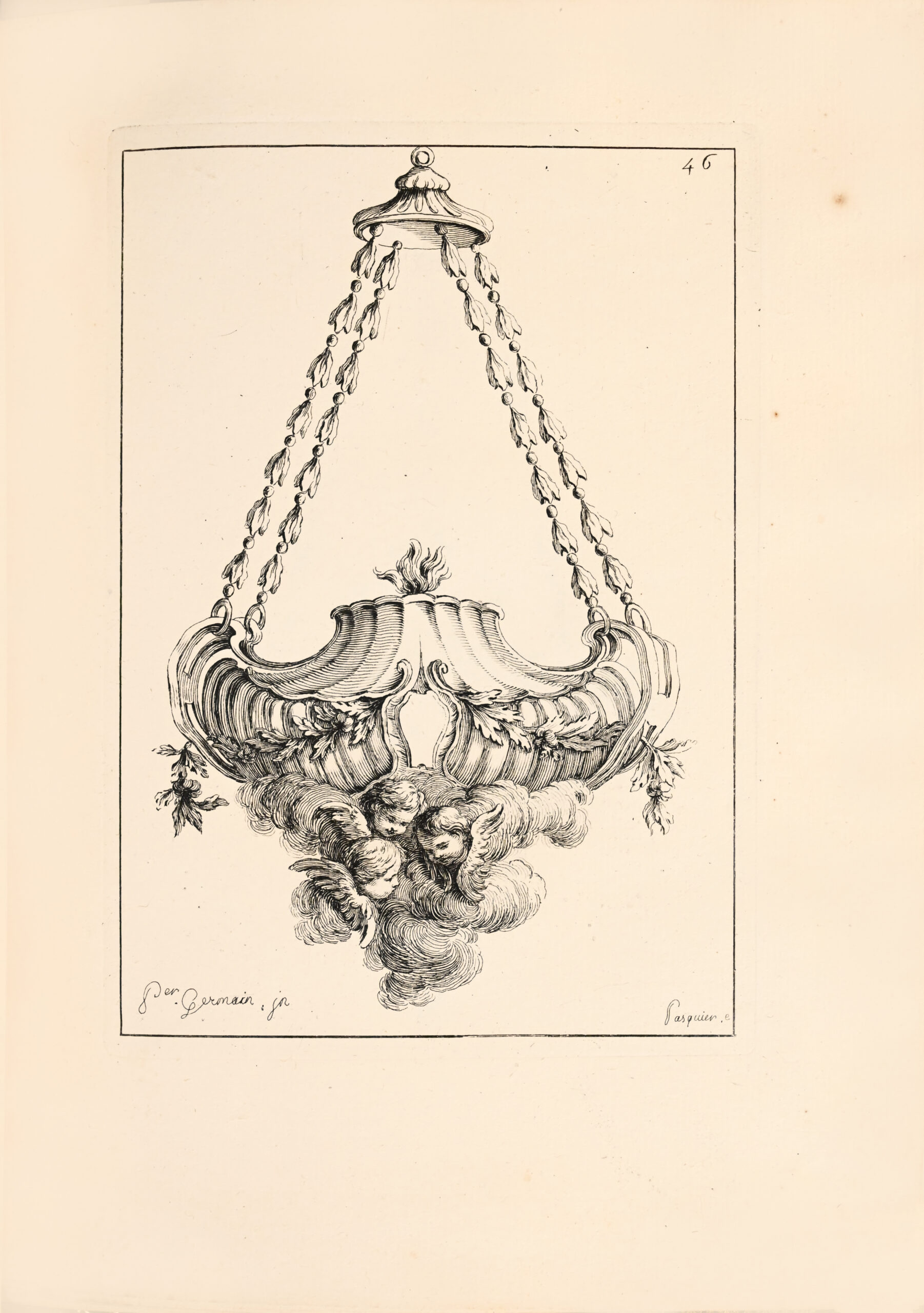
Paris, published by the author and by the Widow of F. Cherau, 1748.
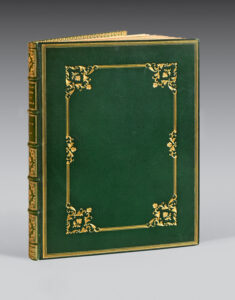
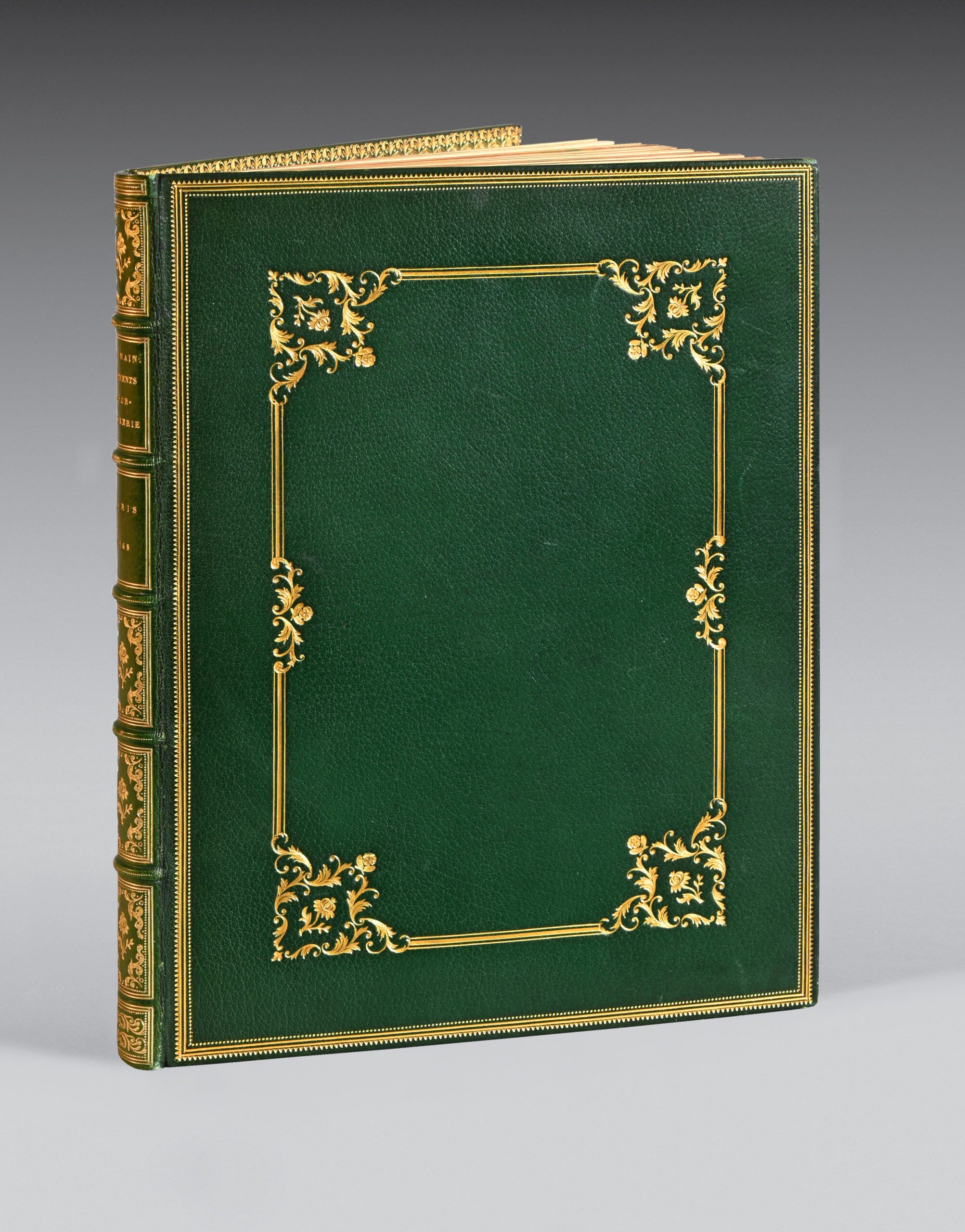
2 parts in 1 quarto volume, with 2 engraved title pages, 3 leaves (Dedication, Notice, table) and 100 engraved plates of goldsmiths’ work. Green morocco, double borders of solid and dotted gilt fillets on the covers, large corner ornaments with pomegranate and cherub motifs, raised-band spine decorated with pomegranate motifs, double gilt fillet on the board edges, wide gilt roll-tool border inside, edges gilt over marbling. Trautz-Bauzonnet, circa 1855.
273 × 203 mm.
First edition of this precious collection of silversmithing designs.
The publication of collections of silversmithing designs was rare. Silversmiths were generally protective of their designs. A dedicated study examines the possible reasons behind this unusual decision by the renowned master silversmith Pierre Germain: financial motives, a desire for recognition, and, above all, an educational purpose: “My sole aim in composing this work, he says in his Notice to the Reader, has been to encourage young people to acquire a grounding in the different branches of silversmithing and the variety of forms” and to “make it easier for students to succeed”.
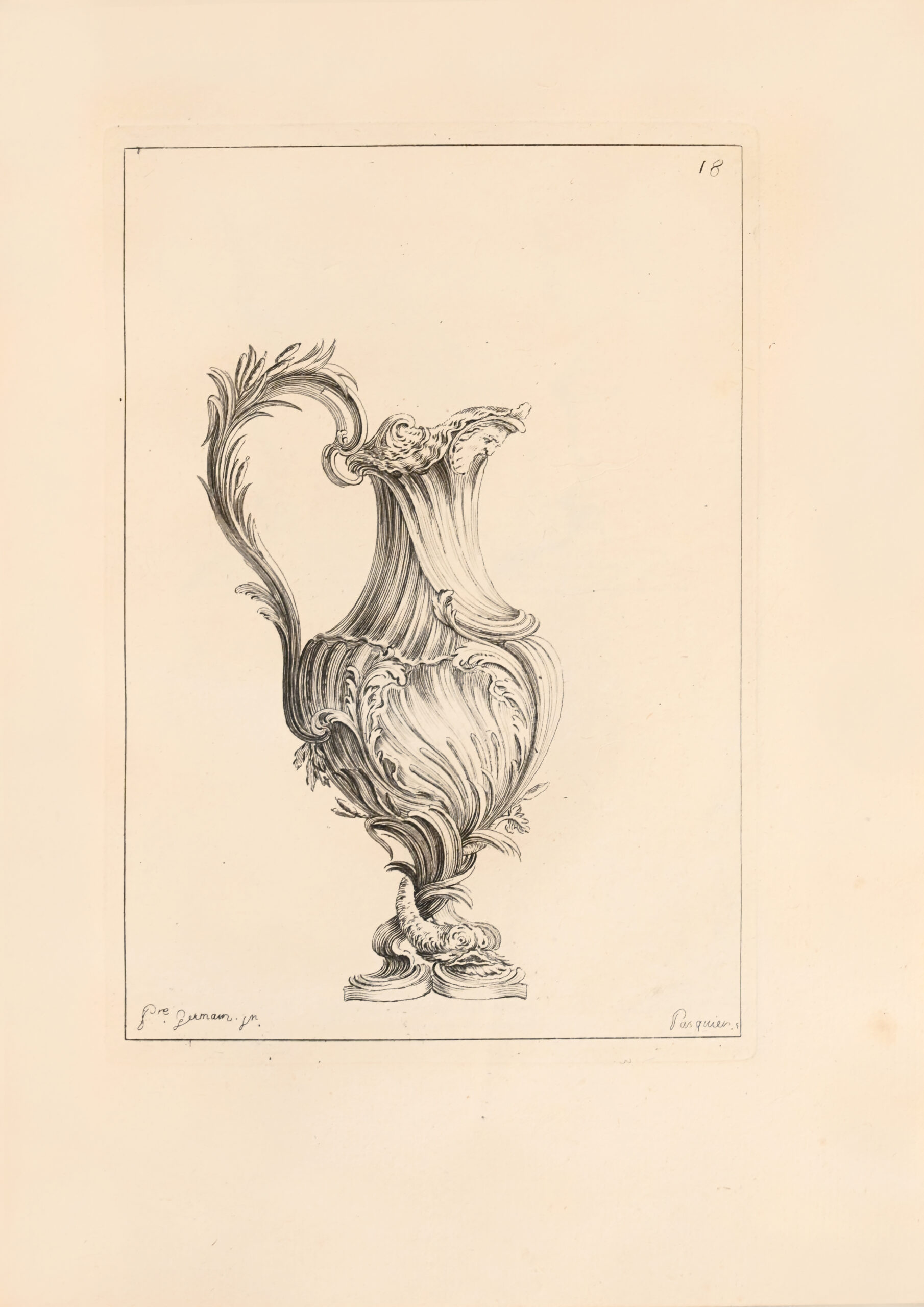
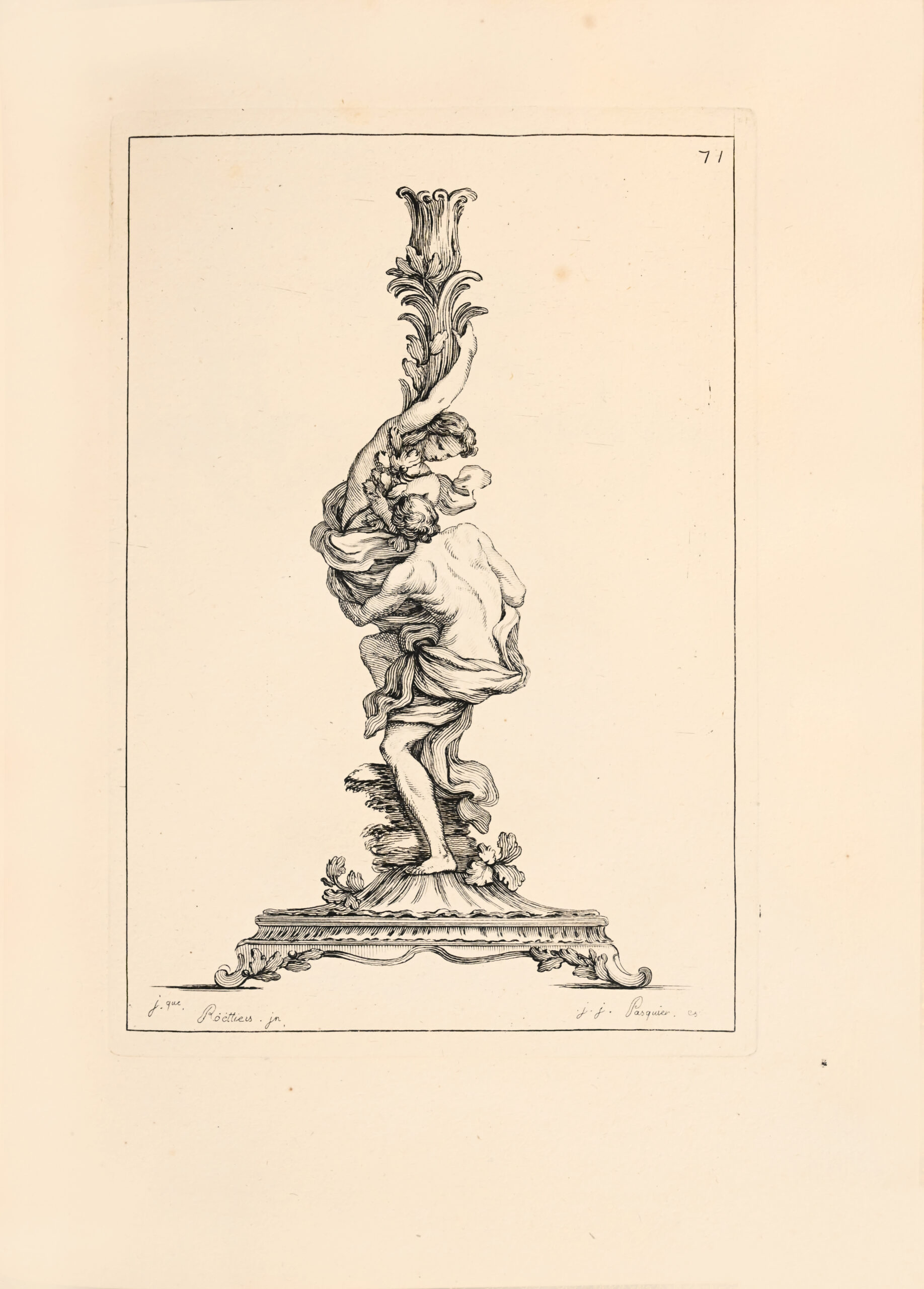
Most of the designs are signed by Germain himself, some by his fellow silversmith Jean-Jacques Roëttiers and others by Baquoy.
Cohen-de Ricci 429-430 (“A precious collection containing the finest designs for Parisian silverware from the reign of Louis XV”); Bapst. Studies on French Silversmithing in the Eighteenthe Century: ; the Germains, the King’s Silversmith-Sculptors, pp. 182 ff. (“it is still considered the most authoritative work of its kind”).
In November 1747, the Mercure de France announced the publication of his Éléments d’orfèvrerie, a collection of 100 plates of designs for religious and secular silverware, engraved with a burin by Jean-Jacques Pasquier and Baquoy.
The silversmith submitted the two parts of his work to the book trade authorities on June 26, 1748, and received the royal privilege on July 16, by which time the first part of the collection was already on sale or in press. Pierre Germain added the privilege by hand to copies already printed, authenticating it with his signature. The second collection, the Livre d’ornements, appeared in 1751.
The volumes were sold in turn by Nicolas Bonnart; by the widow of François II Cherau, Geneviève Marguerite, active from 1755 to 1768; then by her son Jacques François (1742–1794); and finally by Etienne François Joubert, who bought the copper plates for both collections from him. Copies were also sold from 1773 to Year X by Watin, first styled Monsieur Watin and later Citizen Watin. As the work aged, its price fell by half between 1748 and 1778. It was purchased by silversmiths (including Benjamin Febvrier, a silversmith in Landernau) and collectors such as Caze de la Bove, Simon-Judes-François Délézenne, the superintendent of buildings Marigny, and the Marquis de Paulmy.
The sources of inspiration for this carefully composed work seem to suggest some affinities with works by Jacques Roëttiers, but too few objects survive to establish this with certainty. The collection’s subsequent influence, however, is more apparent. It was imitated in the provinces, for example by Frédéric Ist Nesme in Lyon in 1756 and by Joseph Opinel in Dole in 1759. It also enjoyed some success abroad, particularly in London, England, where it was extensively plagiarized, imitated or adapted by Thomas Heming, Parker and Wakelin, and in Italy, where it may have influenced Andréa Boucheron in Turin. It remained a major source of inspiration until the end of the 19th century, particularly for the houses of Aucoc and Cardeilhac. Its engravings were widely reproduced in the plates of Diderot and d’Alembert’s Encyclopédie between 1751 and 1772.
This fine collection of goldsmiths’ designs features numerous finely drawn and engraved objects: “Outlines of dishes, sugar pots, salt cellars, mustard pots, sugar bowls, candlesticks, wine coolers, garlic pots, centerpieces, tureens, tea services, powder and beauty-patch boxes, jewelry chests, water jugs, mirrors… etc.”
“All these pieces are charming in their composition and very useful for goldsmiths to consult.” Guilmard, Les Maîtres ornemanistes, 175, no. 50.
It was used by the House of Boin-Taburet as a source of inspiration in creating its designs.
The collection is dedicated to Monseigneur de Machault, Controller-General of Finances, whose coat of arms is engraved at the head of the dedication.
A superb copy of this engraved collection, evoking the artistic genius of the great Parisian goldsmiths during the reign of Louis XV, in a fine morocco binding by Trautz-Bauzonnet.
Provenance : Émile Froment-Meurice, 1856 ; Archibald Philip Primrose (1847–1928), 5th Earl of Rosebery, with his armorial bookplate bearing the motto of the Order of the Garter, “Honi soit qui mal y pense”.
Emile Froment-Meurice was a goldsmith and official supplier to the City of Paris, as was his father François-Désirée Froment-Meurice, for whom Victor Hugo wrote a few verses attesting to the beauty of his art (Les Contemplations, 1856). Taking over his father’s workshop, Emile Froment-Meurice also worked for Napoleon III and the Duke of Aumale, for whom he created the binding of the Breviary of Jeanne d’Evreux (currently at the Château de Chantilly).