France, Champagne (Troyes?), circa 1460–1475.
Small quarto (177 × 126 mm).
A famous and remarkable illuminated hunting manuscript, notably featuring a unicorn, considered by R. Schwerdt, (Hunting, Hawking, Shooting) to be one of the highlights of his collection.
Small quarto (177 x 126 mm).
Collation : 99 ff., preceded and followed by two paper flyleaves, incomplete manuscript, partly bound out of order, gatherings of 8 leaves (current collation, numerous leaves mounted on guards: i6, ii6, iii4, iv6, v4, vi4, vii5, viii4, ix4, x7, xi8, xii8, xiii8, xiv8, xv4, xvi8, xvii4).
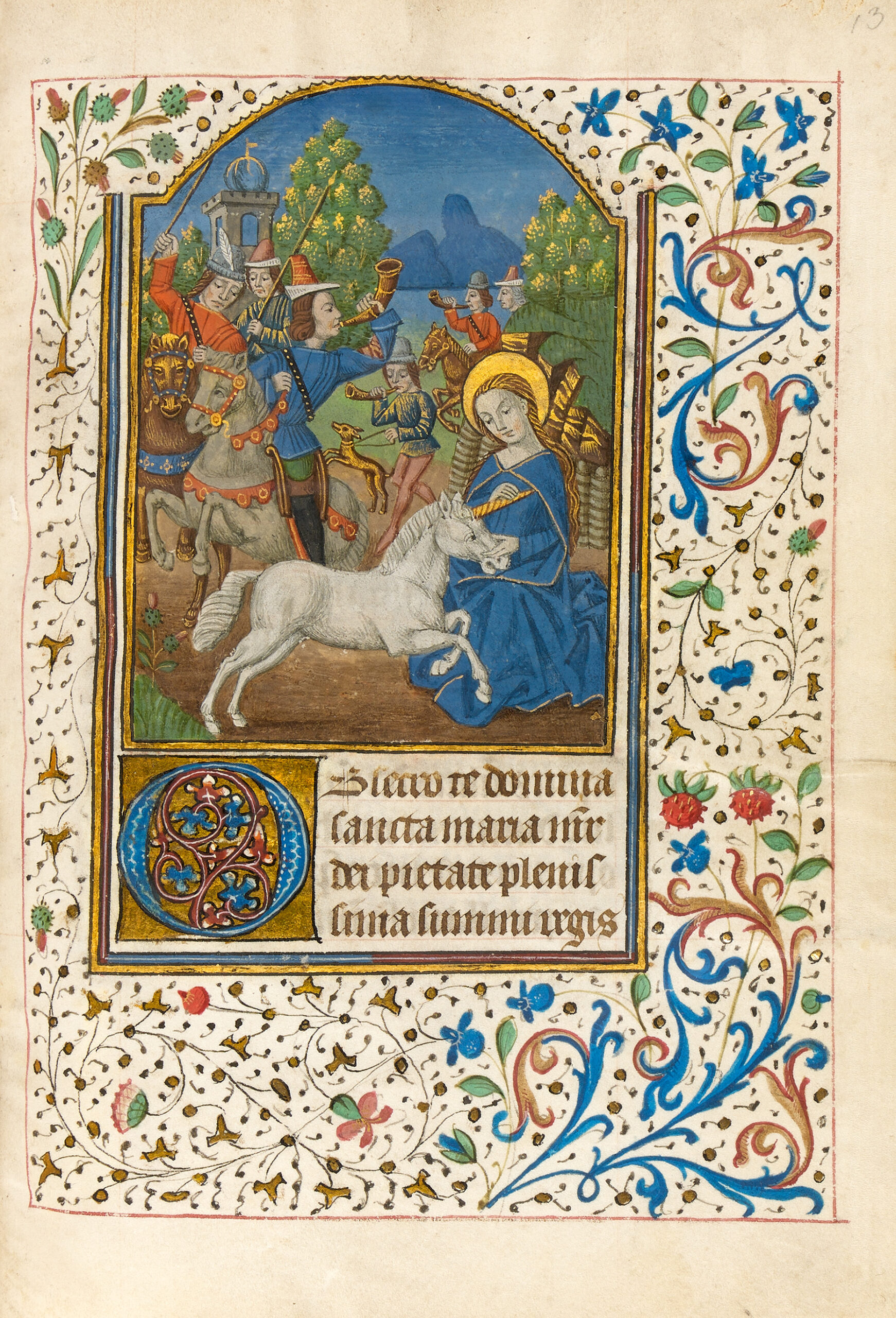
Painting : with 4 large illuminations in the upper portion, with arched tops: 2 15th-ecentury miniatures on ff. 33, 42v (circle of the Master of Michault de Guyot II Le Peley) and 2 miniatures overpainted approximately 150 years ago on leaves with 15th-ecentury illuminated borders (ff. 13 and 32v).
- f. 13: three hunters on horseback, one blowing a hunting horn, followed by other hunters in the background. Seated Virgin with a unicorn resting on her lap. Note that the recto of this leaf is ruled but blank [late 19th-ecentury miniature, by a forger].
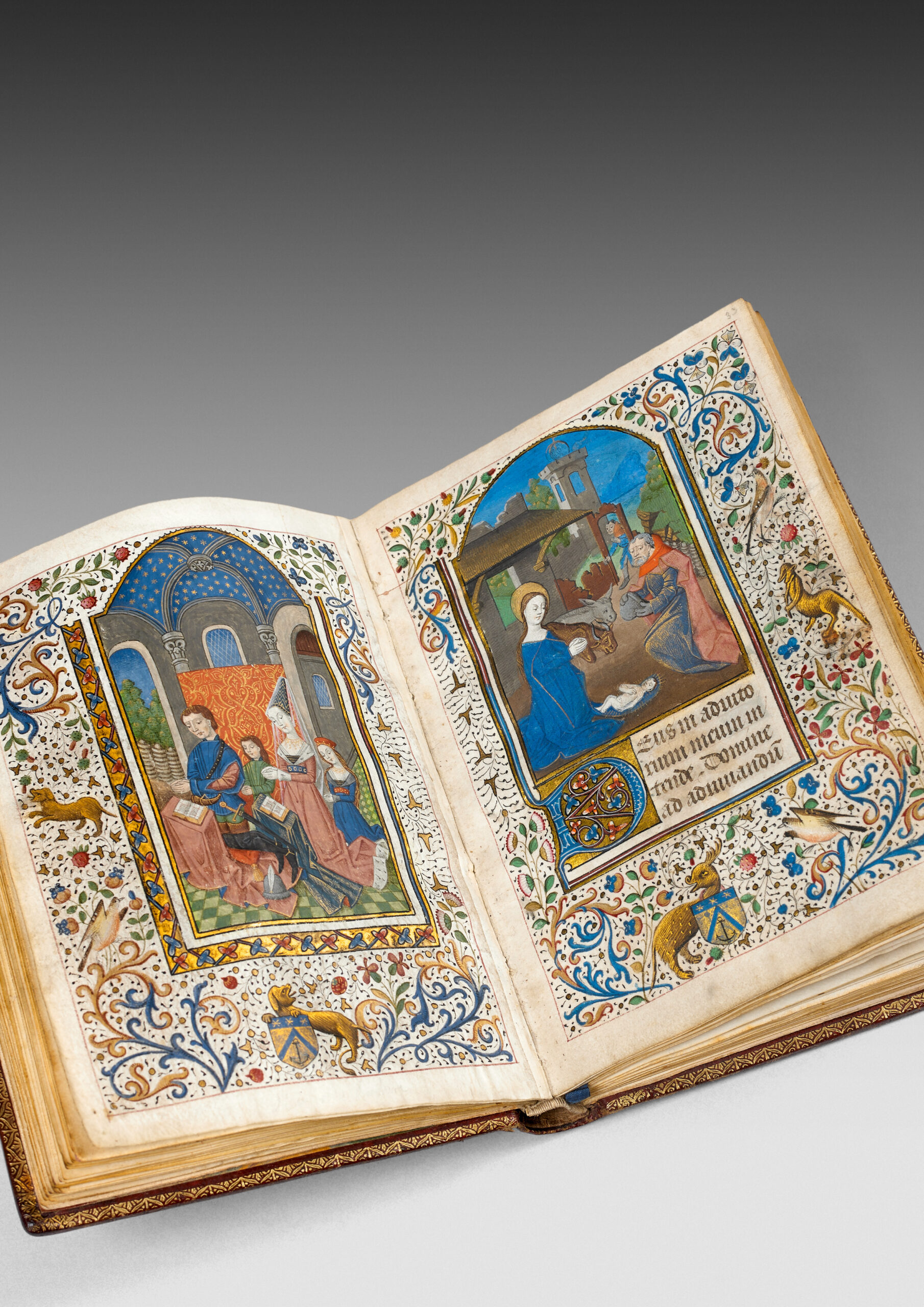
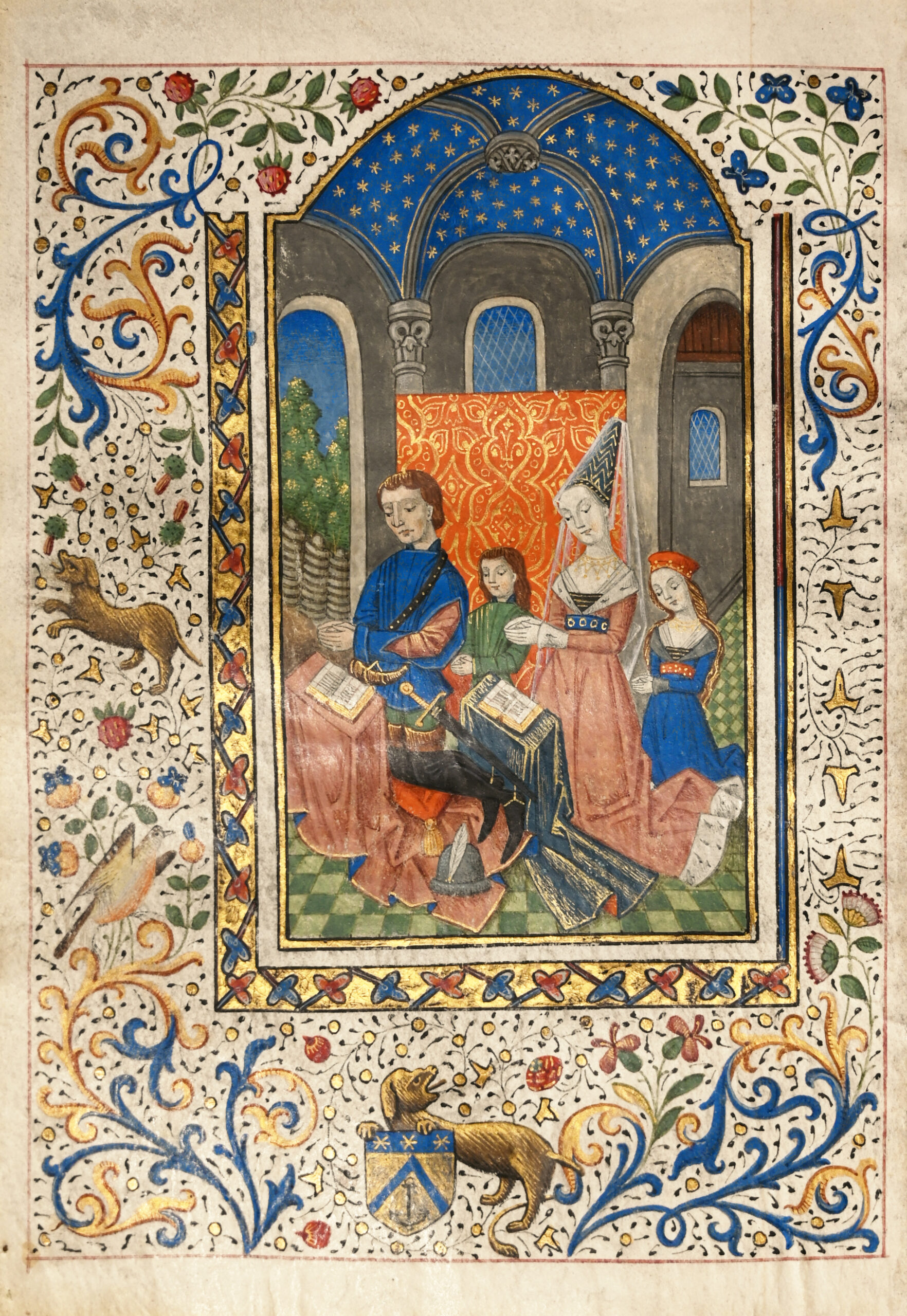
- f. 32v: a family kneeling in prayer in a chapel before open books: a man, a hunter carrying a hunting horn and a sword, his wife and their two children [late 19th-ecentury miniature, by a forger].
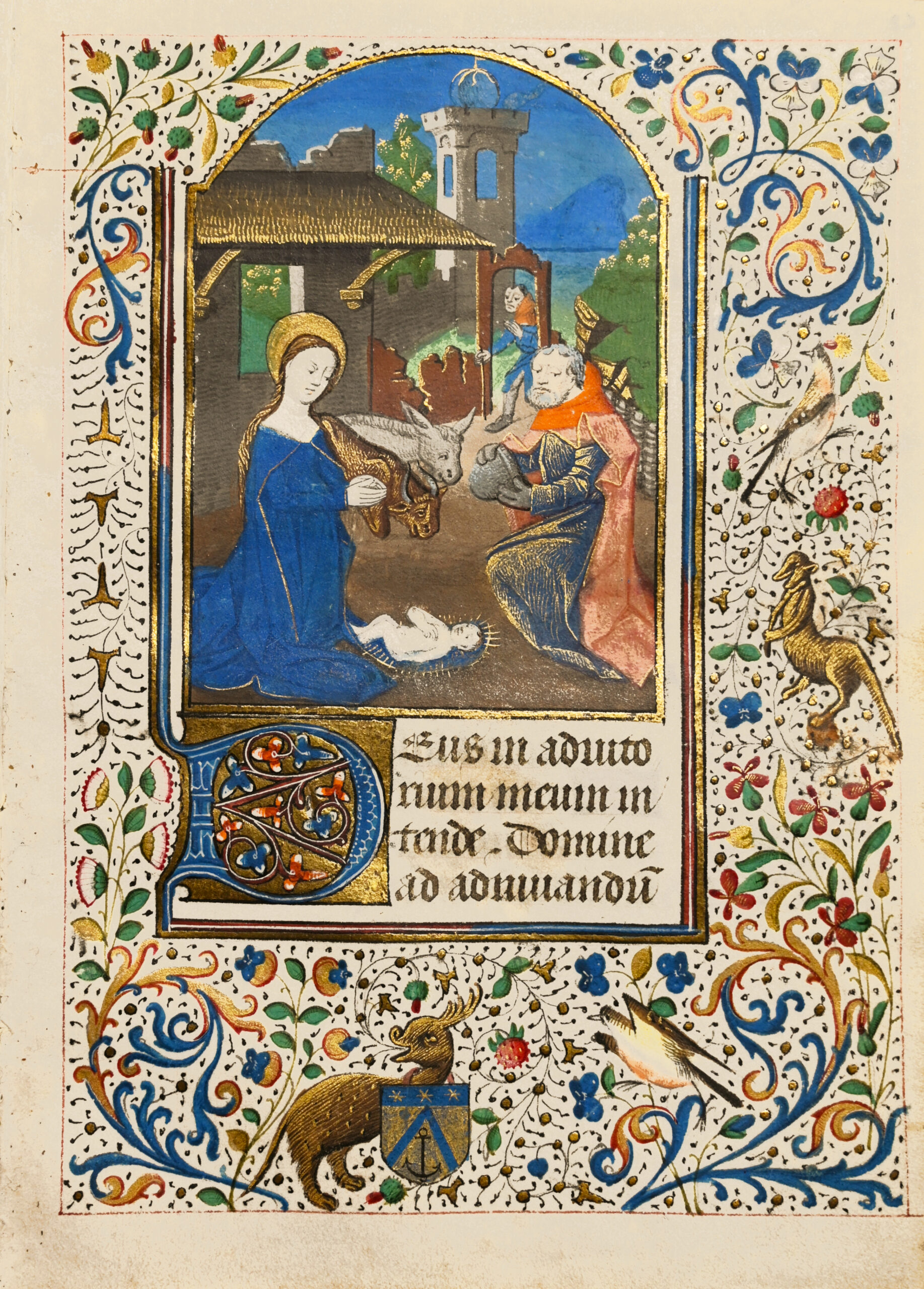
- f. 33: Nativity [original 15th-e century miniature].
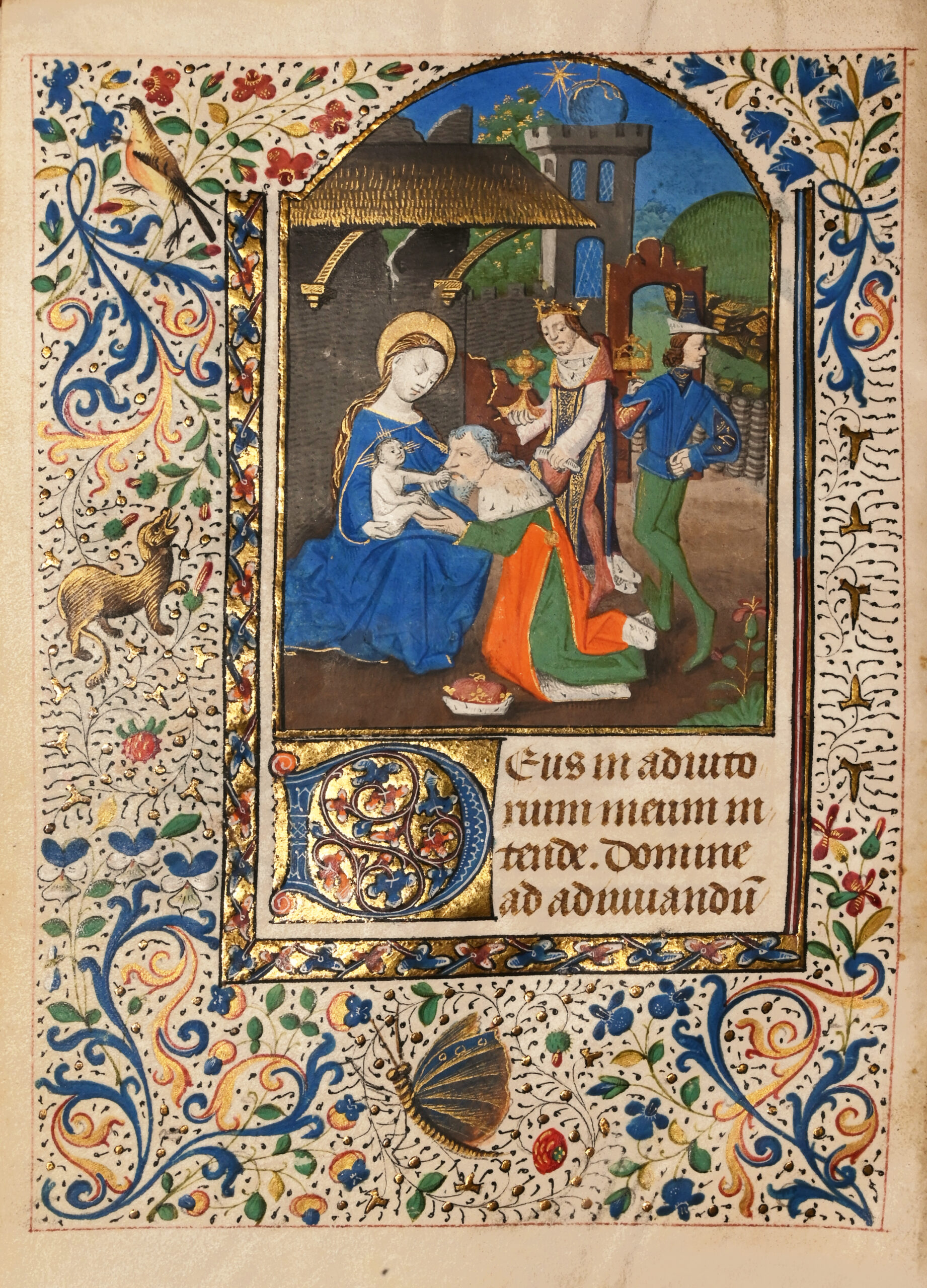
- f. 42: Adoration of the Magi [original 15th-ecentury miniature].
Decoration : Gothic script in dark brown ink, 16 lines per page, some calligraphic flourishes/cadels (for example f. 71, f. 91, with the profile of a head wearing a hat), capitals in the text highlighted in pale yellow, rubrics in red, line fillers in dark pink and blue with white highlights and burnished-gold roundels, numerous initials 1 to 2 lines high in burnished gold on dark pink and blue grounds with white highlights, large initials introducing the major textual divisions in blue with white highlights, set within a design of colored vine leaves on burnished-gold grounds (4 lines high), calendar in red and dark brown ink, KL initials in burnished gold on dark pink and blue grounds with white highlights, illuminated borders in the outer margin (every other leaf) with colored acanthus leaves, scrollwork, burnished-gold vine leaves and small colored floral motifs on reserved grounds, the same borders on all four sides (with the addition of hybrid zoomorphic creatures and birds that appear genuinely 15th-e century and original; two zoomorphic figures hold coats of arms on ff. 32v and 33), framing the leaves with miniatures (ff. 13, 32v, 33, 42v; a border on all four sides on fol. 16v).
Text : ff. 1-12v: Calendar, in French, in red and brown ink; note the following saints: Saint Parre (January 6); Saint Frobert [founder of Montier-la-Celle Abbey] (January 7); Saint Remigius (in red, January 13; in brown, October 1); Saint Maurus (in red, January 15); Saint Savinian [or Sabinian, martyr of Rilly; the first apostle of Christianity in the diocese of Troyes] (in red, January 24); Saint Savina [“blood sister of Saint Savinian”] (January 29); Saint Nicetius [Saint Nizier of Lyon] (April 2); the Holy Cross (twice: in red, May 3 and September 14); Saint Helena (in red, May 4); Saint Mastie (Mastidia) [Mathie, patron saint of Troyes] (in red, May 7); Saint Nicholas (May 9; in red, December 6); Saint Falle [Saint Phal or Fidolus] (May 16); Saint Lyé (May 25); Saint Syra [two saints named Syra are known: one, Saint Syra of Troyes or Rilly, and the other, Saint Syra of Châlons or Meaux] (June 7); La Couronne Dieu (August 11); Saint Mammert (August 17); Saint Fiacre [founder of a monastery near Meaux, dependent on Sainte-Croix Abbey] (August 30); Saint Loup (September 1); Saint Virilien (September 13); Saint Liénard (November 6); Saint Audry (in red, November 30).
- 13-16: Prayer, Obsecro te [complete text], feminine form: “…Et michi famule tue…” (fol. 15)
- 16v: O intemerata [incomplete, ending missing], explicit: “[…] atque misteriis celestibus ultra omnes inibitus… »
- 17–44: Office of the Virgin, very incomplete, with leaves sometimes bound out of order, but nevertheless following the liturgical use of Troyes, interspersed with the Hours of the Cross (entirely missing) and the Hours of the Holy Spirit (only two leaves survive). Hours of the Virgin: Matins, ff. 17–23 and f. 70; Lauds, ff. 24–30; Prime, ff. 33–37; Terce, ff. 40–42; Sext, ff. 42v–44; None and Compline are missing. Hours of the Holy Spirit: ff. 38–39.
Note, on fol. 30: antiphon, “Dignare me”; chapter, “Felix namque” (Lauds of the Hours of the Virgin, use of Troyes); fol. 37: antiphon, “Ave Maria gratia plena”; chapter, “Hec est virgo sancta” (Prime of the Hours of the Virgin, use of Troyes); fol. 41–41v: antiphon, “Tota pulcra es”; chapter, “Paradisi porta” (Terce of the Hours of the Virgin, use of Troyes). These details clearly confirm that these Hours follow the use of Troyes.
- 45–59v: Penitential Psalms (incomplete), followed by the litany (ff. 55v–58v) [notable names: Savinien; Quentin; Loup; Nicolas; Rémi; Hilaire; Hélène; Mastidie; Hoyldis [Saint Hoïlde]; Aldegonde; Gertrude; Foy; Savinia; Syre] and prayers.
- 60–99v: Office of the Dead (incomplete), following the use of Troyes, with the following responsories: (I) Credo quod; (II) Qui Lazarum; (III) Requiem eternam; (IV) Absolve domine; (V) Domine secundum; (VI) Tuam deus piissime; (VII) Ne intres in iudicium; (VIII) Peccantem me; (IX) Libera me [see Paris, BnF, MS NAL 3163, no. 160, “Leroquais survey”].
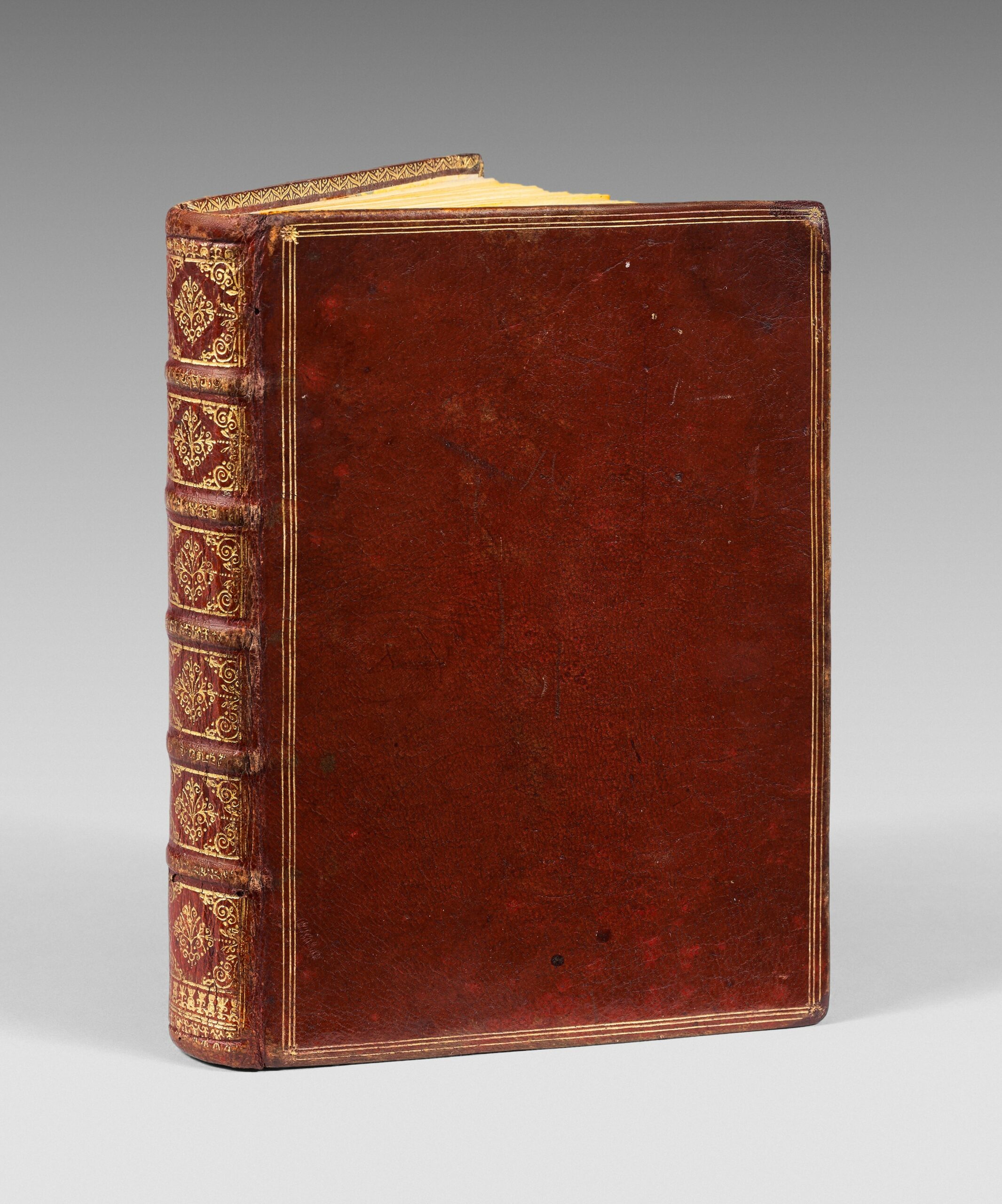
Red morocco, gilt decoration, triple-fillet border, raised bands on the spine, comb-marbled paper endpapers, gilt edges. The manuscript is housed in a modern hinged case of red morocco, with a spine divided into compartments by five raised bands and decorated with floral motifs (a pastiche imitating 18th-ecentury bindings). Early 18th-century bindinge.
Provenance :
- Manuscript for liturgical use in Troyes, as confirmed by the few identifiable features
in the Hours of the Virgin. The calendar and litanies confirm this use in Troyes through the many saints venerated in the diocese of Troyes. It should be noted that certain saints in the calendar and litanies have a connection to the small town of Rilly (Rilly-Sainte-Syre, Aube department).
- Illuminated book of hours for a woman if the feminine wording “mihi famuletue ” in the prayer Obsecro te (fol. 15) is any indication.
- Coats of arms painted in the lower margins of folios 32v and 33: Or, a chevron azure accompanied in base by an anchor sable, on a chief azure three stars (or mullets?) or. They were painted in the 15the century. These arms appear to be those of the Péricard family, lords of Palteau and Paron, who also held lands in Maine, Normandy and Champagne. These arms are preserved in a stained-glass window now in the Musée de Troyes. See: L. Le Clert, Armorial historique de l’Aube, Marseille: Laffitte, 1976 [reprint of the Paris, 1912 edition], p. 244, no. 1319: “Nicolas Péricard, of Troyes, was ennobled by letters patent in 1433” (the arms are also described in A. Dey, Armorial historique de l’Yonne, Sens, 1862, p. 16). A François de Péricard is known from the 16the century: Bishop of Avranches, supporter of the Catholic League, and son of Jean de Péricard, a prosecutor at the Parliament of Normandy. We thank François Avril for confirming this attribution.
- Jacques Rosenthal (1845–1937), a prominent bookseller based in Munich (Buch und Kunst-Antiquariat, Karlstrasse 10, Munich). He founded his business in 1895 and sold it in 1935. Jacques Rosenthal, whose birth name was Jakob, was born in Bavaria and grew up in a family of art and book dealers. In 1874, at the age of nineteen, he joined the business his elder brother Ludwig had founded in Munich. In 1878, he was sent on a business trip to Paris, where he deepened his knowledge of rare books with the librarian Léopold Delisle and the bookseller Anatole Claudin. The year he spent there was a profoundly transformative experience: having become a true Francophile, he even changed his first name to “Jacques.” The manuscript appears in his catalogue The Art of the Book in the Middle Ages and in Modern Times up to the Sixteenth Century (Cat. 27, c. 1900), no. 45, p. 21 and plate 4:
« Book of Hours for the use of a church (Tours? Reims?). A very fine manuscript produced in France in the 15the century. It is written in red and black on vellum and adorned with four large miniatures of exceptional interest… Two of the borders contain a coat of arms: Or, a chevron azure accompanied in base by an anchor, on a chief azure three stars or (Cramoisy?)… A fine manuscript, remarkable for its miniatures. The first depicts the mystical hunt of the Unicorn, which takes refuge in the Virgin’s lap; the second, the family of a former owner. The father, dressed for hunting, kneels in the foreground; behind him are his richly dressed wife, a son and a daughter. The border surrounding this miniature displays the coat of arms mentioned above. The other two miniatures depict the Nativity and the Three Magi. Very well preserved.”
- Charles Francis George Richard Schwerdt (1862–1939). Armorial ex-libris label pasted onto the recto of the first flyleaf, “Ex-libris Schwerdt.” Hunting, Hawking, Shooting: illustrated in a Catalogue of Books, Manuscripts, Prints and Drawings, 1928–1937 (reprint 1996), vol. II: “Horae. Prayerbook of a Hunter. [c. 1400] (sic!)… An exquisite little document of a unique kind.” Schwerdt himself chose the miniature depicting the three hunters and the Virgin with the unicorn to illustrate the frontispiece of vol. I of his personal catalogue.
- Sotheby’s, London, The Schwerdt Collection – Fifth Portion, no. 2218, part of the series of sales (according to the reference provided by the Schoenberg Database of Manuscripts).
- Sotheby’s, London, Western Manuscripts and Miniatures…, 12 June 1988, lot 56. The manuscript was then catalogued as having been partially painted in the 19the century, with two original miniatures and two miniatures described as “forgeries.” Catalogue entry by Christopher de Hamel. The name Péricard was also suggested for the coat of arms in 1988.
- Ramsen (Switzerland), Antiquariat Tenschert. Leuchtendes Mittelalter: Some stains on the parchment, but generally in good condition despite the losses noted. Traces of old inscriptions (a family record book?), erased and illegible to the naked eye (ff. 1, 8, 9).
This manuscript combines two original miniatures, painted in the circle of the Master of the Michault of Guyot II Le Peley, an artist from Troyes, with two miniatures overpainted around 1875 by a highly talented artist who created convincing pastiches. The manuscript thus became a Book of Hours with a hunting theme, perfectly suited to the remarkable Schwerdt collection.
In this manuscript, two miniatures can be dated to the 15the century and belong to the original cycle of illustrations. The manuscript’s origin in Troyes is also confirmed on stylistic grounds, since the Nativity (fol. 33) and Adoration of the Magi (fol. 42v) are comparable to works attributed to an artist in the circle of a known artist from Champagne: the Master of the Michault of Guyot II Le Peley. His works were recently studied as part of the exhibition Très riches heures de Champagne (2007, cat. 26–34). This is an artist active in Troyes between the 1460s and 1480s who enjoyed the patronage of Louis Raguier, bishop of Troyes (1450–1483), as well as Guyot II Le Peley, a wealthy merchant from Troyes. The artist is named after a manuscript of the moralist poet Pierre Michault, Le Doctrinal du temps présent et La Danse aux aveugles (Paris, BnF, français 1654; datable to around 1475–1480), commissioned by Guyot II Le Peley. He painted numerous books of hours, delegating part of this work to his circle and workshop. If the identification of the original patron of this Book of Hours as a member of the Péricard family is confirmed, the manuscript is of interest because it adds another family to the clientele of this master’s workshop.
This manuscript contains two other miniatures painted in the style of the two original paintings, but clearly distinguishable from them. These are two inserted miniatures painted by a 19th-ecentury artist, perhaps a contemporary of the famous Spanish Forger. In his catalogue devoted to the study and inventory of the works of the Spanish Forger (1978), W. Voelkle classified the present Book of Hours among the “Other Related Forgeries”, recognizing that the miniatures were not by his hand but resembled his work. Voelkle makes no distinction between the two original miniatures and the two 19th-century eminiatures, almost certainly because he had no access to the manuscript, whose “location unknown” he notes in his entry. The two later miniatures are clearly the work of a highly talented artist who took his imitation to great lengths, reproducing even the backgrounds, landscapes and architecture. One can see, for example, the identical treatment of the tower topped by a small dome. This feature appears in original miniatures by the Master of the Michault of Guyot II Le Peley, as, for example, in the manuscript of the Heures dites de Croÿ (Paris, Library of the National Assembly, MS 11; see Très riches heures de Champagne, 2007, cat. 31, p. 155). Even the features of the Virgin with the Unicorn faithfully reproduce the style of the Virgins depicted in this master’s original miniatures. It is clear that this artist carefully studied the original miniatures in the present manuscript (Nativity and Adoration of the Magi). This illumination work must have been done around 1875, since it is listed by the bookseller Jacques Rosenthal, whose catalogue entry states that the manuscript contains four miniatures, two of them extraordinary hunting scenes.
In his most recent and excellent article on the Spanish Forger, W. M. Voelkle reproduces a miniature added by the artist to a 15th-e century antiphonary [New York, The Pierpont Morgan
Library, MS M. 786a, fol. 64]. The caption calls it “The Hunt of the Unicorn Annunciation”. The depiction of the Virgin with the Unicorn was therefore indeed a model circulating in France at that time. See: W. M. Voelkle, “The Spanish Forger. Master of Manuscript Chicanery”, in The Revival of Medieval Illumination: Nineteenth-Century Belgium Manuscripts and Illuminations from a European Perspective, ed. T. Coomans and J. De Maeyer, Leuven, 2007, p. 211, fig. 11.3.
Publication: W. Voelkle. The Spanish Forger. Exhibition, New York, Pierpont Morgan Library, 19 May to 29 July 1978, New York, 1978, OM3, fig. 298, p. 67: “Location unknown, with 4 miniatures added by a forger ”. This manuscript was included in the section: “Other related forgeries”: “In addition to the works by the Forger or his shop, we have also included a section dealing with other and perhaps related forgeries, which are distinguished by OP (other painting), OM (other manuscript), or OL (other leaf) numbers. Since these are rarely reproduced, we feel it is important and appropriate to do so here, for they provide useful yardsticks by which questionable works may be measured and around which other forgeries may be grouped ” (Voelkle, 1978, p. 16).
Bibliography:
W. Voelkle, The Spanish Forger. Exhibition, New York, Pierpont Morgan Library, 19 May to 29 July 1978, New York, 1978 — F. Avril, Bibolet, F., Hermant, M. Très riches heures de Champagne : l’enluminure en Champagne à la fin du Moyen âge, Paris, 2007.