Lucerne, Editions Facsimilé, 1992.
Large in-4 of 128 ll., including 25 full-page color illustrations.
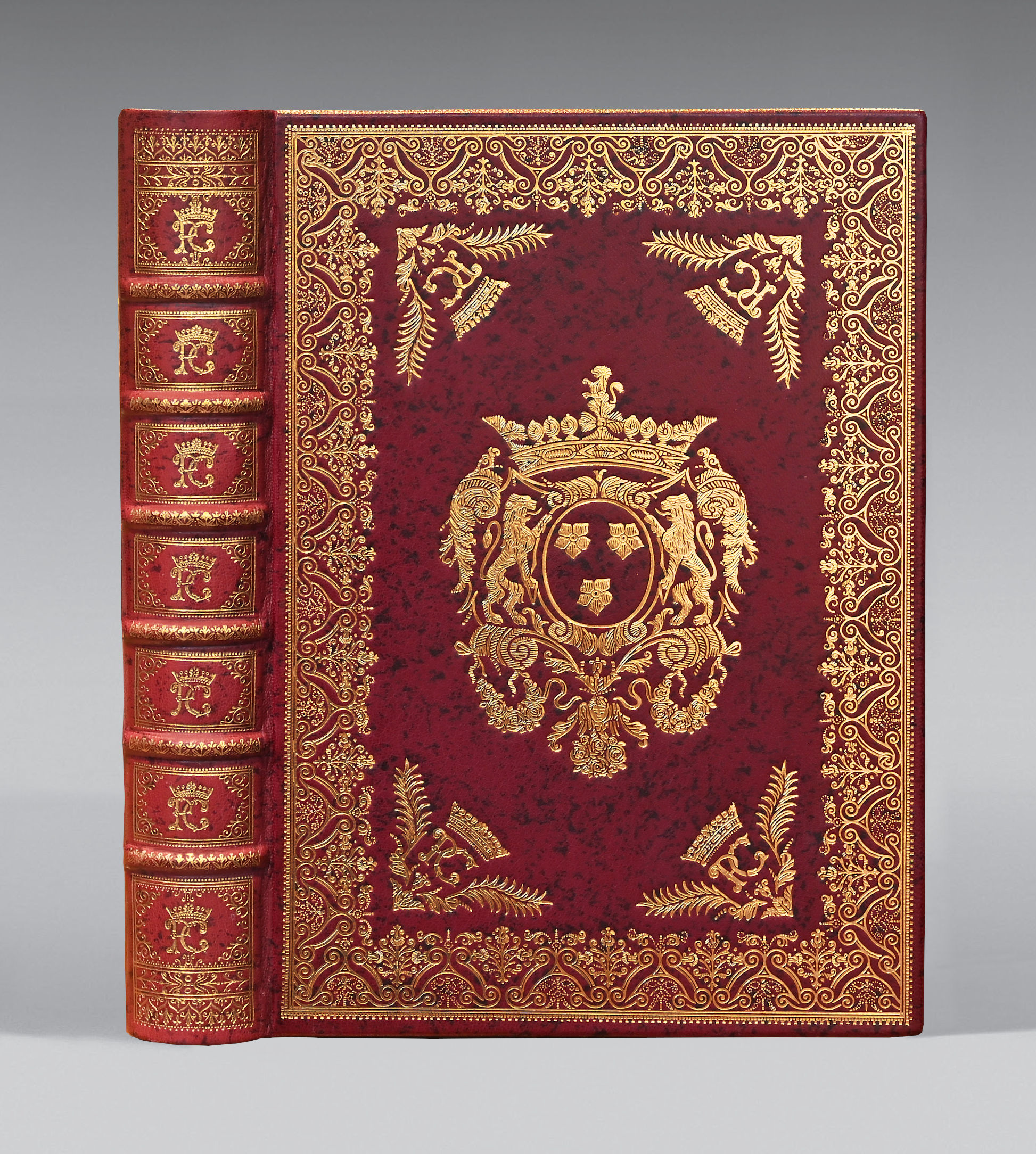
Red calf very richly decorated, wide gilt roll around the covers, crowned monogram at the corners, gilt-stamped arms at the center of the covers, raised-band spine decorated with the same monogram in the compartments, decorated edges, gilt inner roll, gilt edges.
– With a volume of explanatory text bound in half red calf.
Both volumes are protected by an acrylic glass case.
282 x 198 mm.
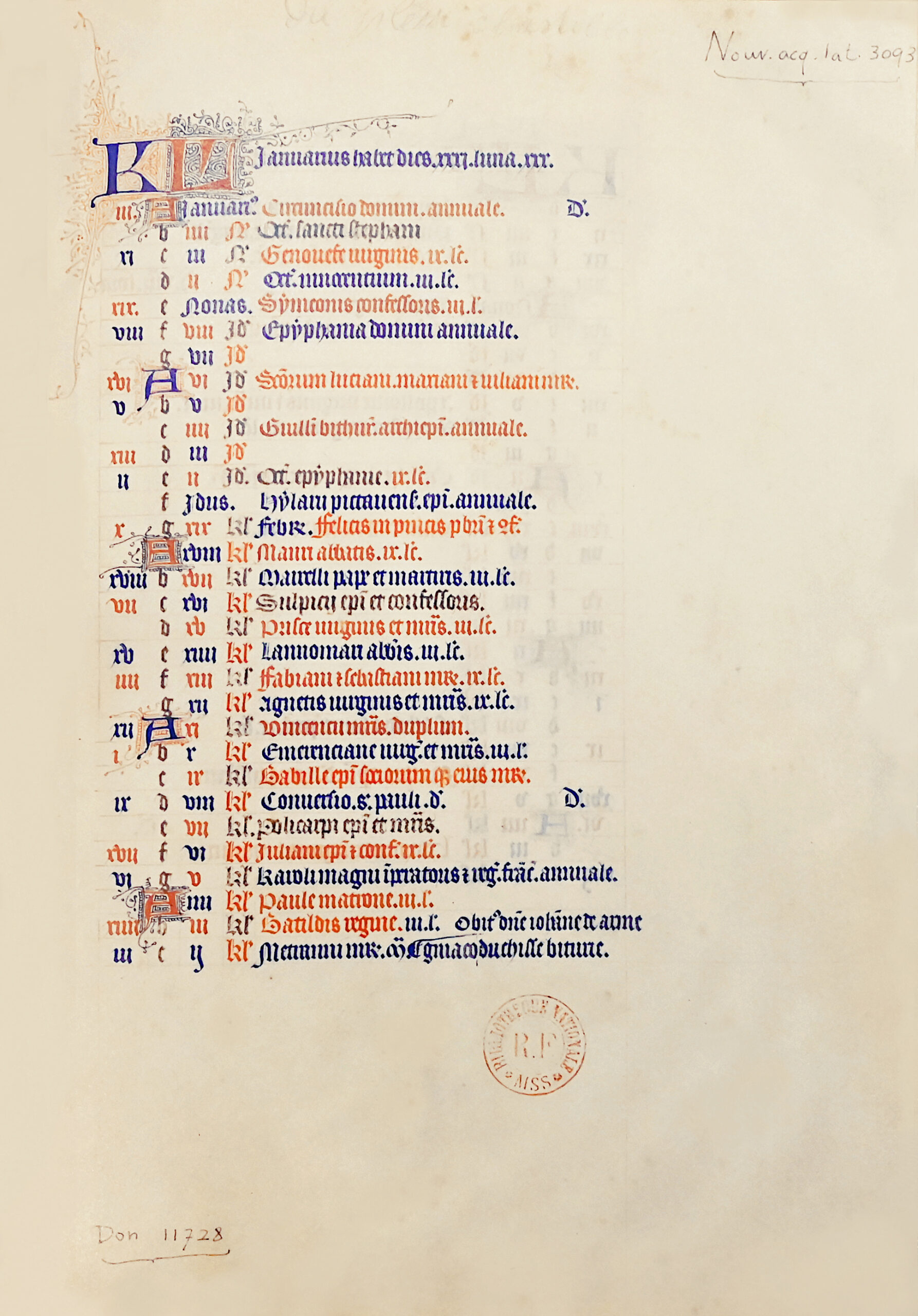
“This facsimile is the identical reproduction of the illuminated manuscript held under reference Nouv. Acq. Lat. 3093 at the Bibliothèque Nationale of Paris.
This work was published in a single edition, limited to 980 copies numbered in Arabic numerals intended for sale throughout the world…
All photolithography and printing work was carried out by the Sticher workshops in Lucerne. The identical reproduction of the gold leaf enhancing the initials and miniatures of the original was produced by the Atelier Graphique Heinz Deuschle in Göppingen.
This volume was hand-sewn on six genuine bands and covered in full burgundy goatskin, gold-stamped, in the workshops of the Reliure d’Art du Centre in Limoges.”
The present copy bears no. 453 from a limited edition of 980 copies.
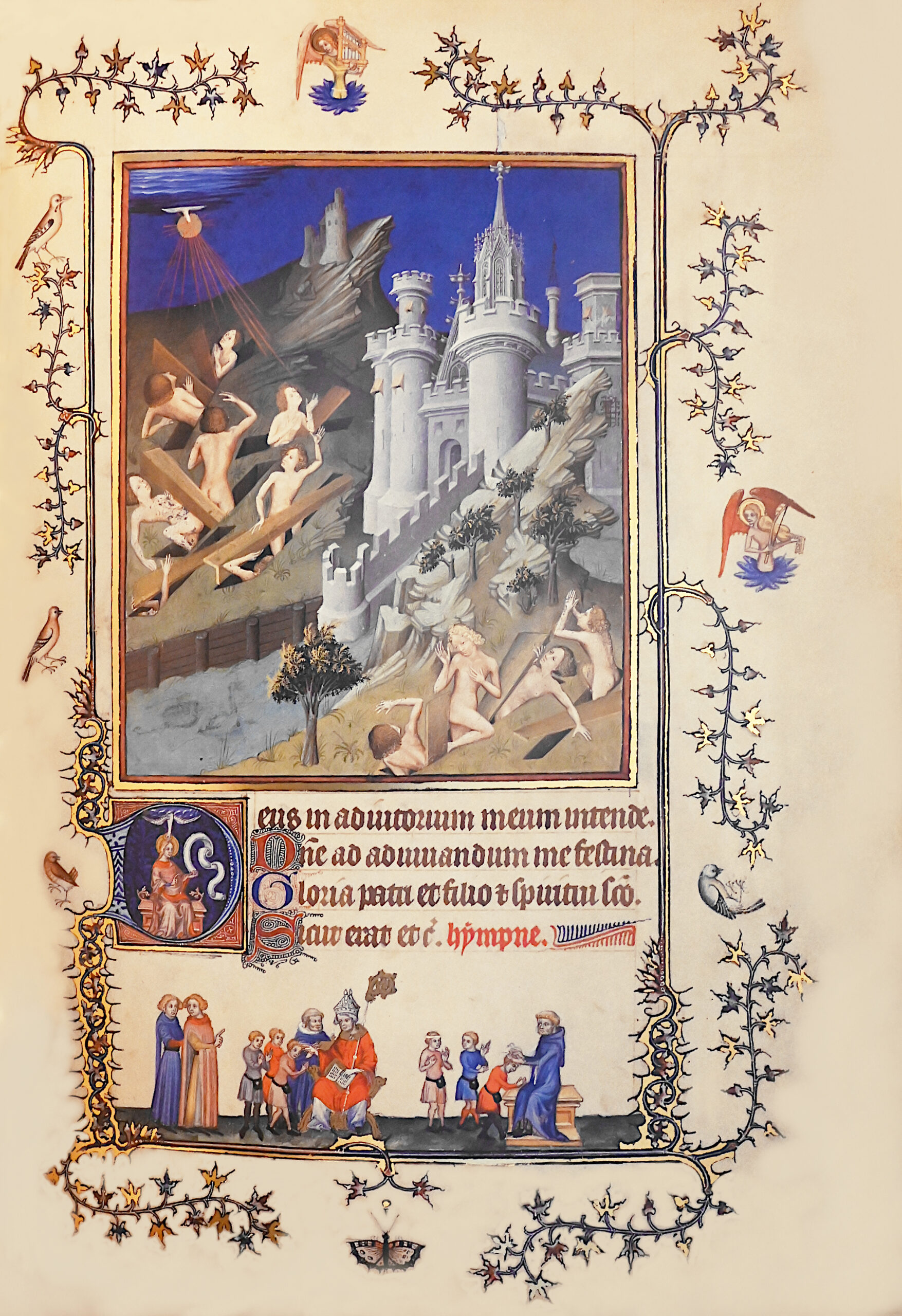
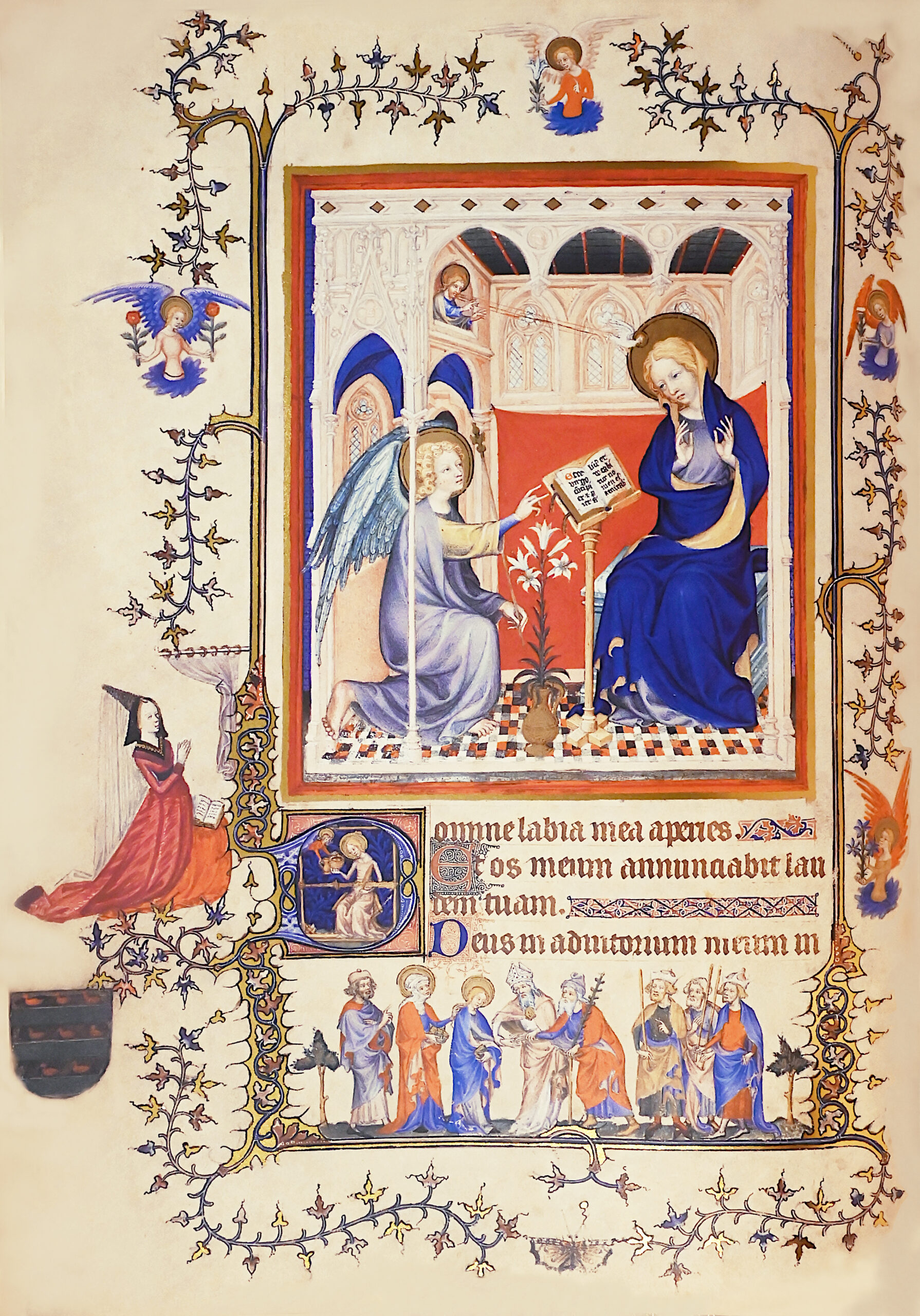
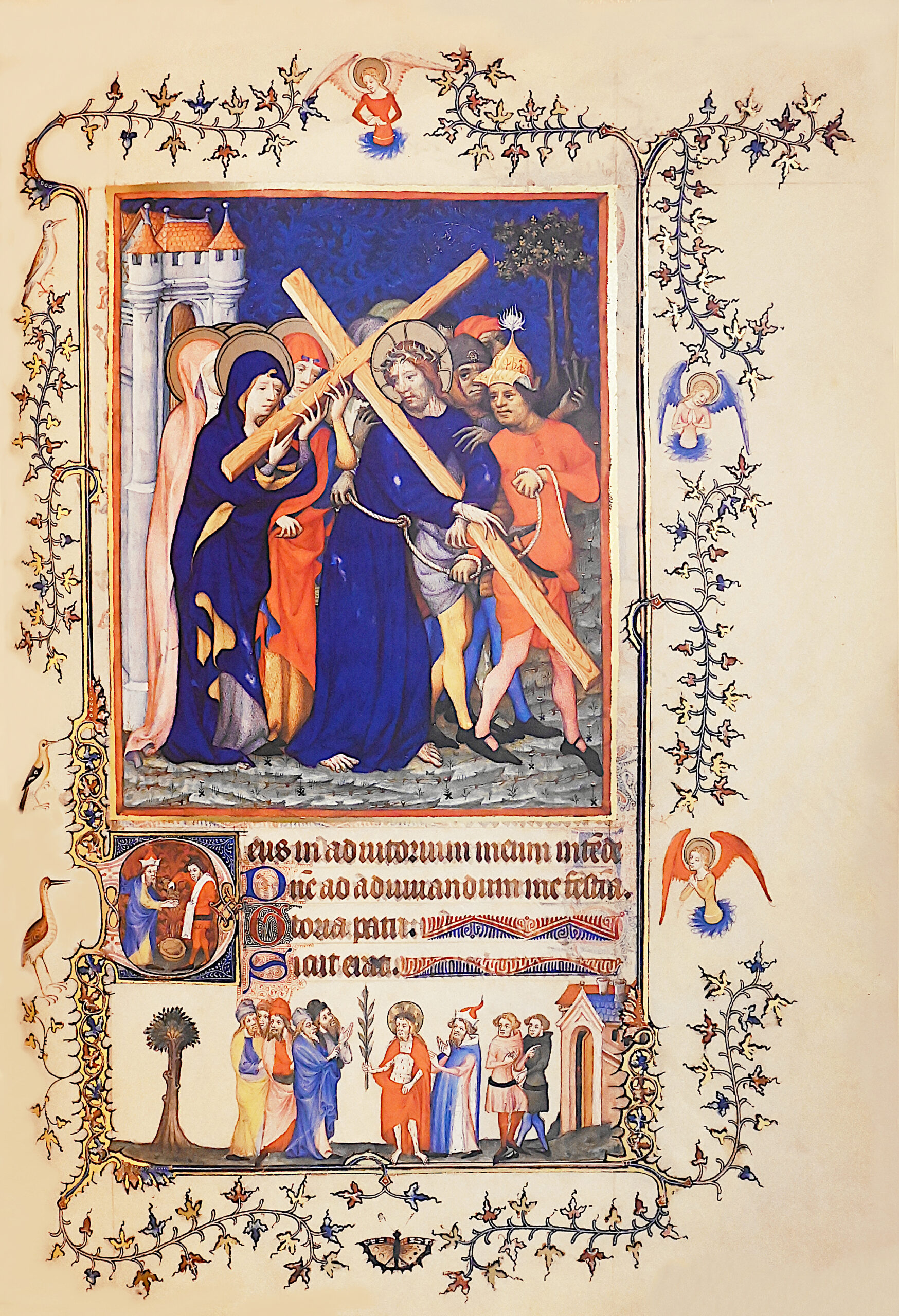
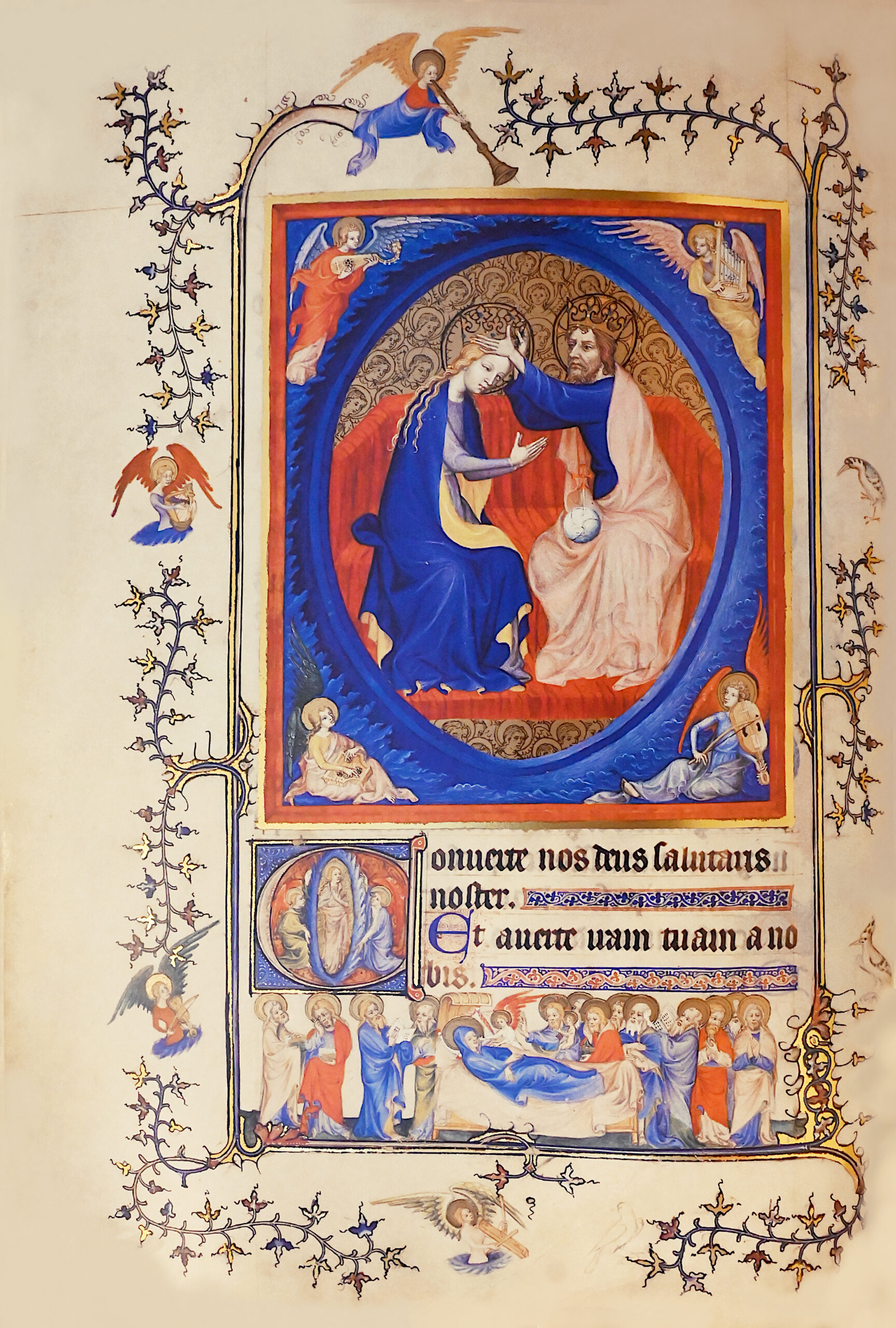
The Illustration Is Composed Of 25 Full-Page Illustrations, Heightened With Gold, As Well As Numerous Decorated Initials.
On each illustrated page, the upper part is occupied by a large miniature, whose frame measures on average 13 to 14 centimeters in height by 10 to 12 centimeters in width. Below the image, the initial that opens the text is historiated—that is, it contains a second subject painted within the letter. Finally, a third composition unfolds at the bottom of the text like a kind of frieze.
The brilliant illuminated manuscript of the Duke of Berry, known as Très Belles Heures, stands as one of the most magnificent Books of Hours, marking a high point in medieval illumination. Created at the beginning of the 15th century by the most gifted artists of the time, this manuscript showcases astonishing effort in both text and image decoration. Lavish gold and colors of unheard-of luminosity are employed to depict scenes narrating the story of late medieval religious and secular life in powerful images. Each of the miniature pages comprises three elements: a large, panel-like miniature; a magnificent initial; and a figurative scene at the bottom edge of the page. Together, these elements create a coherent impression of the highest design quality. In their original form, the Très Belles Heures de Notre-Dame constituted one of the most monumental manuscript concepts in art history. Owing to its beauty and luxurious, elaborate furnishings, the work was already valued as an art and collector’s item in the Middle Ages.
“Jean de France, duc de Berry, brother of King Charles V, born at the château of Vincennes on 30 November 1340, died in Paris in his hôtel de Nesles on 15 June 1416, is rightly counted among the greatest art lovers who lived in France in the Middle Ages…
Beautiful painted manuscripts held a great place among his preferences, and among these manuscripts figured a whole series of Books of Hours. Some of these Books of Hours dated from before the time when they became the property of the duc de Berry. Others, on the contrary, had been produced directly for the duke, being decorated and illustrated by artists whose talent Jean de France directly employed and remunerated…
Among all the Books of Hours belonging to the Duke and made for him, six are noted in the inventories as particularly precious, bearing the laudatory epithets of ‘Très Belles Heures,’ ‘Très grandes moult et riches Heures,’ ‘Belles Heures, très bien et richement historiées,’ the ‘Très riches Heures,’ etc.
The Très belles Heures de Notre-Dame given by duc Jean de Berry to Robinet d’Estampes deserve to be ranked among the most splendid volumes ever undertaken for the duke. The text was transcribed, as the ducal inventory says, “in grosse lettre de forme,” that is, in characters of large size and impeccable regularity. The leaves, of the finest parchment, measured more than 28 centimeters in height and more than 20 centimeters in width, containing a maximum of 20 lines per page—this number of lines being reducible to three or four, and even, in one case, to only two, when the page was illustrated with one of the large miniatures that I will soon discuss…
A general plan had been adopted for the decoration of these painted pages. On each of them, the upper part was reserved for a large miniature, which I will call a “tableau,” whose frame measured on average 13 to 14 centimeters in height by 10 to 12 centimeters in width. Below the tableau, the initial that opened the text was to be historiated—that is, given a second subject painted within the letter. Finally, a third composition was intended to unfold at the bottom of the text like a kind of frieze. Around the pages, a rich ornamentation in gold and colors had been placed in advance, formed of holly-leaf stems, in the style of fine French manuscripts of the late 14th century—an ornamentation that could be enriched if necessary by adding figures in the margins. These figures turned out almost always to be half-length angels, whose attitudes correspond to the subjects of the large tableaux…”
Superb reproduction of one of the most precious illuminated manuscripts of the late middle ages, adorned with hundreds of decorated initials and 25 large miniatures heightened with gold.