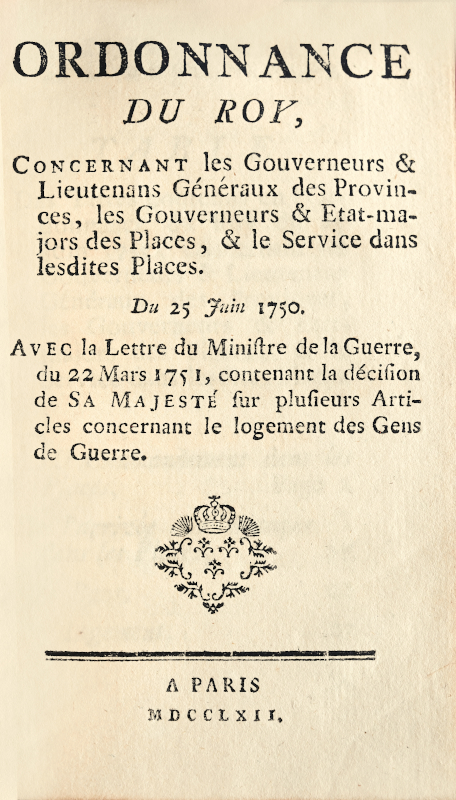
Paris, 1762.
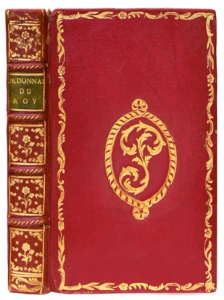
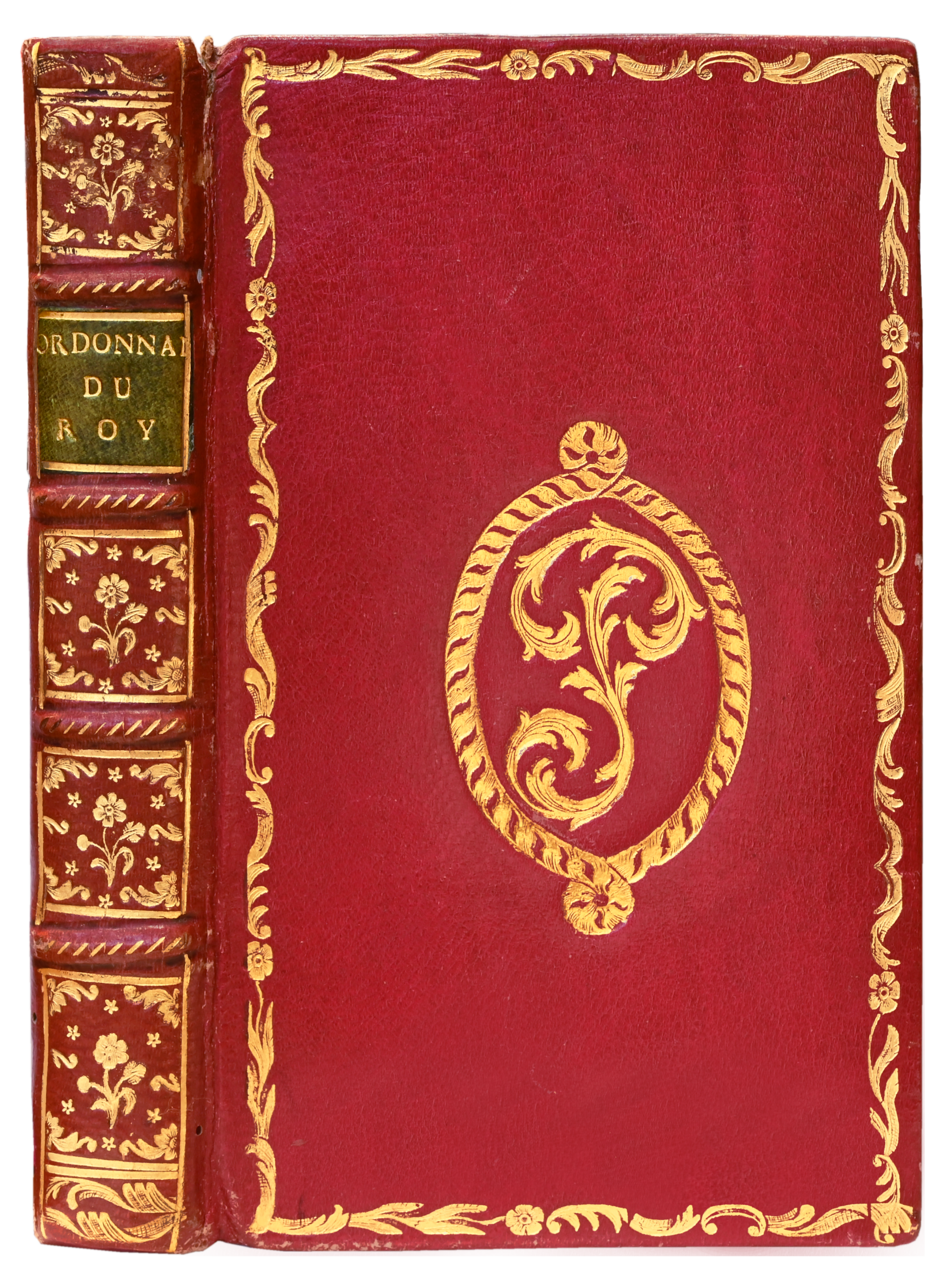
12mo of 4. and 302 pp. Full red chevrette with gilt border around the covers, monogram of Emperor Paul I of Russia stamped in gold in the center, ribbed spine decorated, green and blue morocco lettering-piece, inner gilt border, gilt edges. Contemporary binding.
136 x 82 mm.
The ordinance of King Louis XV concerning the service of the Places.
Superb copy in red chevrette with the monogram of Paul i of Russia (1754- assassinated on March 23, 1801).
Paul I of Russia belonged to the first branch of the House of Oldenburg-Romanov (Holstein-Gottorp-Romanov), which was descended from the first branch of the House of Holstein-Gottorp, itself descended from the first branch of the House of Oldenburg. He is the ancestor of the current head of the Imperial House of Russia, Grand Duke Nicholas Romanovich and Prince Georgi of Russia.
Catherine II, aware of her son’s inability to rule, was preparing her succession in favor of her grandson Alexander, but she died of a heart attack and Paul, suspicious, had all the documents concerning his mother’s succession burned.
Paul was deeply resentful of his mother, her favorites, her advisors and everything she admired. To destroy the work of the Great Catherine and to annihilate her decisions is a constant of his short reign of five years and his policy is the opposite of the latter:
– He changed the law of succession to the throne at his coronation in 1797: male primogeniture replaced the free choice of the reigning monarch as had been provided by Peter the Great in 1722. The succession to the Russian throne was determined by a fixed and precise rule that would prevail until the fall of the monarchy in 1917.
– He released from prison writers and intellectuals exiled by his mother and allowed their return to Russia. Radishchev was allowed to return from his Siberian exile, but kept under house arrest, and Nikolai Novikov was released from Schlüsselburg prison, while being kept under house arrest, as well as leaders of the Polish revolt of 1795, including Tadeusz Kosciuszko.
– He showed concern for defending the autocracy, but intended to leave little freedom to the nobility. It was in this sense that 2,000 acts were issued, for example, re-establishing corporal punishment for nobles and recalling them to active service in the army. At the same time, he relied more and more on the bureaucracy for local and general administrative tasks in preference to the nobility. At the same time, he took some measures to soften the lot of the serfs: drudgery was limited to three days a week and prohibited on Sundays and holidays. Peasants could no longer be sold at auction. These laws were not enforced and perhaps they could not be enforced, but they were a turning point in the attitude of the Russian government towards serfdom: from now on, the limitation and, eventually, the abolition of serfdom were going to become solutions considered by the state.
The copy bears the stamp of the personal library of the emperor Tsarkoe Selo.