(1528).
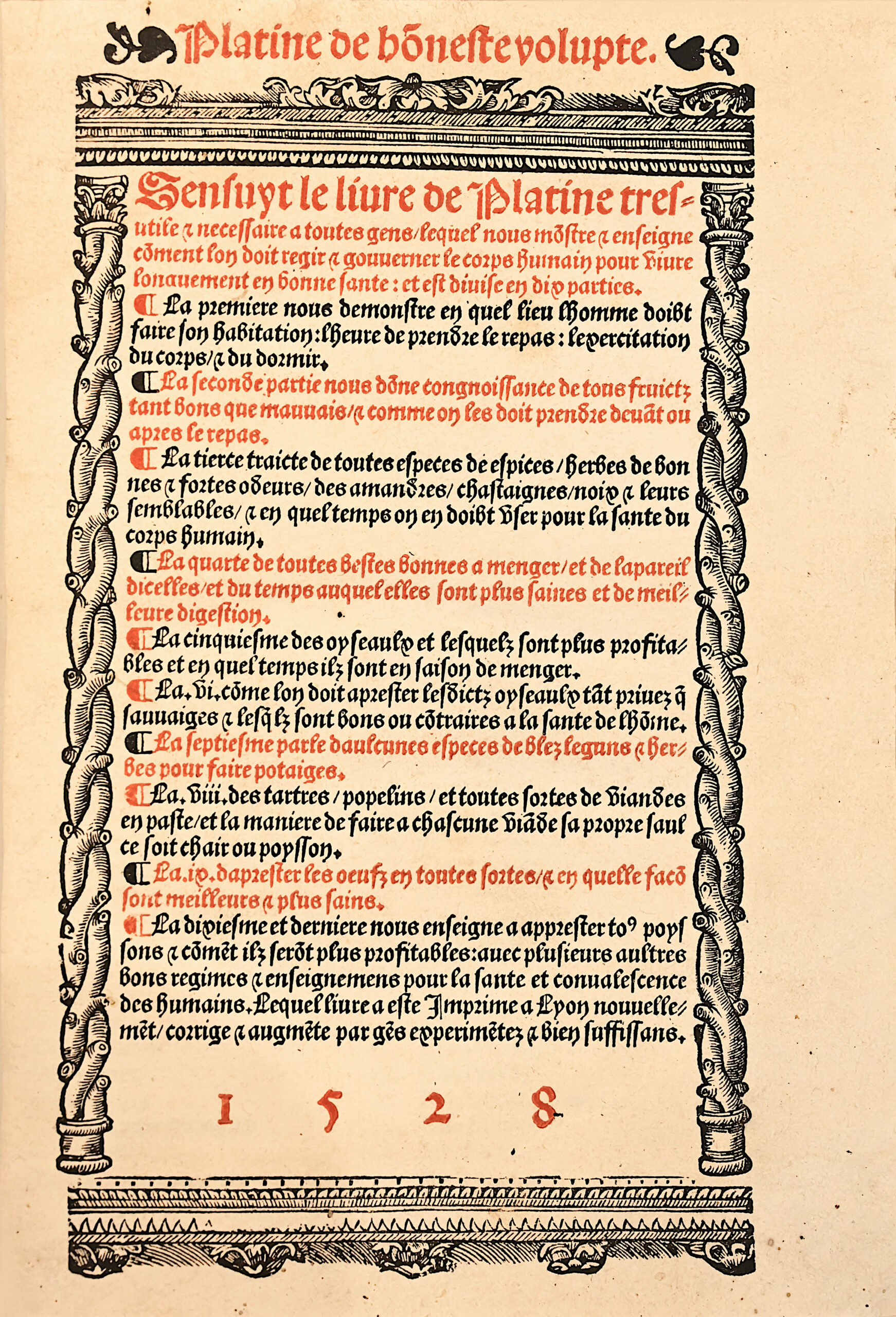
(4) ll: title page printed in red and black within a frame, table, cxi ll., (1) l. with the mark of Antoine du Ry; printed in Gothic type on two columns, numerous decorated initials with vegetal or historiated motifs.
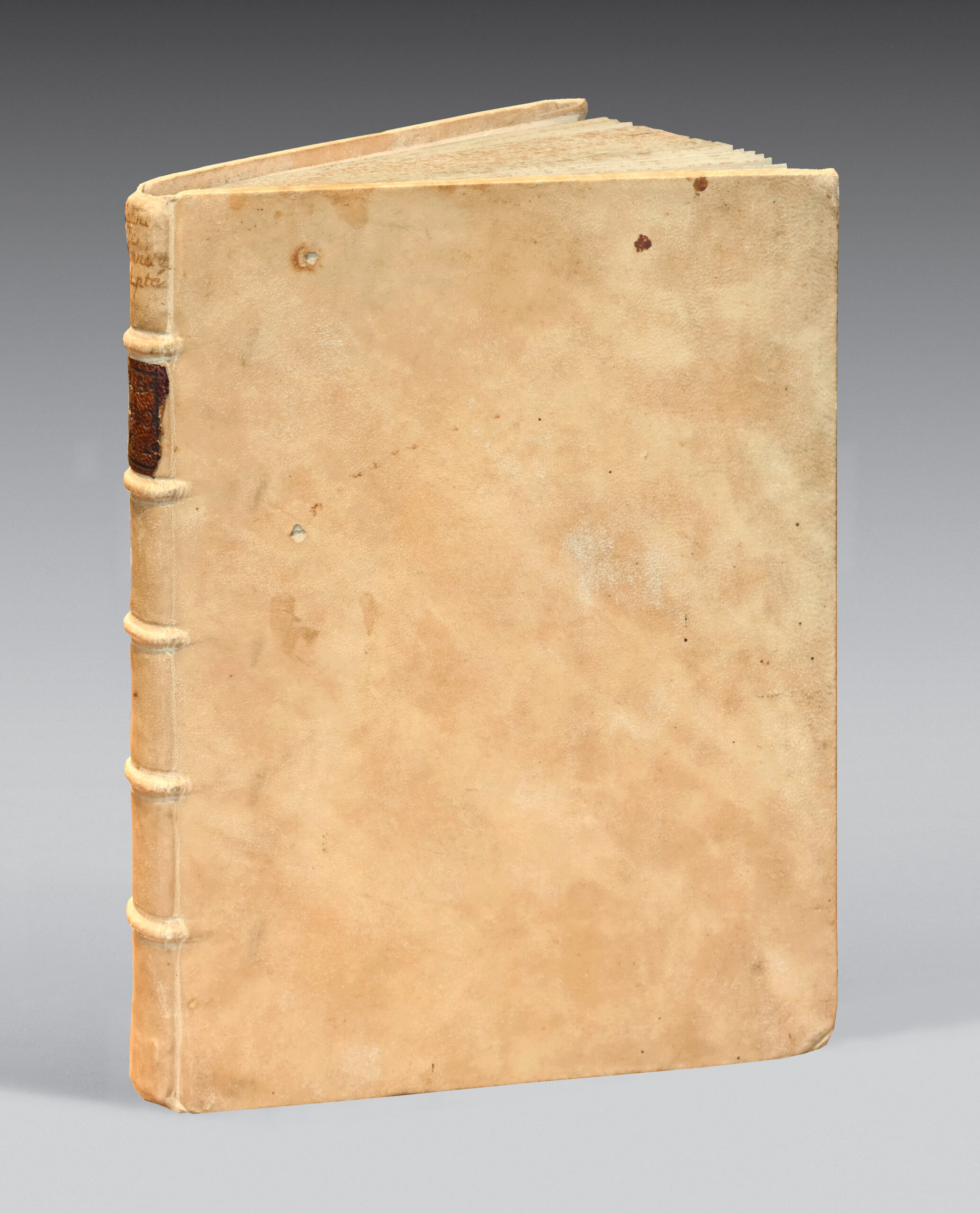
Ivory pigskin over wooden boards, spine with raised bands, brown morocco title label, mottled edges. Old binding.
238 x 167 mm.
Superb copy of the rarest edition of Platina printed in the 16th century.
“Edition that we have not seen” notes Vicaire (col. 694).
The copy cited and described from the Arsenal Library in Toulouse is missing the remarkable title page in red and black.
“We owe to Platina (1421-1481) the most important culinary treatise of the 15th century.” (G. Oberlé).
Platina’s book will achieve international distribution and be translated into several languages. Thanks to this, it will renew European cuisine by Italianizing it. The primary concern that should guide, according to him, the cooks is to distribute joy, health, and well-being. He claims to follow Epicurus, Columella, and Apicius.
In the 15th century, while the success of certain medieval culinary manuscripts is undeniable, it is with the invention of printing that recipes are disseminated more widely in Italy, Germany, and France. The first cookbook to benefit from this technology is De honesta voluptate et valetudine by Platina of Cremona, known as “Il Platina,” pseudonym of Bartolomeo Sacchi (1421-1481).”
Written in Latin and printed in Rome in 1473, this very original gastronomic treatise mixes literary reminiscences of antiquity, cooking recipes, and medieval medicine. More than a cookbook, De honesta voluptate et valetudine will serve as a “manual for good living” in humanist Europe of the 16th century.
Platina was born in Piàdena, Cremona, Italy, in 1421. After a brief military career and studies in letters, he moved to Florence, where he became a tutor for the Medici family and associated with the city’s humanists. In 1461, he settled in Rome, where he served as secretary to Cardinal Francesco Gonzaga and then as abbreviator for Popes Pius II and Paul II. In 1475, he was appointed head of the newly established Vatican Library. He then wrote the Liber de vita Christi ac pontificum omnium et Historia urbis Mantuae. However, his major work is De honesta voluptate et valetudine, written before 1467 and entrusted for printing in 1473 to Ulrich Han (1425-147.), one of Rome’s first printers. Published anonymously, the work likely met with some success since a new edition appeared in 1475 in Venice (by Laurentius de Aquila & Sibyllinus Umber), this time with the author’s name. Around twenty editions followed until the mid-16th century in Venice, Bologna, Cologne, Basel, and Strasbourg.
In France, however, the work saw its widest diffusion thanks to the translation by Didier Christol (14..-15..), prior of Saint-Maurice near Montpellier, who added numerous comments to the text. The first French edition of 1505 was printed in Lyon. A second Lyon edition, this one the rarest of all, appeared on June 4, 1528.
The title of the work announces the themes addressed: the pleasure of the table (voluptate) and good health (valetudine), without falling into excesses (honesta).
In his prologue, Platina specifies: “I write for any citizen who seeks good health, moderation, and elegance in food rather than debauchery, and I believe I have shown posterity that the people of our time had enough talent to at least imitate, if not delight, our ancestors.”
The first part of the work lists the main foods and the best way to prepare them. The second part contains almost 200 recipes of dishes classified according to their medicinal virtues. Platina is inspired by the texts of Greek and Latin naturalists and doctors, such as Cato, Virgil, Pliny, or Dioscorides. Based on the teachings of Galen and the theory of humors, it is also part of the Hippocratic dietetic tradition, according to which digestion is a cooking process responsible for transforming the properties of foods, classified into four types (cold, hot, moist, and dry), which will impact the four humors and four human temperaments. Since internal diseases are due to an excess of one humor in the body, it is enough to remove it or make it disappear through an appropriate diet. Thus, patients suffering from fever will be given particularly cold foods, such as cucurbits or salads, which are not recommended in ordinary times.
De honesta voluptate skillfully combines theory (by analyzing the qualities of each food) and practice in the form of cooking recipes. Cold foods can be warmed by spices and condiments, whose strength is in turn tempered by milder seasonings. A naturally moist and cold waterfowl, like the water it lives in, will be dried if roasted and accompanied by warm and dry spices.
The De l’honneste volupté is organized in ten parts.
Pouletz au verjust : les pouletz cuyras avec quelque chair sallee, et quant seront demy-cuytz, mettras dedans ton pot des raysins passis levés les grains […] Après, decouperas menuement du persil et de la mente, et pilleras du poyvre et redigeras du saffran en pouldre. Et quant lesdits pouletz seront cuytz, tu mettras tout et infondiras dedans ledit pot […] Cette viande […] pource quest saine grandement et salutaire au corps, nourrist grandement, est de facile concoction, et convient sur tout à l’estomach, au cueur, foye et aux reins et : et aussi réprimist la colere.
De la chair sallee ou jambon de porceau : la chair sallee du porceau, entrelardée du gras et du maigre, couperas a belles lesches ou pièces deliee, puis les friras à la poille, non mye grandement ; et cuytes et que soient mises sur ung plat, inspargiras par dessus icelles du vin aigre / sucre / cynamone et persil découpe bien menu.
Tartre de cerises ou griotes : les cerises aigres qui sont dictes griotes exossees pilleras au mortier, pillees que soient y adjousteras des roses rouges bien pillees, ung peu de fromaige frais et du vieulx pillez ou gratusez, ung peu de poyvre, aussi peu de gingembre, aulcunement plus de sucre, quattre oeufz bien batus. Et tout mesle ensemble feras cuyre en la poille bien oincte et subscrostee a petit feu, et yssue du feu la surfondras du sucre et eaue rose.
And more originally, the bear, which Platine specifies, however, that it is preferable not to eat the head because it has “ le cerveau envenimé”… Its meat is moreover difficult to digest. Bears “nuysent à la rate & au foye, engendrent mauvaises humeurs… cest une viande fastideuse & visqueuse sur toutes autres chairs…& donnent petit nourrissement”.
Platina’s Lyon editions in the 16th century:
Since 1472 and the creation of the first workshop by a merchant Barthélémy Buyer (1433-1485), Lyon has continually welcomed new printers. Ranked as the third printing city in Europe behind Venice and Paris, it attracts literary figures and becomes a hub of humanism. In 30 years, around fifty printers came to compete with Barthélémy Buyer; most of them were German, a few came from Venice, but few were from Lyon.
While most works were written in Latin and intended for learned individuals, about fifteen Lyon printers printed the great classics of medieval culinary literature in the vernacular. There are nine editions of the Viandier de Taillevent printed between 1534 and 1615, five editions of La fleur de toute cuysine between 1567 and 1604, two editions of the Livre de cuysine tres utile et proufitable by Olivier Arnoullet in 1542 and 1555, one of Pratique de faire toutes confitures by Benoist Rigaud in 1588, De re cibaria (“On Foods”) by Sebastien Honoratum in 1560, and the Thresor de santé by Antoine Huguetan in 1607.
For Platina’s work, there are 5 Lyon editions printed between 1505 and 1571.
The first vernacular edition of Platina’s work, dated 1505, was published under the title Platine en francoys tresutile & necessaire pour le corps humain qui traicte de hôneste volupte et de toutes viandes et choses que lôme mange…
The work presented here is the second Lyon edition, the rarest of all. Released from the presses of Antoine du Ry (14..-15..) in 1528, it is titled Platine De honeste volupte. The title page in red and black is adorned with a wood-engraved frame. The characters are Gothic (French bastard). The colophon reads: “ imprime nouvellement a Lyon par Antoine du Ry, lan mil cinq cens vingt et huit, le IIII jour de juing “.
In its early days, printing was a continuation of the manuscript. These two editions of Platina’s work are characterized by the presence of large woodcut initials, resembling those of miniaturists.
The typographic characters used for these two editions belong to the Gothic family and the group of bastards. During the Renaissance, the French bastard was mainly used for works in the vernacular. It is derived from Gothic cursives and is characterized by f and s extending below the line, clearly seen in these two editions of 1505 and 1528.
Characteristics of the 1528 edition:
The rarest and most expensive of Yemeniz’s editions of Platina: his editions of 1480 and 1485 were sold for 160 gold francs and 23 gold francs (nos. 884 and 883), this one, also bound by Trautz-Bauzonnet, was sold for 165 gold francs (no. 886), while “Le Grant Testament de Maistre François Villon” printed by Guillaume Nyverd (circa 1518-1520) was sold for 80 gold francs (no. 1625). This volume was sold for €432,818 on June 2, 2023.
The most beautiful copy in ancient binding recorded for a century.