Venise, Bartolomeo Zanetti, 1537.
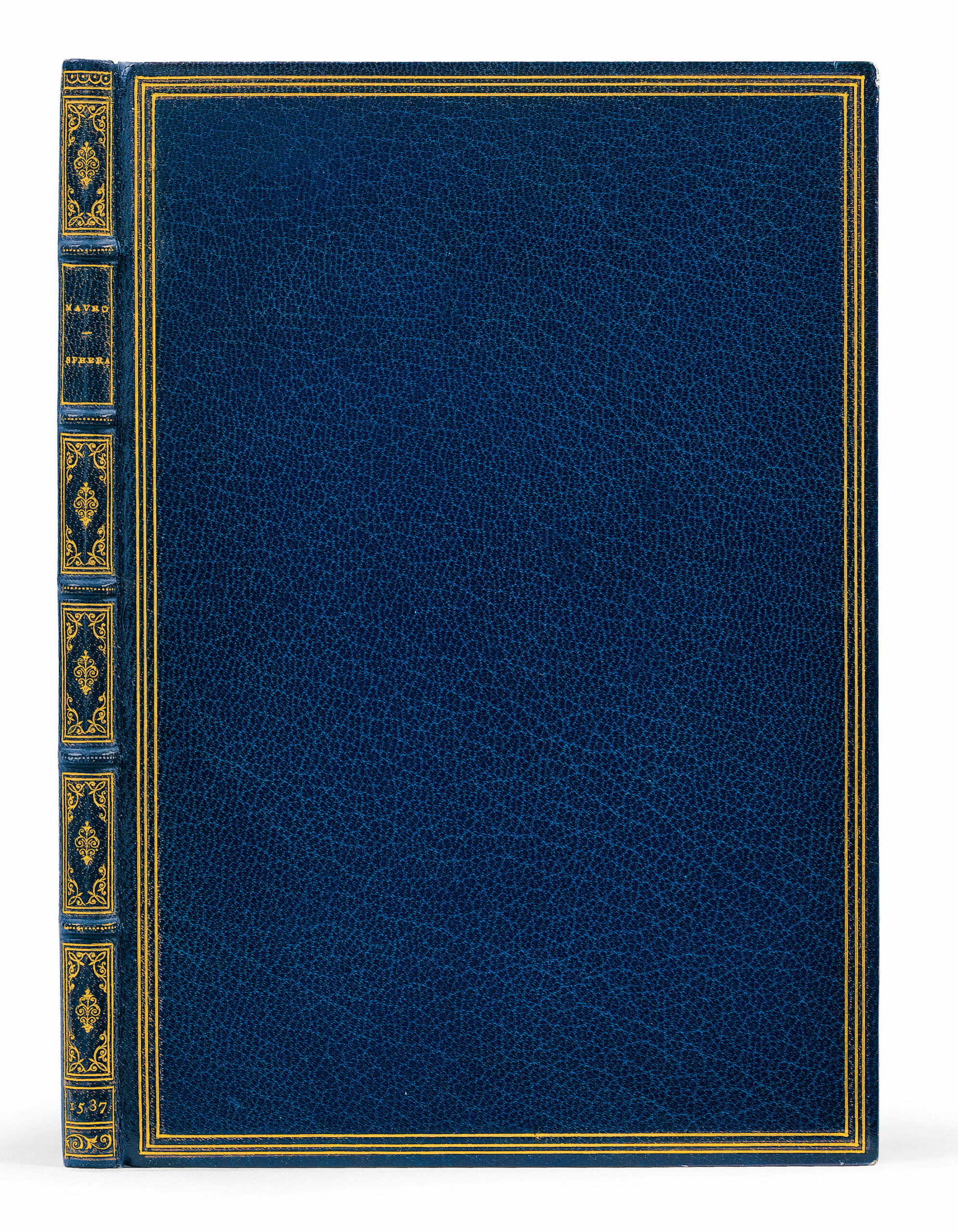
4to of (58) ll. Well complete with the rare errata leaf and a small engraved element printed on the conjugated leaf probably intended to be used as a volvelle on the compass shown on leaf N1verso and which, according to Mortimer, are missing from the Folger Library and British Library copies. Blue morocco, triple gilt fillet around the covers, finely decorated ribbed spine, inner gilt border, gilt over marbled edges. 19th century binding.
198 x 138 mm.
First edition of the Italian translation of Sacrobosco’s famous Treatise on the sphere.
Riccardi, II, 137; Mortimer, Italian, 452; Sabin, 32677; Sander, 4441; Adams H-738; Harrisse, 219; Church, 75.
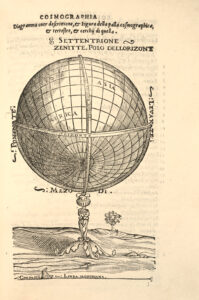
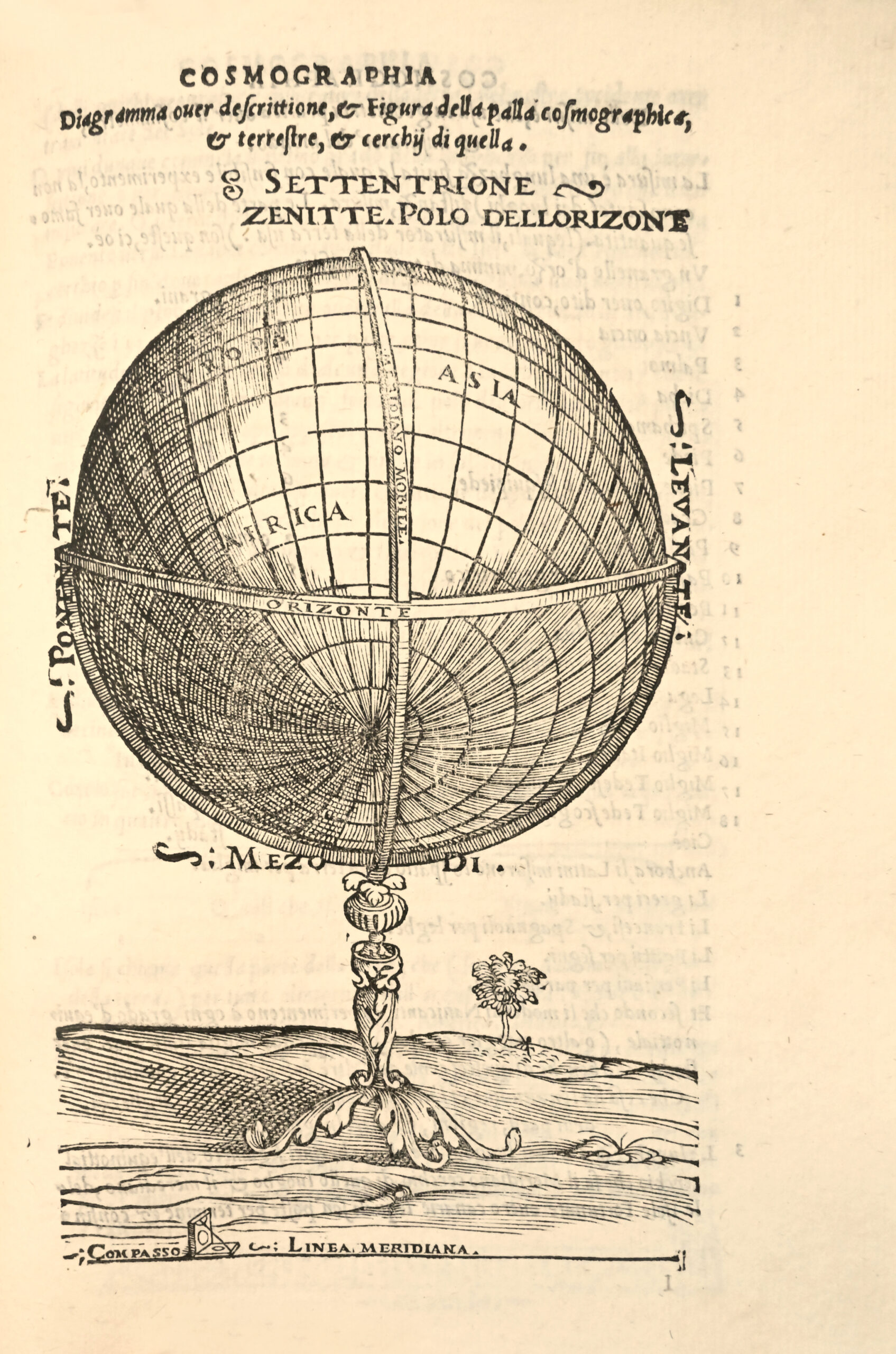
“The ‘De Sphera’ of Sacro-Bosco became to the mathematicians and geographers of the century following the re-discovery by Columbus, an inexhaustible source of commentaries, some of which certainly contain references to the oceanic discoveries, attributed, especially by the Italian commentators to Vespuccius. The above contains only a woodcut of a globe with America” (Sabin).
This is one of the finest illustrated editions of this work.
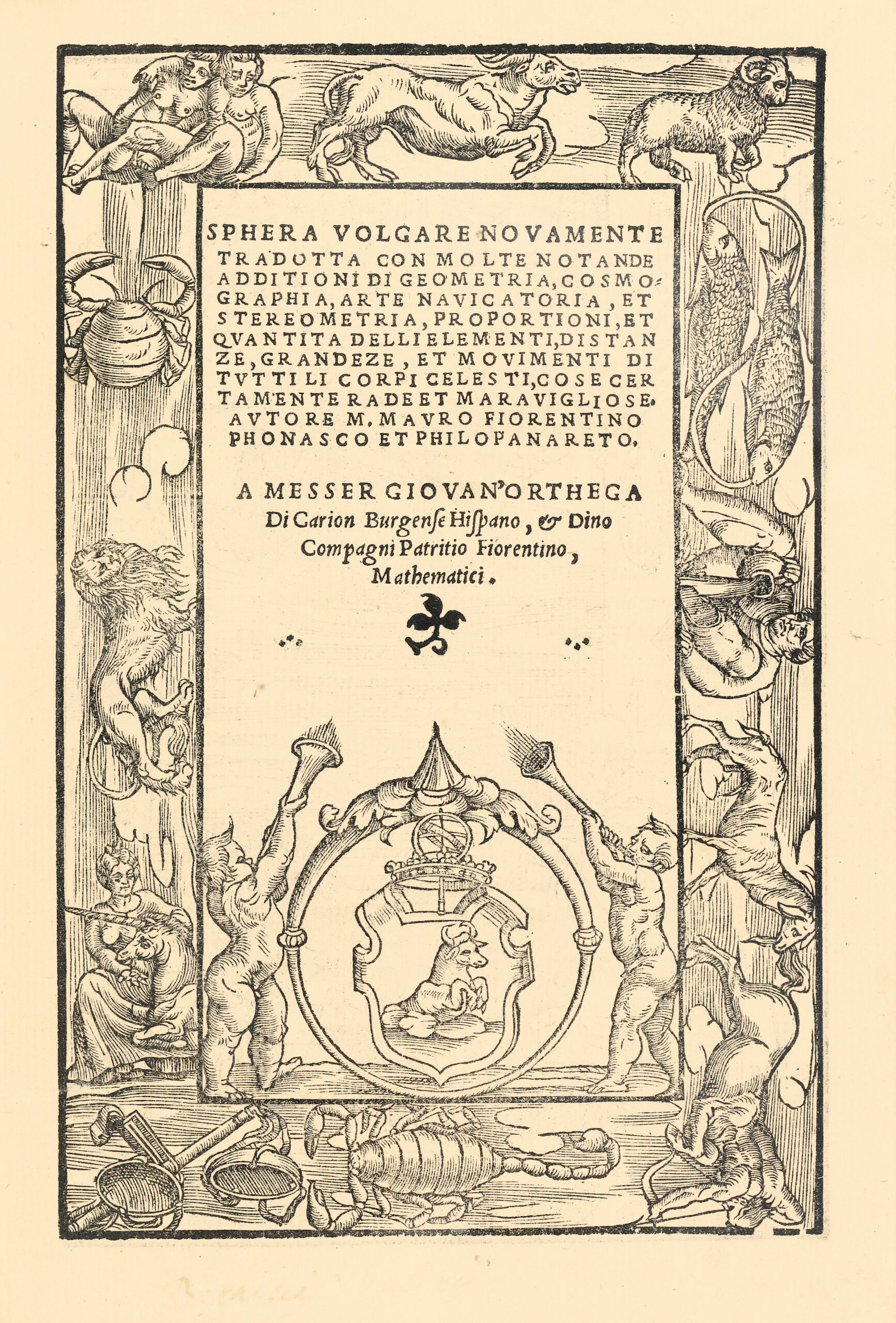
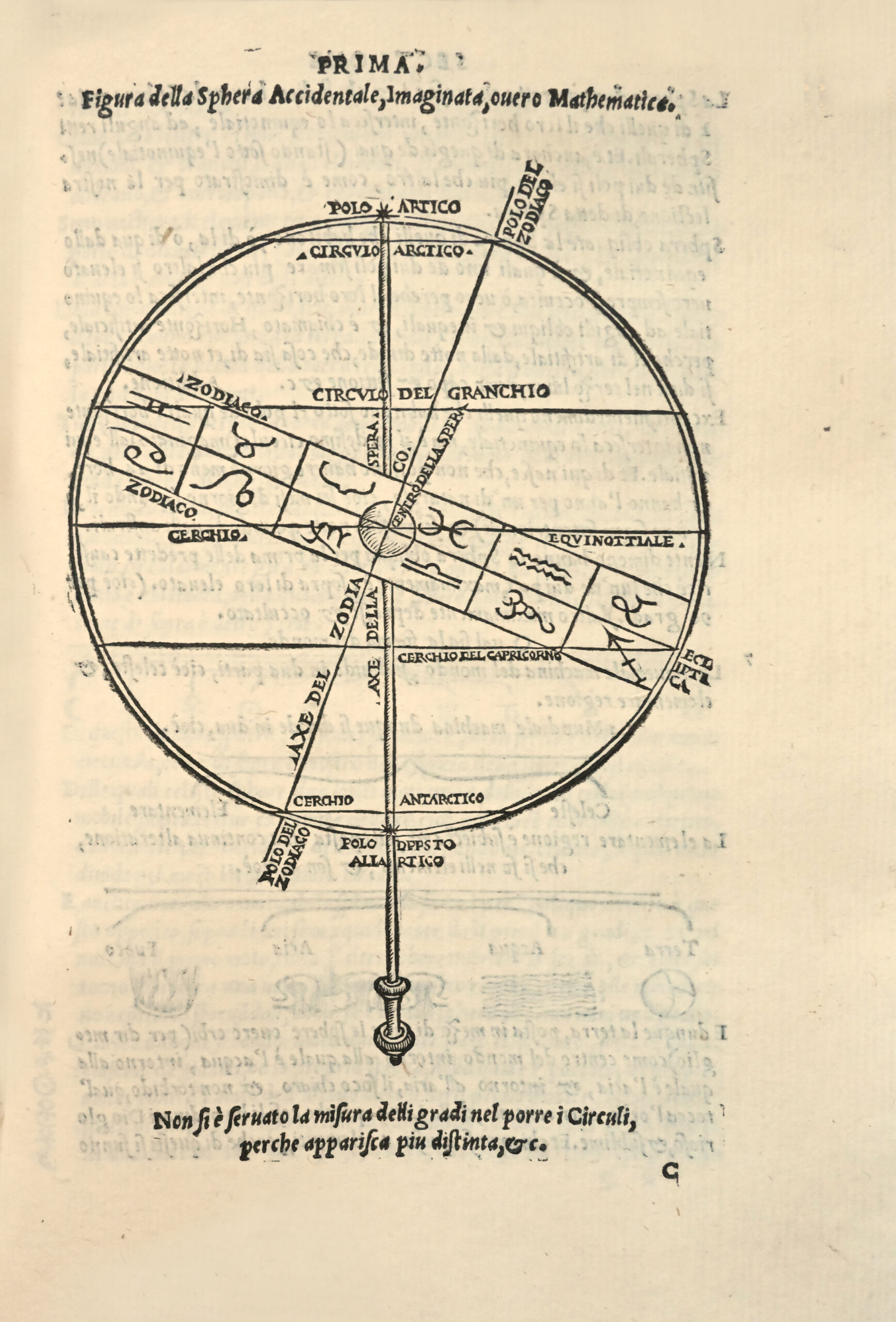
It is illustrated with a beautiful engraved title with the signs of the zodiac, numerous full-page engraved figures and nearly 90 wood engraved astronomical and geometrical diagrams, all of which appearing here for the first time.
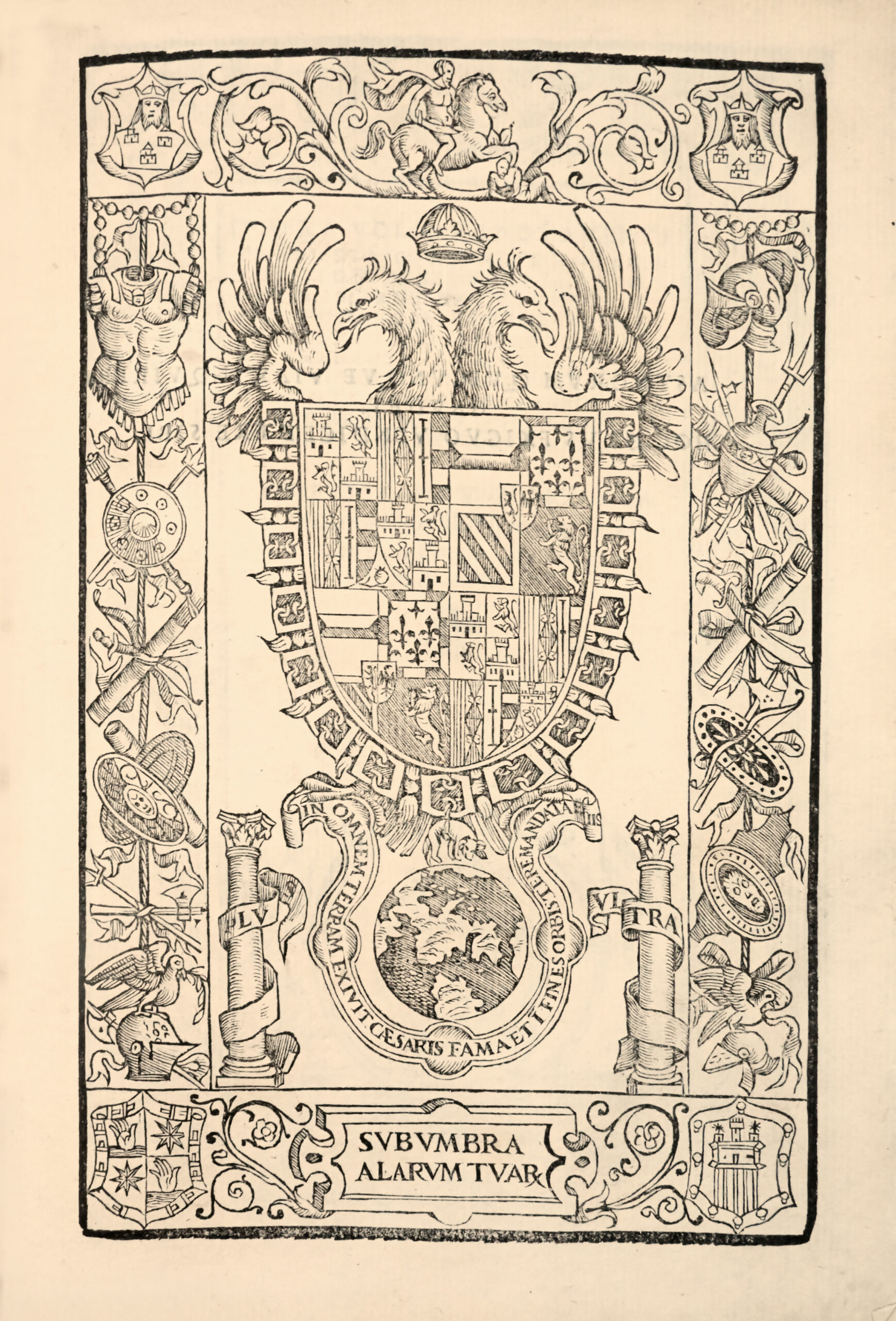
It contains one of the first maps of South America. The frontispiece is decorated with the arms of Charles V.
“Two of the figures represent a globe, on which is marked America” (Graesse, Trésor de livres rares, 211).
“Rarissimo ed assai apprezzato” (Riccardi).
A copy well complete with the errata leaf and the small engraved element printed on the leaf probably intended to be used as a volvelle on the compass shown on folio N4 and which, according to Mortimer, are missing from the Folger Library and British Library copies.
Sacrobosco’s Sphaera (editio princeps 1472) was the first printed astronomical book, and a fundamental text of medieval and post-medieval astronomy. It is a synthesis of Ptolemy and his Arabic commentators, presenting an elegant, accessible cosmology, and for this reason was adopted as the most authoritative astronomical textbook of its time.
Fra. Mauro (1493-1556), mathematician, philosopher, theologian and musician, contributed considerably to the present edition; he supplied whole new sections on cosmography, navigation, solutions for tracking celestial figures, inventions and surveying.
Of particular note are the attractive woodcut preliminaries created for this specific edition.
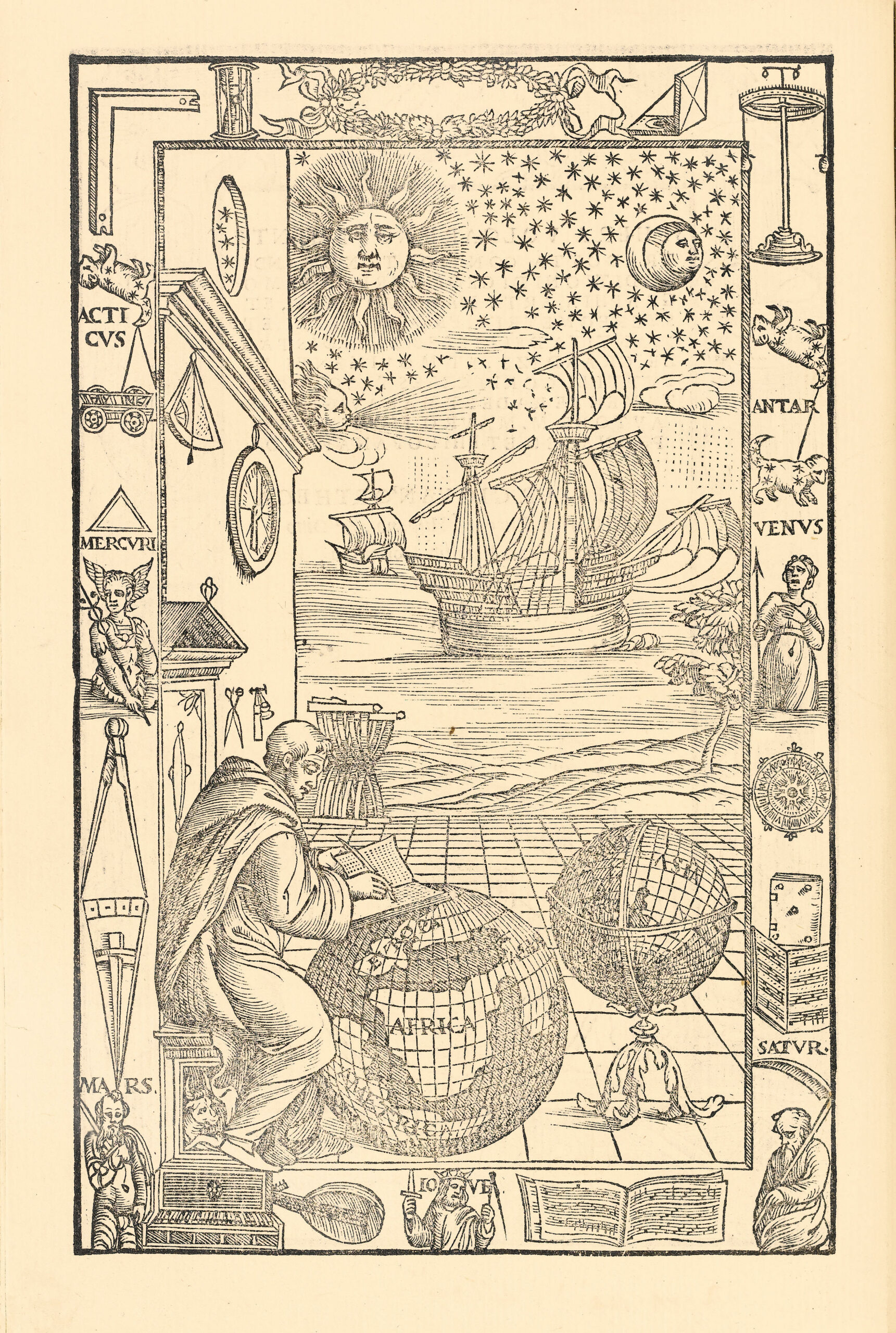
The title page is presented within a border containing signs of the zodiac, with Mauro’s device of a bull on a shield at the bottom. On the verso of the title is a woodcut showing ships sailing under the sun, moon and stars surrounded by a border of constellations, astronomical and mathematical instruments, and musical books. Fra. Mauro is depicted at lower left in the act of writing, using a globe naming America as a writing surface.
The translation is the work of a Florentine Benedictine, Marco Mauro (1494-1556), who dedicated it to Dino Compagni and to the famous Spanish mathematician Juan Ortega de Carion, who commissioned the edition and whose coat of arms appear in O4v.
The work includes an Epitome of the Treatises of Ptolemy, Alfragan and Albateginus. Mauro added his own observations and described an instrument that made it possible to locate figures in the sky without calculations and a marine compass shown in the border of his portrait.
Sacrobosco’s Sphera mundi is followed by a treatise on cosmography, the art of navigation and a treatise on altimetry. America is twice referred to as an island.
The first depiction of the marine compass can be found in the engraving showing the translator at his work table on the verso of the title. The world map also shows one of the first maps of South America, here called Ametrica.
“This rare volume, quoted in M. Harrisse’s Bibl. Americana vetus, was priced by M. Tross at 80 fr. in 1872” (Brunet).
A precious copy of this rare treatise, complete with the two leaves missing from almost all the recorded copies, finely bound in 19th century blue morocco.