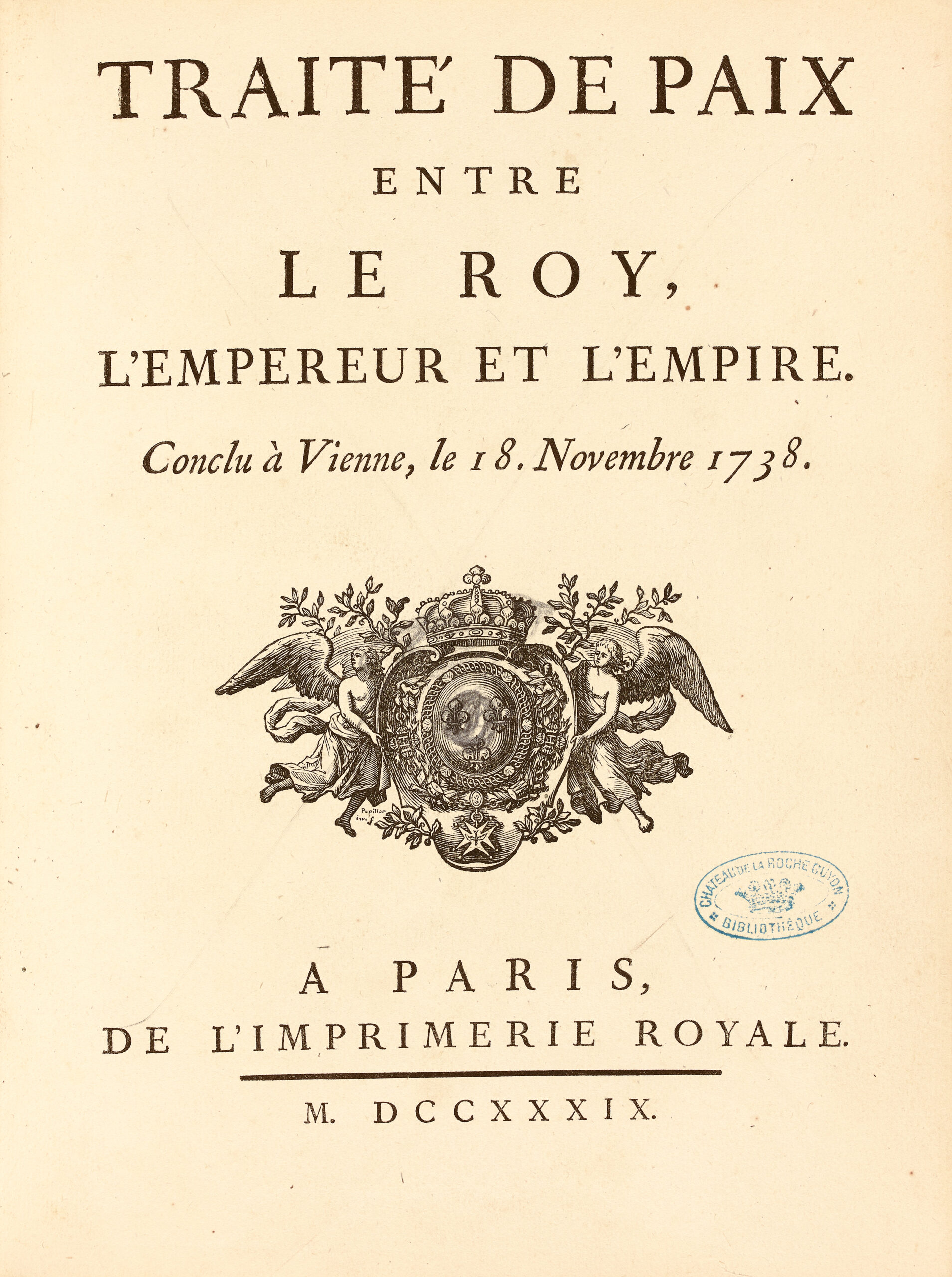
A Paris, de l’Imprimerie Royale, 1739.
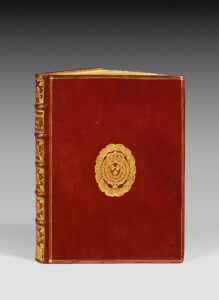
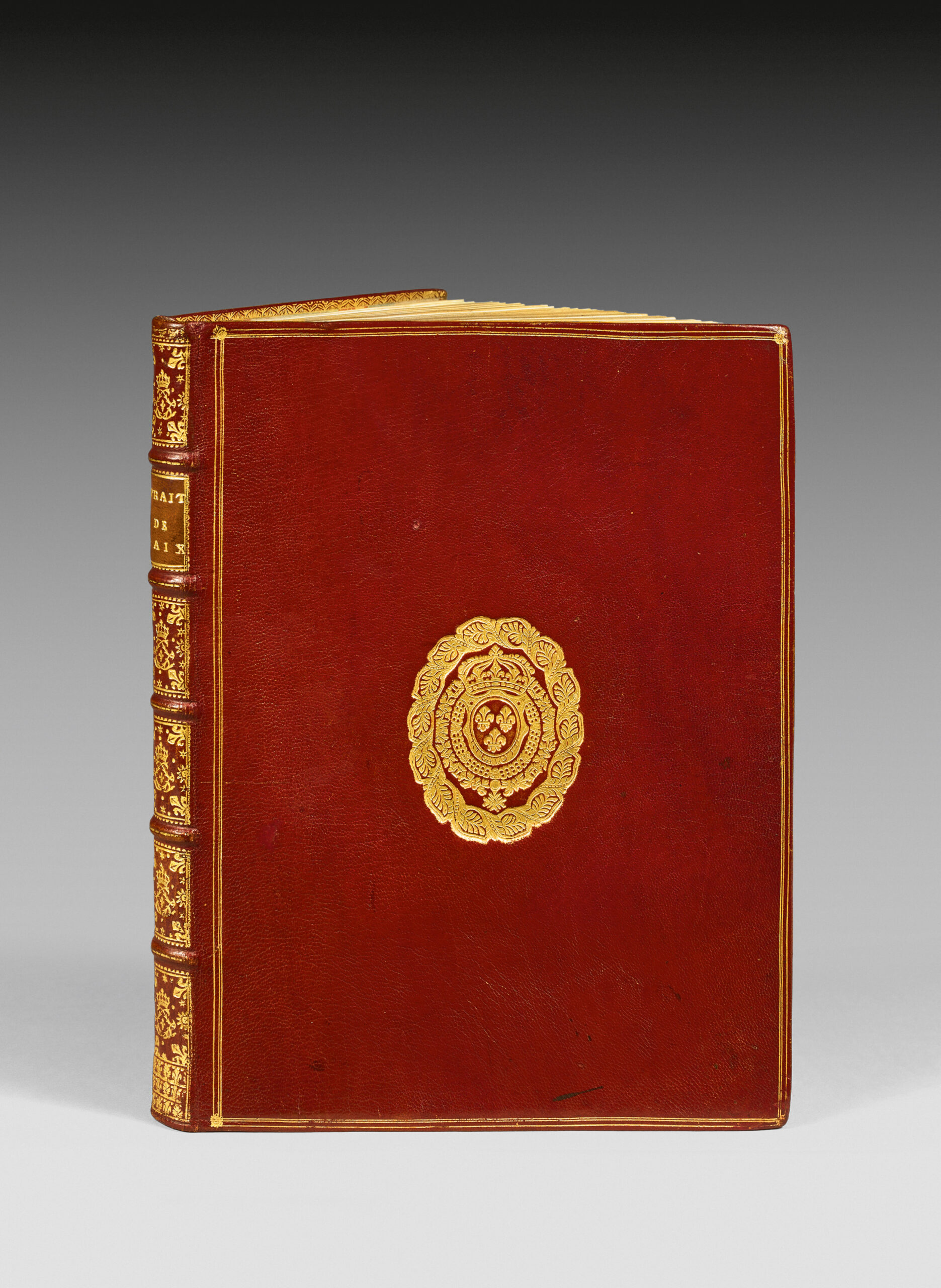
4to of (1) l., 150 pp. Full red morocco, triple gilt fillet framing the covers, large arms of King Louis XV at the center, spine with raised bands decorated with the crowned royal cipher, fleurs-de-lys and radiant suns, gilt fillet on the edges, inner roll, gilt edges. Contemporary royal morocco binding.
252 x 190 mm.
First edition, very rare.
Copy of King Louis XV, printed on large Holland paper, of the famous Treaty of Vienna of 1738.
The Treaty of Vienna of 1738, signed on November 18, 1738 between Austria and France, put an end between these two countries to the War of the Polish Succession. It included several dynastic provisions that altered the political map of Europe and ensured a new balance between the two powers.
Preliminary articles of peace had already been signed at Vienna in November 1735, three years before the final treaty, between the France of Louis XV and Emperor Charles VI, head of the House of Habsburg, Archduke of Austria, King of Hungary and of Bohemia.
These preliminary articles were followed by a convention of implementation, signed at Vienna on August 28, 1736, concerning the modalities of the cession of Lorraine, accepted by a declaration of François III de Lorraine on December 13, 1736.
In return, Louis XV recognized the Pragmatic Sanction, by which, in 1713, Charles VI had established that in the absence of a son, the Habsburg patrimony would pass to his eldest daughter. In 1736, she, the Archduchess Maria Theresa, married François III.
- The Elector of Saxony, who had become King of Poland in 1733 under the name Augustus III, was maintained on the throne of Poland; his rival Stanislas Leszczyński, also elected in 1733, renounced all his claims, while retaining the title of King of Poland.
- In compensation, Stanislas received the duchies of Lorraine and Bar for life; upon his death they would be united to the kingdom of France (which would occur in 1766).
- François III renounced his rights to the duchies of Lorraine and Bar and was offered in exchange the Grand Duchy of Tuscany. As husband of Maria Theresa, he would be able to accede to the imperial throne (access, however, being subject to election). François retained certain minor territories in the Rhineland: the counties of Falkenstein (near Mont Tonnerre), Sarrewerden, and Zutphen. Among his now honorary Lorraine titles, he retained that of Marquis de Nomeny, which granted him princely rank and the right to sit in the Imperial Diets.
- Don Carlos, son of Philip V of Spain and Elisabeth Farnese, renounced Tuscany and received in exchange the kingdoms of Naples and Sicily, ceded to him by the Emperor: Don Carlos thus became King of the Two Sicilies and inaugurated the Bourbon dynasty of Naples.
- The King of Sardinia obtained Novara and part of the Duchy of Milan.
- Finally, Elisabeth de Bourbon, eldest daughter of Louis XV, married Philip I, Duke of Parma, brother of Don Carlos: this marked the restoration of the dynastic alliance between France and Spain.
The convention of 1736 was implemented as soon as possible, even before the final treaty, since Stanislas Leszczyński took possession of the duchies of Bar and Lorraine as early as March 1737.
François III became Grand Duke of Tuscany upon the death of Gian Gastone de’ Medici in July 1737.
As for the succession to the imperial throne, a new conflict, the War of the Austrian Succession (1740–1748), was required before François III could be elected Emperor in 1745 under the name Francis I.
Precious and beautiful copy presented by King Louis XV.
Louis-François-Armand de La Rochefoucauld de Roye, duc d’Estissac, later duc de La Rochefoucauld, first baron of Champagne, initially styled comte de Marthon, then comte de Roucy, son of Charles, comte de Blanzac, governor of Bapaume and lieutenant general of the armies, and of Marie Henriette d’Aloigny de Rochefort, widow of the marquis de Brichanteau de Nangis. He was born on September 22, 1695; governor of Bapaume upon his father’s death in September 1732, brigadier of infantry on February 20, 1734, he was created duke under the name duc d’Estissac by brevet of October 24, 1737 and knight of the Saint-Esprit on February 2, 1749; he received the office of grand master of the wardrobe in December 1757, became head of his house upon the death of the last duc de La Rochefoucauld, his father-in-law, in 1762, and died in Paris on May 28, 1783. He had married on November 18, 1737, in Paris, Marie de La Rochefoucauld, known as Mademoiselle de La Roche-Guyon, his cousin.