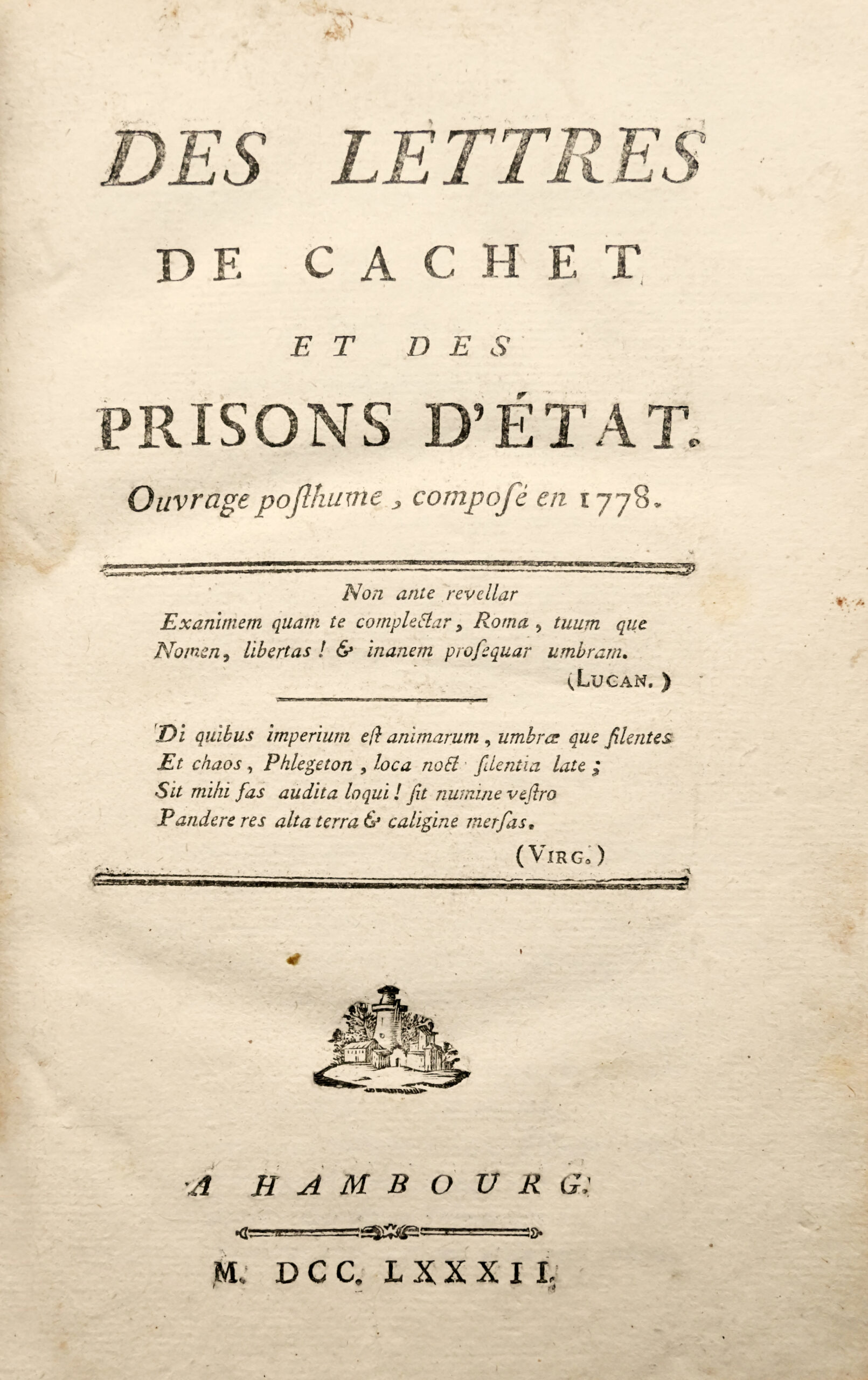
Hambourg, 1782.
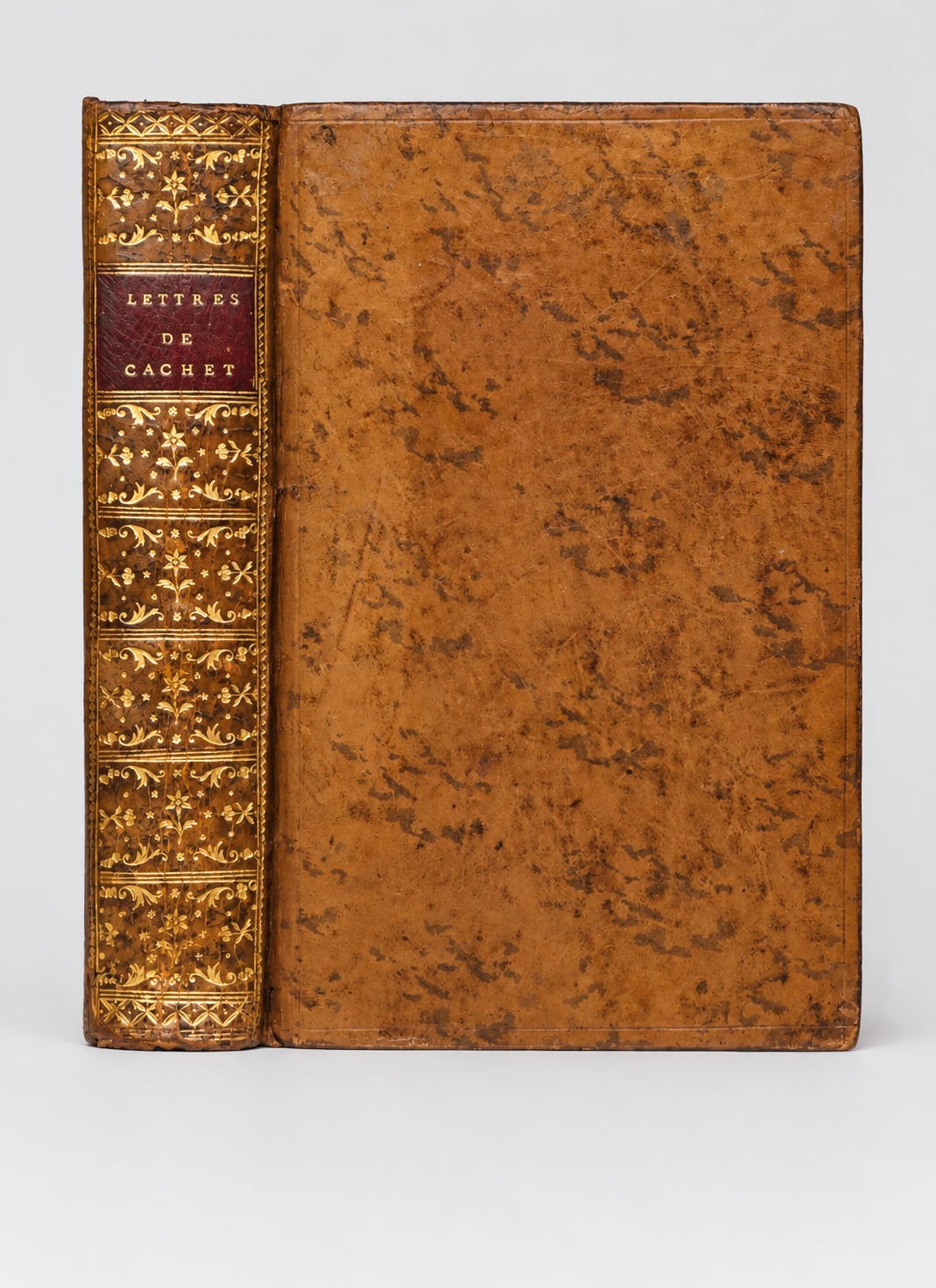
2 parts in 1 octavo volume: xiv pp., (1) f., 366, (2) pp., 237 pp., waterstaining in the upper margin of pp. 1 to 17 of the second part. Full marbled calf, blind fillet around the covers, smooth decorated spine, red edges. Contemporary binding, joints and spine ends rubbed.
195 x 125 mm.
First edition of Mirabeau’s virulent work written during his imprisonment in the keep of Vincennes and denouncing despotism.
Graesse, IV, 535; Einaudi 3932; Cioranescu 45191; Conlon 82; Bûcher 573.
Mirabeau (1749-1791) was the son of the economist Victor Riquetti de Mirabeau. A French statesman, he was one of the most striking figures of the Revolution and the most brilliant orator of the Constituent Assembly. He had extremely difficult relations with his father and led a dissolute life in which he accumulated numerous debts. To shield him from these, he was imprisoned several times by lettres de cachet at his father’s request.
After appealing to both his father and the King concerning his condition as a prisoner, both of whom remained silent, Mirabeau wrote this essay analyzing inequity and denouncing arbitrary power. In the second part he castigates “good pleasure” and prosecutes the cases of Richelieu and Louis XIV, whom he regarded as the gravediggers of the monarchy. The work had a great impact at the time.
The work, composed during the four years of Mirabeau’s incarceration at Vincennes, is an indictment of arbitrary justice and power. It begins with a history of French criminal law and continues with the organization of the penitentiary administration at the end of the Ancien Régime, which he denounces violently.
Mirabeau was therefore imprisoned in the keep of Vincennes from 1777 to 1780. There he met Sade, who was confined there during the same period. He wrote extensively there: letters, notably to Sophie de Monnier, published in 1792 under the title Lettres à Sophie, a masterpiece of passionate literature, as well as a virulent pamphlet against the arbitrariness of the justice system of his time, Les Lettres de cachet et des prisons d’Etat, but also a particularly explicit erotic work. Des Lettres de cachet et des prisons d’État was published in 1782.
“‘Des Lettres de cachet’ is not merely an eloquent protest against despotism, a passionate plea in favor of individual liberty, but also a true work of scholarship filled with historical examples, and one that presupposes immense reading.” (Barbier).
“It is through history and reason that Mirabeau combats arbitrary detention.” (P. Negrin)
“Des Lettres de cachet deserves the highest praise. The principles of natural law, the foundation of all society and all civilization, are set forth and developed with as much force as clarity. Mirabeau already reveals himself here as a great publicist, and the writer foreshadows the orator.” (A. de Montor).
“This work, a new denunciation of arbitrary power, a plea in favor of individual liberty, and a defense of justice and humanity against despotism, had such an impact at the time that Vergennes asked Prussia to halt the publication of this licentious work, seize it, and destroy the manuscript…” (H. Auréole, Bibliography on Mirabeau).