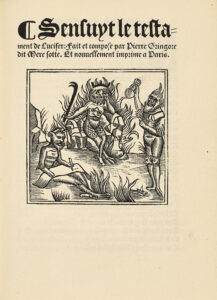
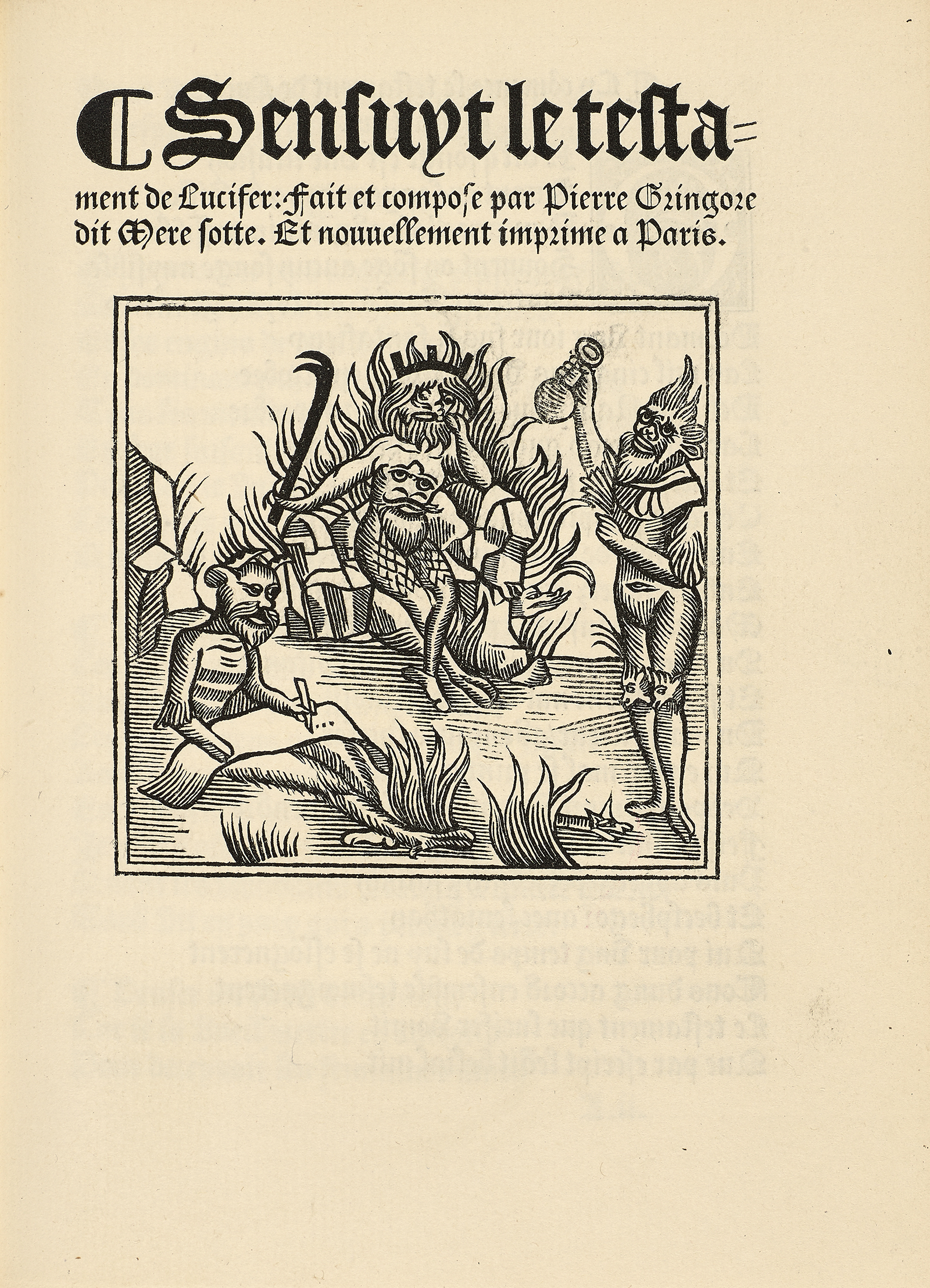
[August 25, 1845, printed by Crapelet for the bookseller Silvestre, Paris].
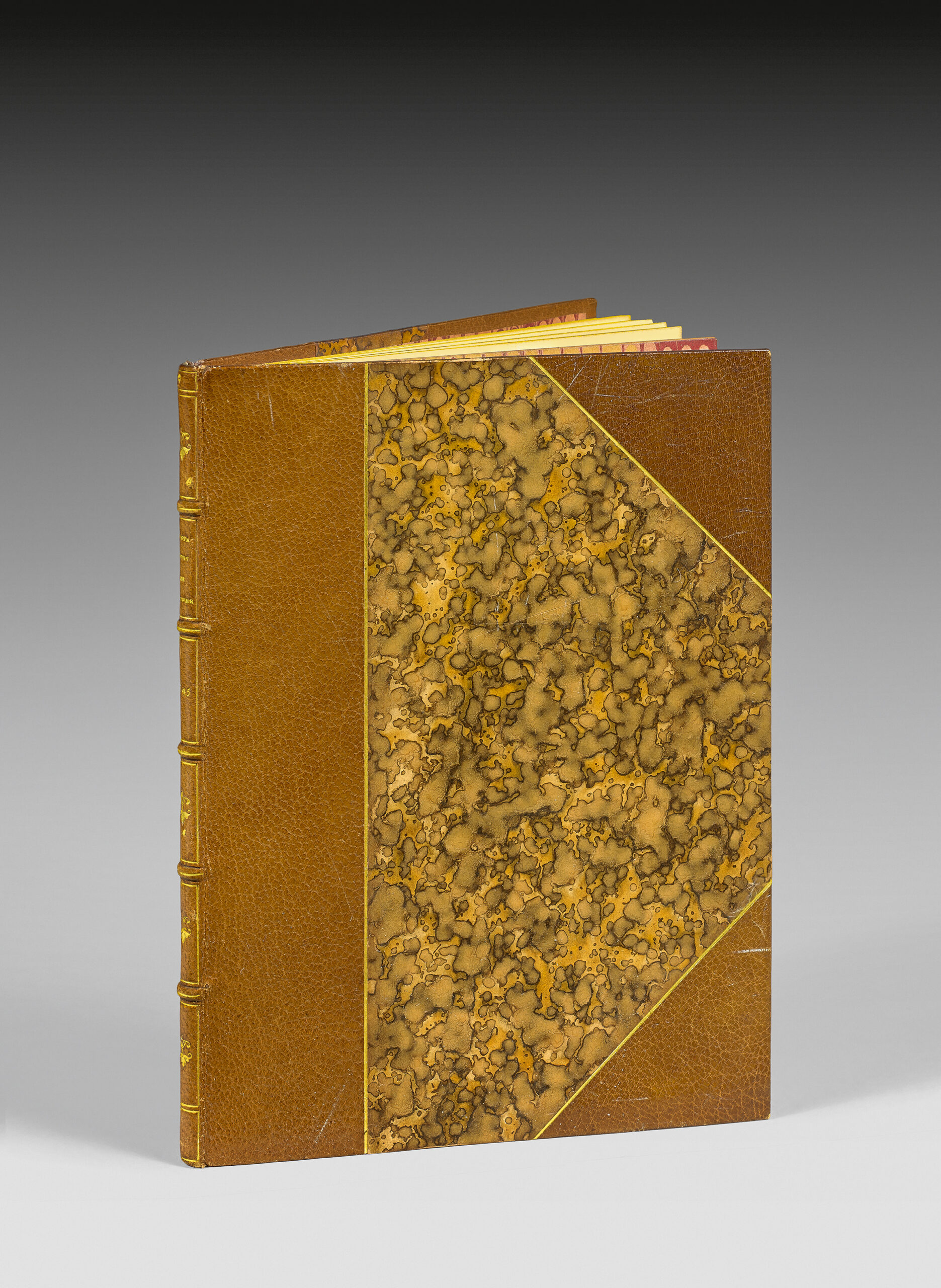
Quarto of 14 pages, gothic characters, half citron morocco with corners, spine with raised bands adorned, gilt top.
152 x 110 mm.
First separate edition of this famous text published in 1521 and already absolutely unobtainable 180 years ago.
“Printed in Gothic letters by Crapelet in 1845 and printed in small number.”
It was described as such in 1845 by Crapelet:
“The rarity of Gringore’s works is undeniable; some are no longer found in the public domain. The difficulty one experiences in acquiring those that time has spared is, it must be said, the dominant cause that makes them eagerly sought after. However, Gringore was quite a good poet for his time. His style, without being very easy, is generally less obscure than that of many of his contemporaries, and his satirical and sententious wit sometimes ridicules with spirit. The “Testament of Lucifer“, which has never been published separately, seemed to us to combine these two conditions, and to represent one of the best productions of the author. Father Niceron probably thought so as well when he reprinted this pamphlet, less the preamble and the last stanza, in the thirty-fourth volume of his literary Memoirs. Be that as it may, one will notice that Gringore, in arranging the marriage of Lucifer’s daughters, often strikes hard and true when he provides for different peoples and certain professions according to the faults or vices that characterized them at that time. What he was saying three hundred twenty-four years ago is not as old as one might think; for, upon examining the share allotted to each, one will find that for us it is not always ancient history.” (Paris, year 1845).
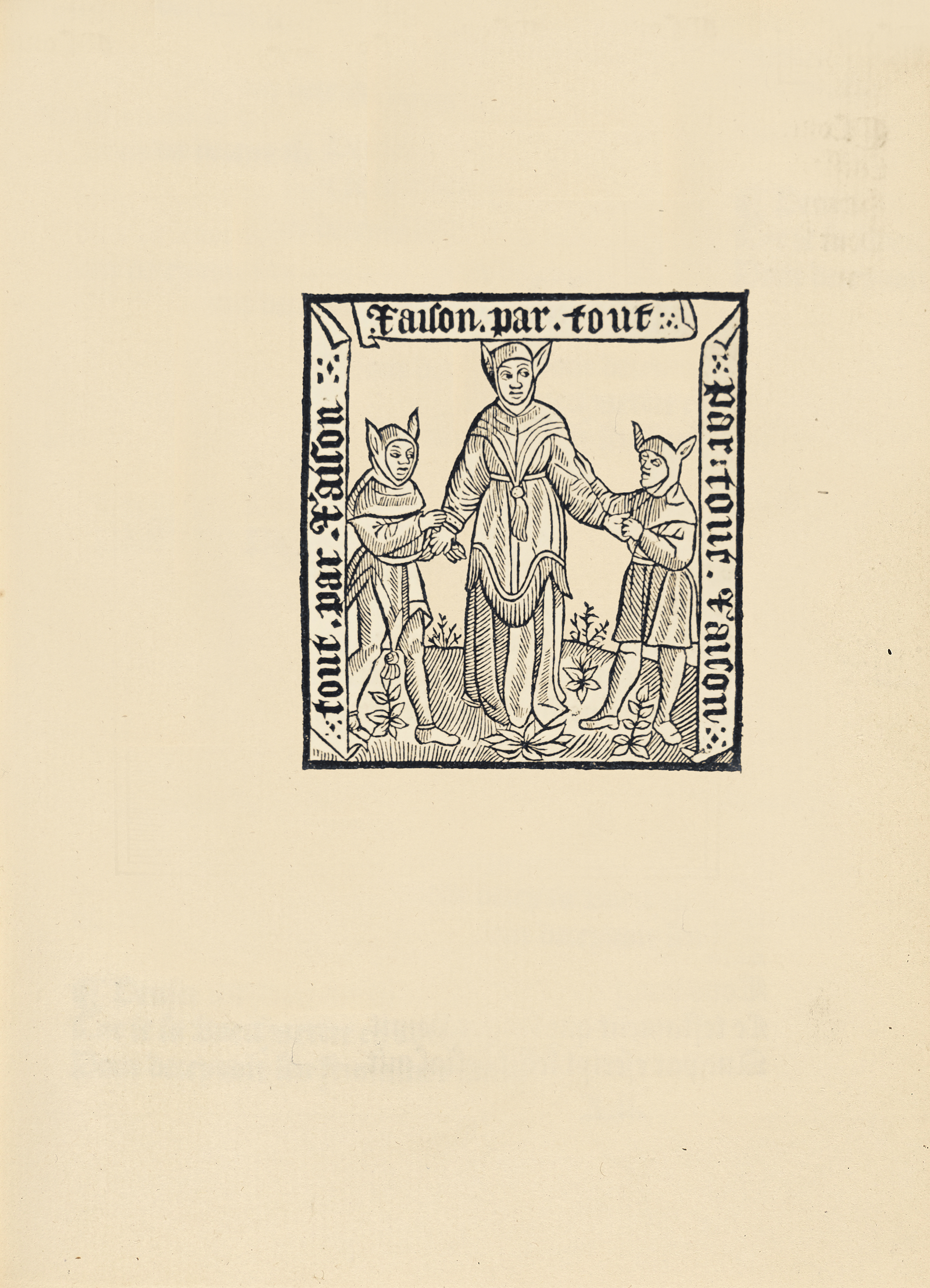
Gringore’s works offer a peculiar mixture of mischief and simplicity, of gaiety and gravity, of naive faith and argumentative temperament; they are the exact representation of the spirit of the Parisian bourgeoisie at the beginning of the 16the century. He is especially remarkable for his dramatic works, to which he owes his reputation; his farces have finesse, his soties have vigor, and his political comedies have a boldness reminiscent of Aristophanes, which one rarely sees on the stage in France. In the Mystery of Saint Louis, he achieves elevation and grandeur. He is frequently energetic in his satirical-moral works where he even affects a solemnity that his style does not always maintain. Most of the works he had printed depict on the frontispiece the portrait of Mother Fool, with a monk’s robe and a hood adorned with donkey ears; around it reads: “All by Reason; Reason everywhere; By everything Reason.” These editions are very rare.
Pierre Gringore has become a fictional character – under the spelling ‘Pierre Gringoire’ – in the works of Victor Hugo and Théodore de Banville. The former anachronistically featured him in Notre-Dame de Paris during the year 1482, and the latter made him the hero of the one-act prose comedy Gringoire, performed at the Théâtre-Français in 1866. It is in scene IV of this play that the character Gringoire recites to King Louis XI the poem known as The King’s Orchard, set to music and sung in 1960 by Georges Brassens.
Alphonse Daudet, in the short story The Goat of Monsieur Seguin wrote to Mr. Pierre Gringoire, lyric poet in Paris.
A very beautiful copy printed on very large Dutch paper in a very low print run.