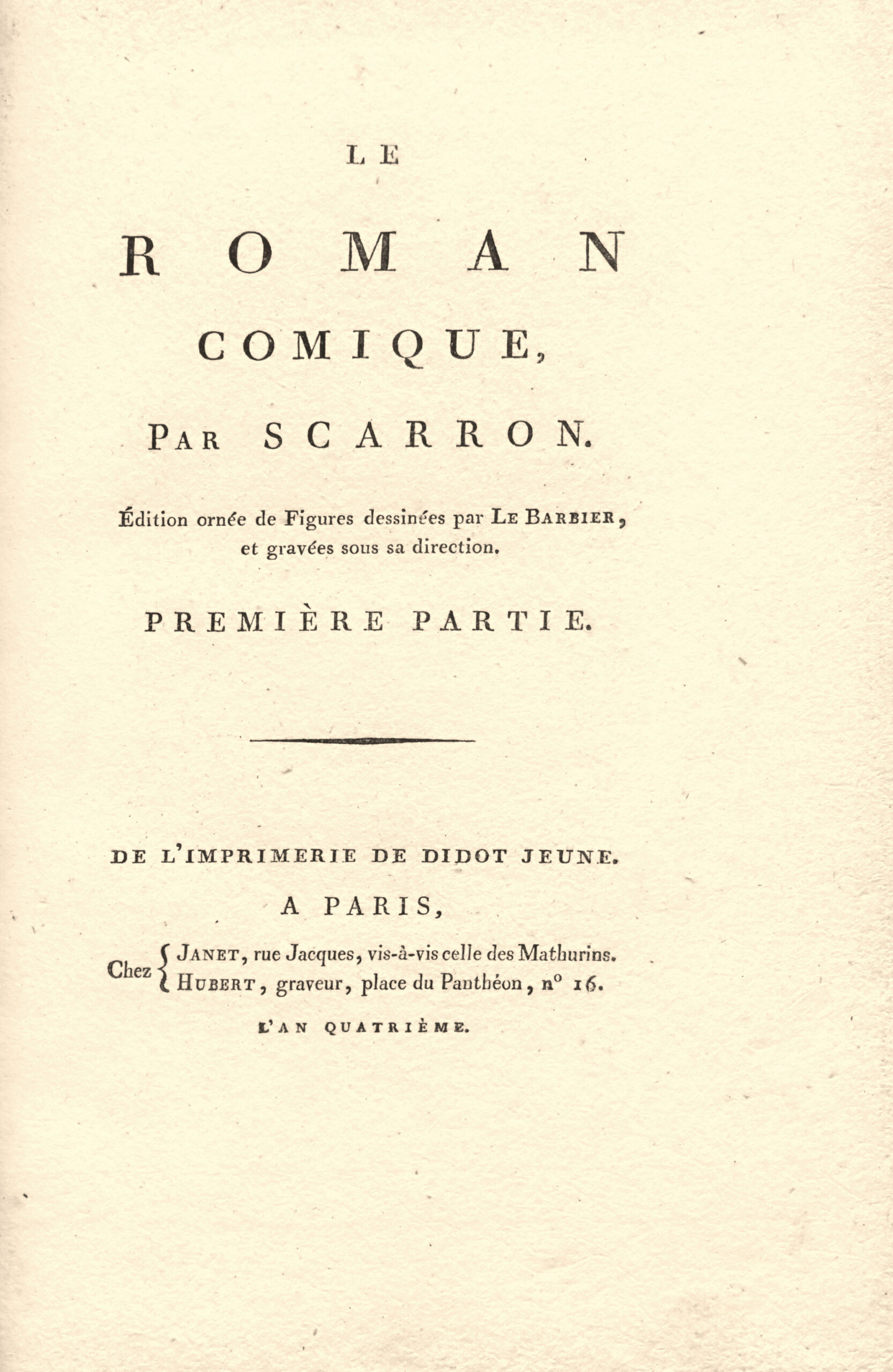
De l’imprimerie de Didot jeune, à Paris, chez Janet et chez Hubert, an IV (1796).
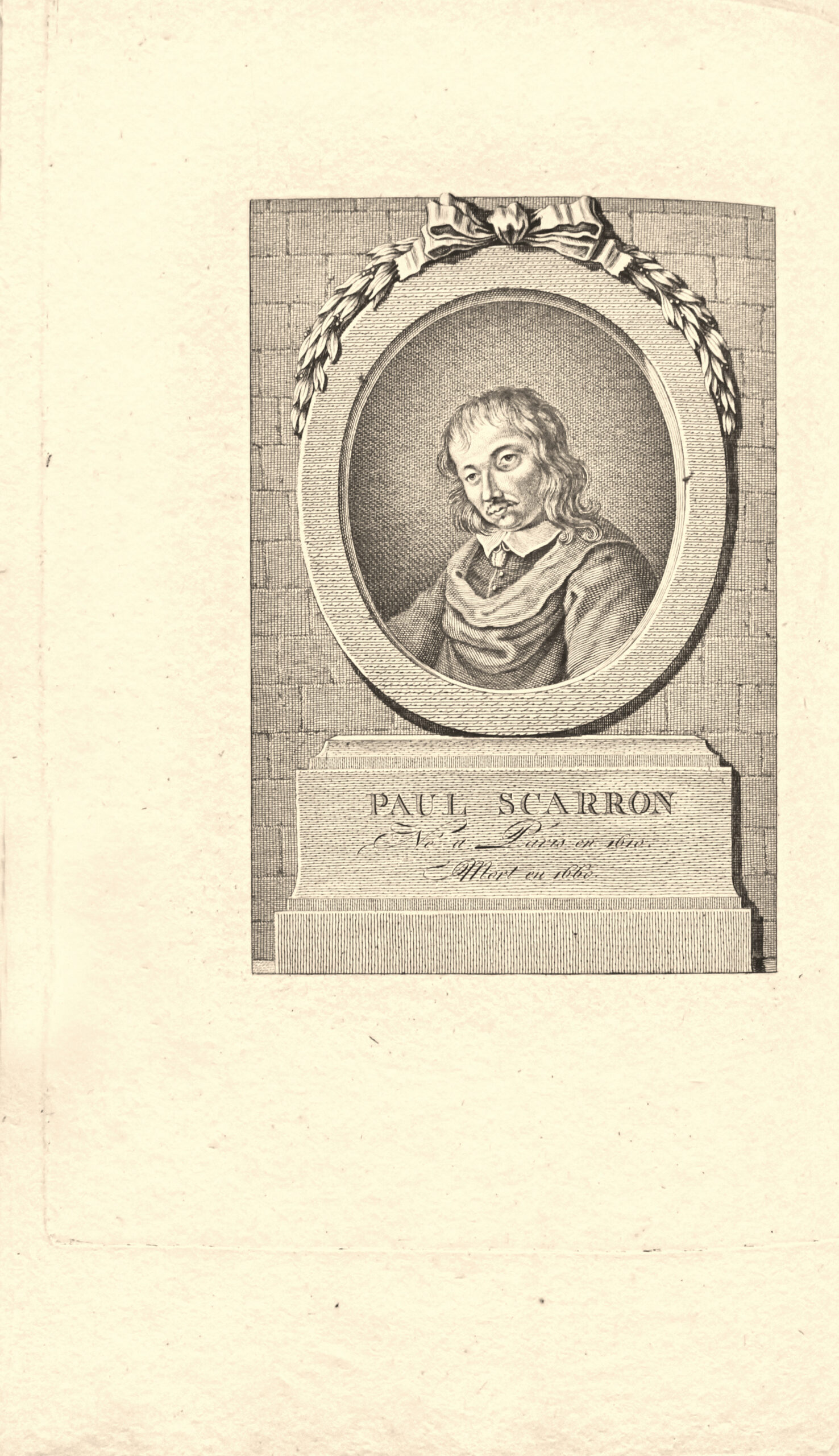
Volume I: VII-277 pp., plus 1 portrait and 6 figures in two states.
Volume II: VIII-252 pp., plus 6 figures in two states.
Volume III: XIII-196 pp., plus 3 figures in two states.
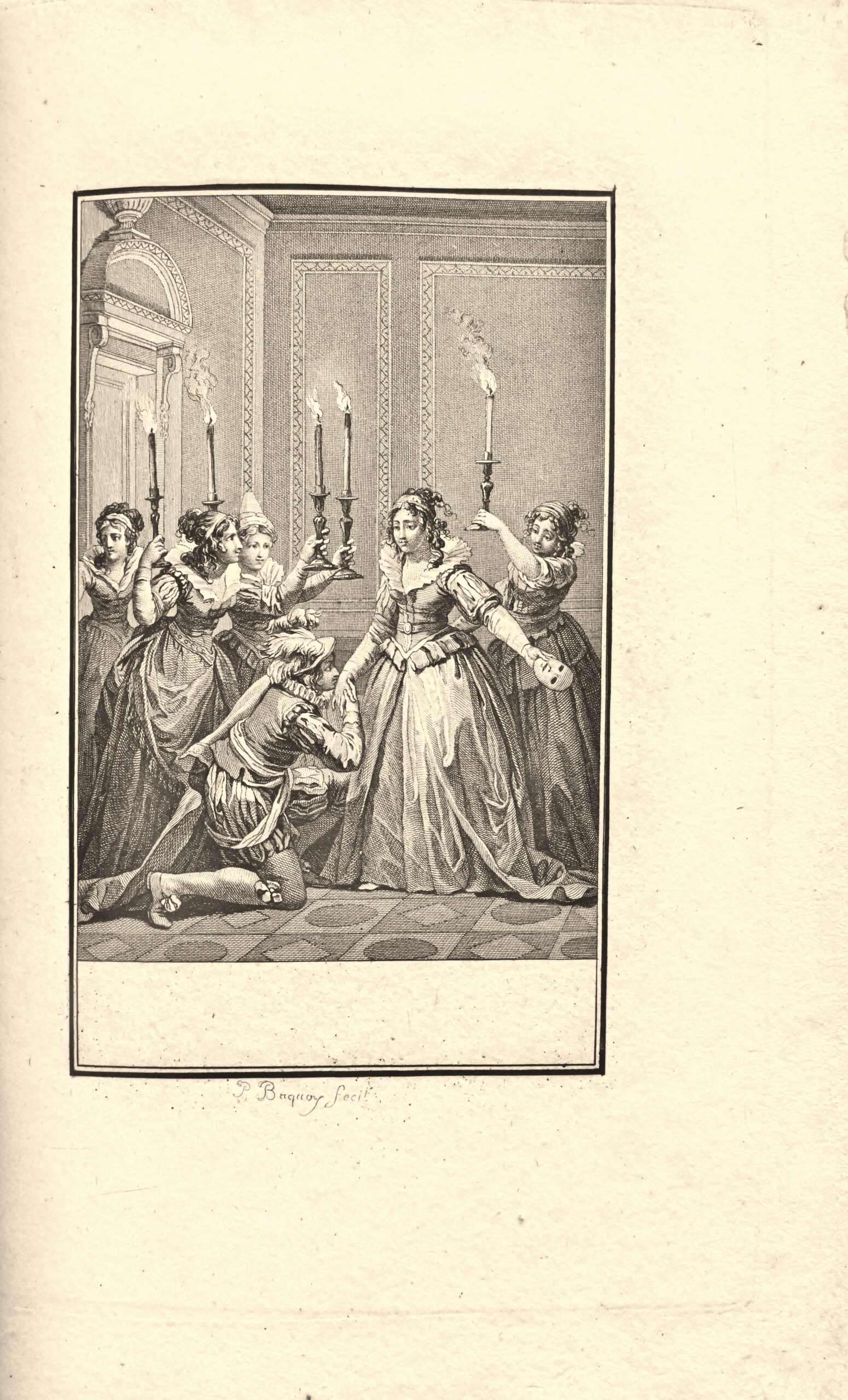
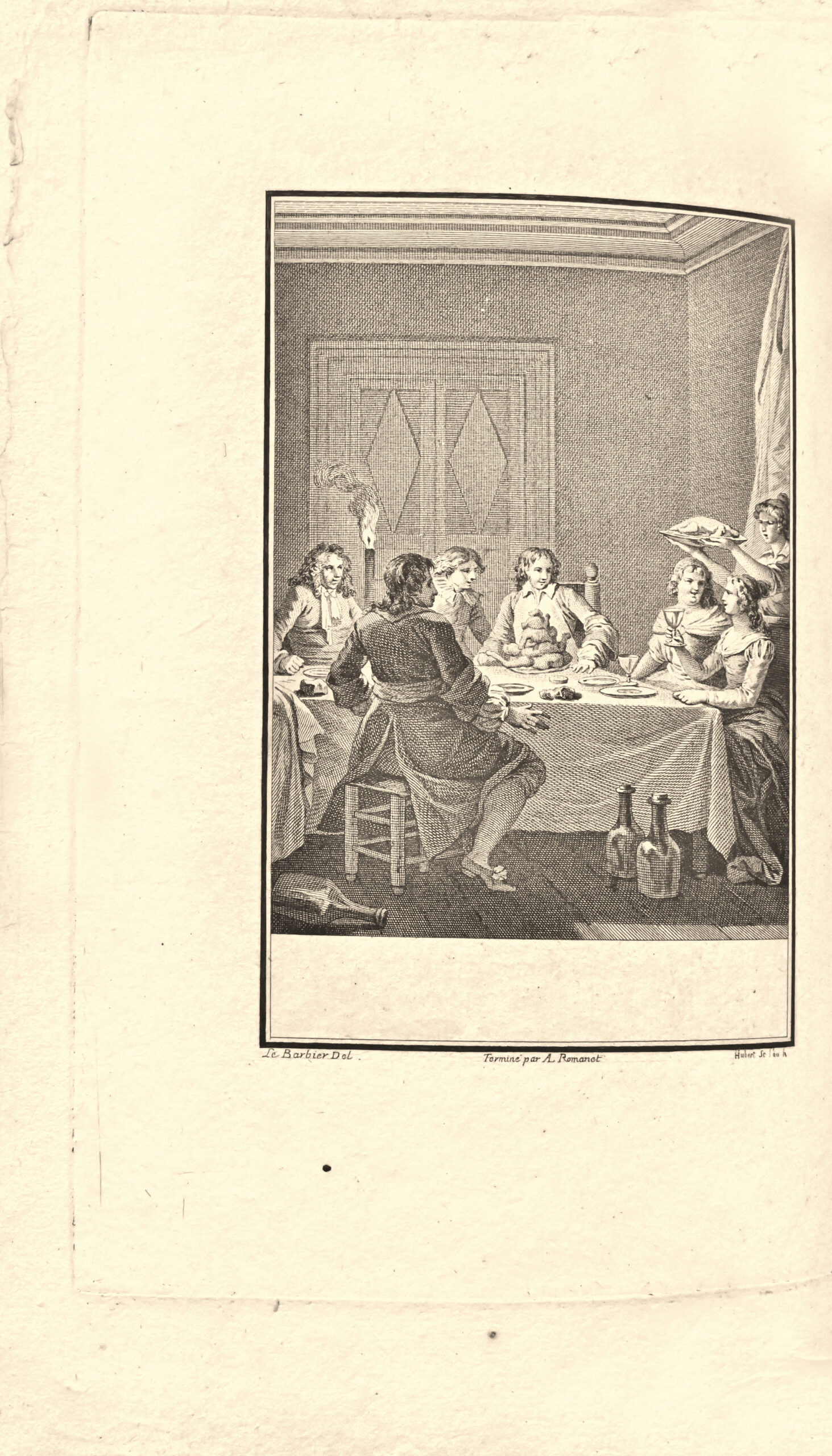
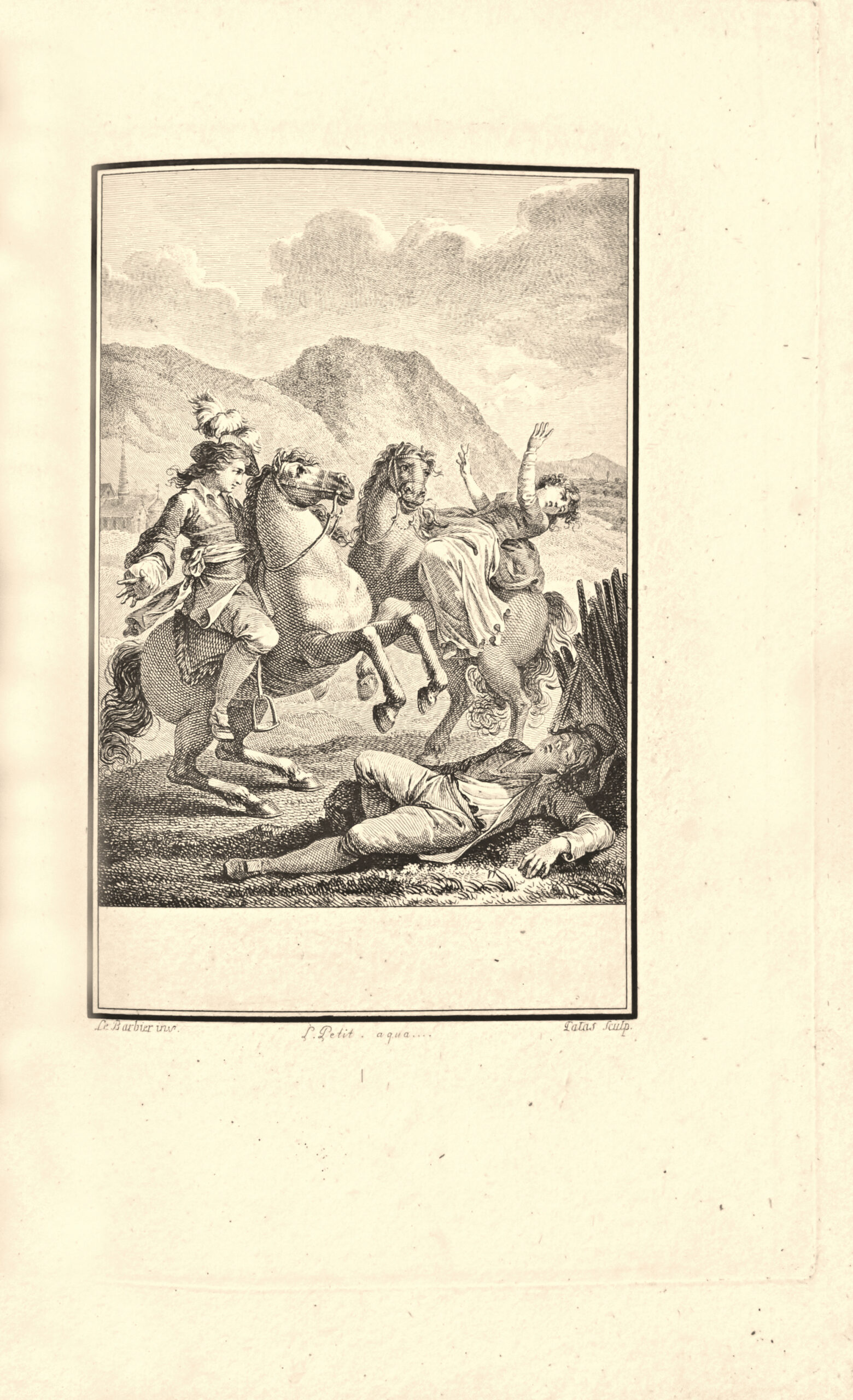
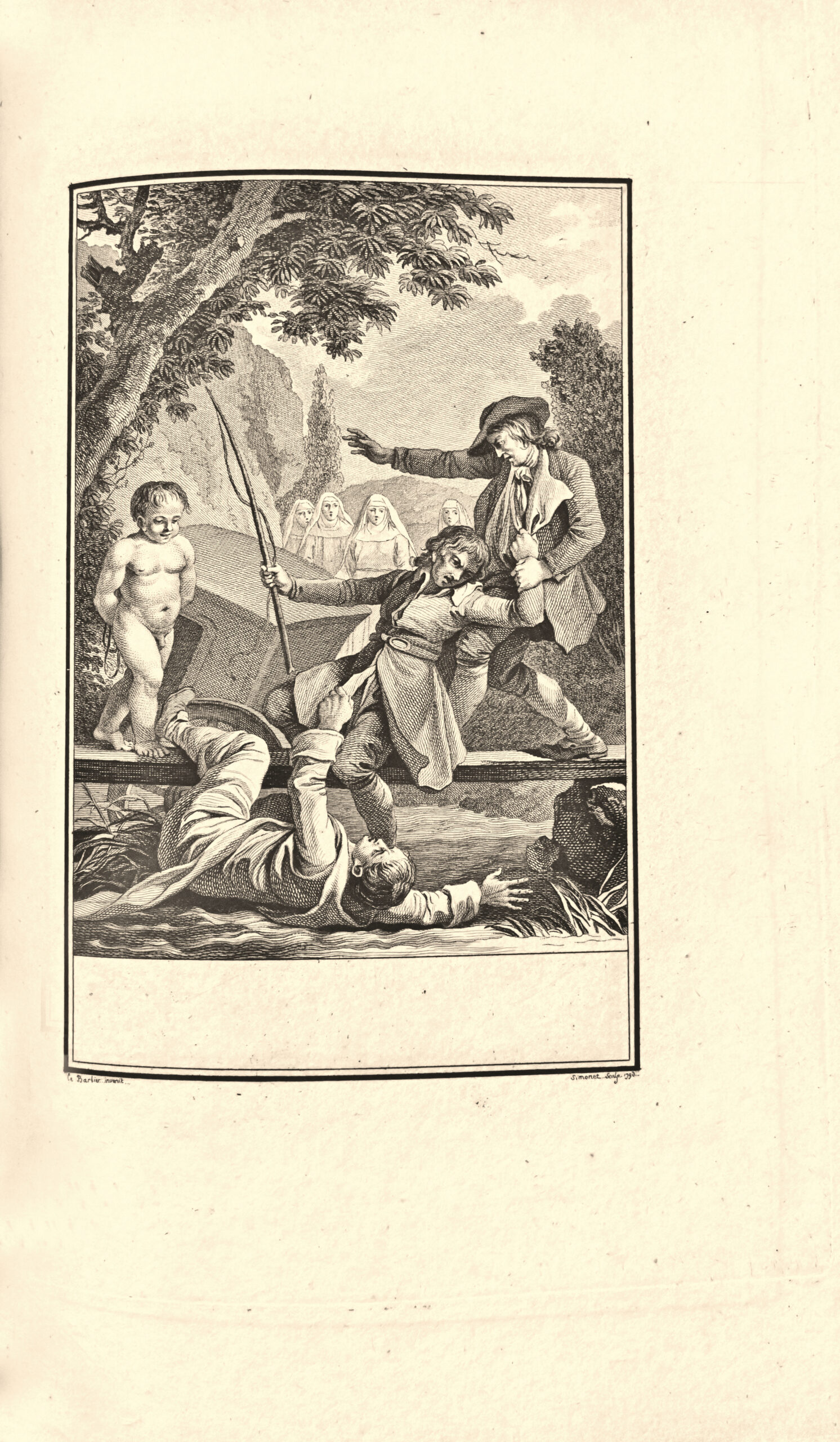
In total, 1 portrait by Lemire and 15 figures by Le Barbier engraved by Baquoy, Dambrun, Duclos, Hubert, Patas, Petit, Romanet, and Simonet.
“There are copies on vellum paper with the figures before letters. Sometimes the collection of etchings is added.” (Cohen)
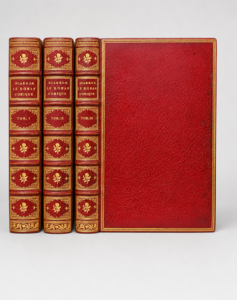
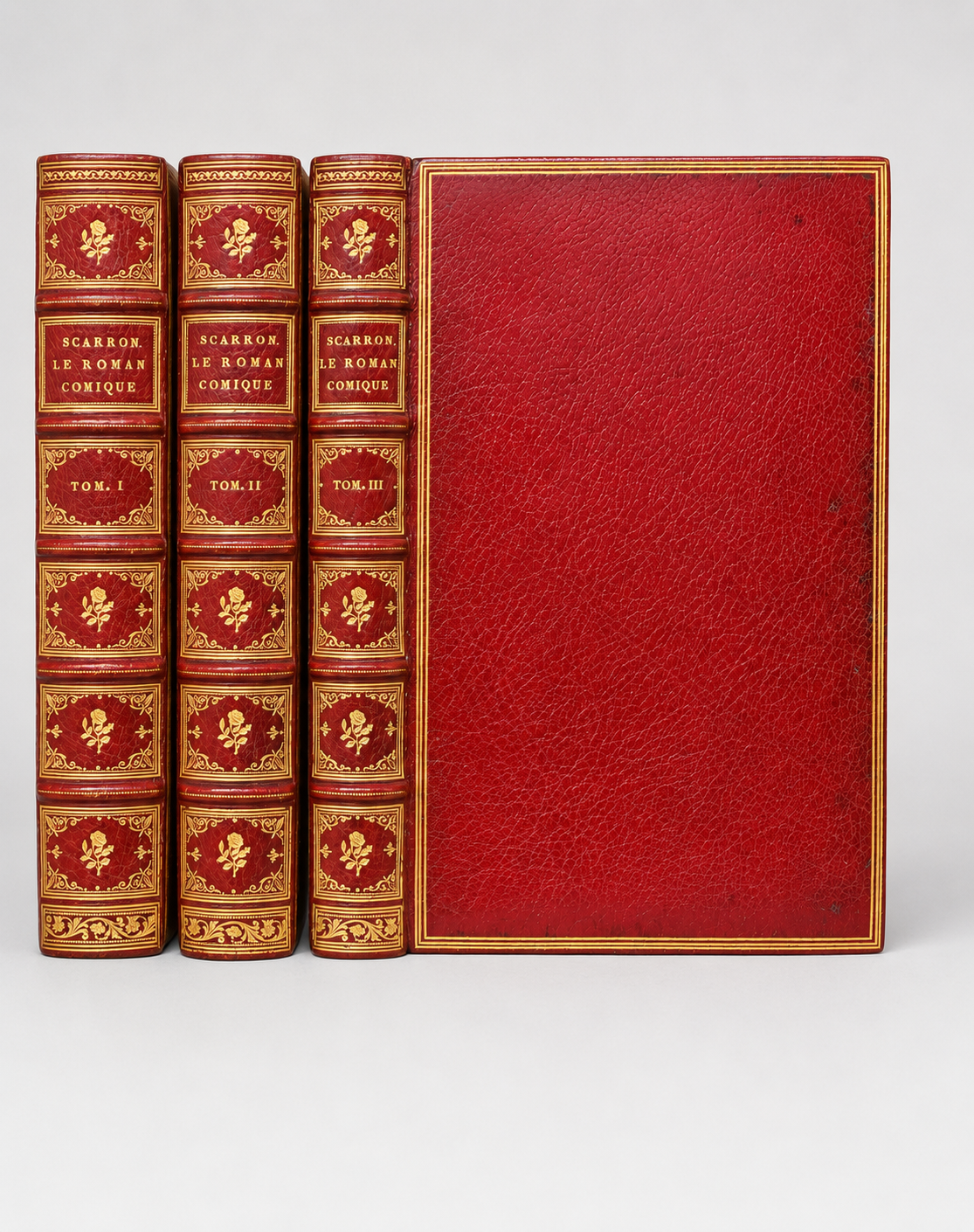
3 large octavo volumes, full red morocco, triple gilt fillet framing the covers, richly decorated spines with raised bands and gilt rose tools, gilt fillets on the edges, doublures of red morocco with straight dentelle tooling, gilt edges. Red morocco doublé binding signed “Cuzin” circa 1875.
242 x 155 mm.
The famous Rich. Lion and Lord Carnarvon copy cited by Cohen, printed on large vellum paper with the figures before letters and the complete set of etchings. Cohen records a value of 80 F. to 100 F. gold for ordinary copies and adds: “A fine copy in red morocco doublé with red morocco by Cuzin and likewise containing the figures before letters and the etchings, 1,300 fr., Rich. Lion sale (no. 232); then on large vellum paper, containing the etchings and the before-letter impressions, which are found in Lord Carnarvon’s copy (no. 50), in red morocco doublé with red morocco by Cuzin, offered at 1,500 fr. in Bull. Morgand II, 6 (1908), no. 631.”
Encumbered with a heterogeneous and voluminous load of baggage, a cart enters Le Mans one evening and stops before the inn known as the Biche. It is occupied by a woman, a ragged young man, and an old man, respectively named la Caverne, le Destin, and la Rancune. All three belong to a troupe of actors, the rest of whom have been delayed elsewhere by a brawl. In order to obtain lodging free of charge, the newcomers offer to perform a sample of their repertoire for the amusement of the innkeepers. They don the disguise of passing travelers, and a general fistfight erupts upon the return of the actual guests. La Rapinière, lieutenant of the Provost, who took part in the fight, brings the actors to lodge at his home. Shortly afterward the rest of the troupe arrives. Now complete, it consists of: Destin, la Rancune, l’Olive, Mlle de l’Etoile, la Caverne, her daughter Angélique, Roquebrune, poet-author and stage director, plus several servants doubling as apprentice actors. Around Mlle de l’Etoile soon gathers the fashionable society of the town, notably one Ragotin, who becomes the butt of the troupe’s jokes and to whom the most humiliating adventures occur. Amid these episodes is interwoven the story of Destin and Mlle de l’Etoile, a veritable melodrama filled with twists and complications. After the abduction of Angélique, followed by that of l’Etoile, matters become more or less resolved: thus ends the work, abruptly interrupted.
Scarron possesses to the highest degree the gift of animating his characters and bringing out the striking traits of their personalities. All of them, even the secondary figures, are endowed with singular vitality.
Belonging to diverse social milieus, they mingle and interact in the most entertaining fashion. All of this, let it be repeated, is recounted in a highly savory language, easy and direct, filled with witticisms and at times tempered by the most exquisite emotion. Certain especially developed figures stand out in striking relief.
But the most modern aspect of Le Roman comique is undoubtedly to be found in its use of paratext (the discrepancy between chapter titles and their contents, parodic incipits, ironic prefaces) and in the author’s many playful intrusions through which a dialogue with the reader is established. To the reader’s greatest delight—addressed directly, made a witness, seduced, mocked, urged to compensate for the writer’s laziness—he enjoys the rare privilege of visiting this living dead man within the monument he built so that eternity might find him alive and agile, as he was before being struck by paralysis.
The work is adorned with 15 beautiful figures by Le Barbier (1738-1826).
After beginning his studies in Rouen, he trained at the drawing school of Descamps. Arriving in Paris in 1757, he entered the studio of Lebas, then that of Jean-Baptiste-Marie Pierre. A student of the Académie royale de peinture, he did not win the Prix de Rome but traveled to Italy at his own expense between 1767 and 1769, from where he brought back numerous landscape drawings. Beginning in 1776, he spent several years in Switzerland. Approved by the Academy on July 20, 1780, he exhibited regularly at the Salon, chiefly scenes from ancient and modern history. He became an Academician in 1785 and a member of the Institut in 1816. He obtained a first medal in 1808. He was an ardent propagandist for Vien and David. He illustrated works by Ovid, Racine, Rousseau, and Delille. He died in Paris in 1826.
Ref: E. Benezit, vol. 6, p. 501, ed. 1976).
Superb copy, one of the most precious described by Cohen.