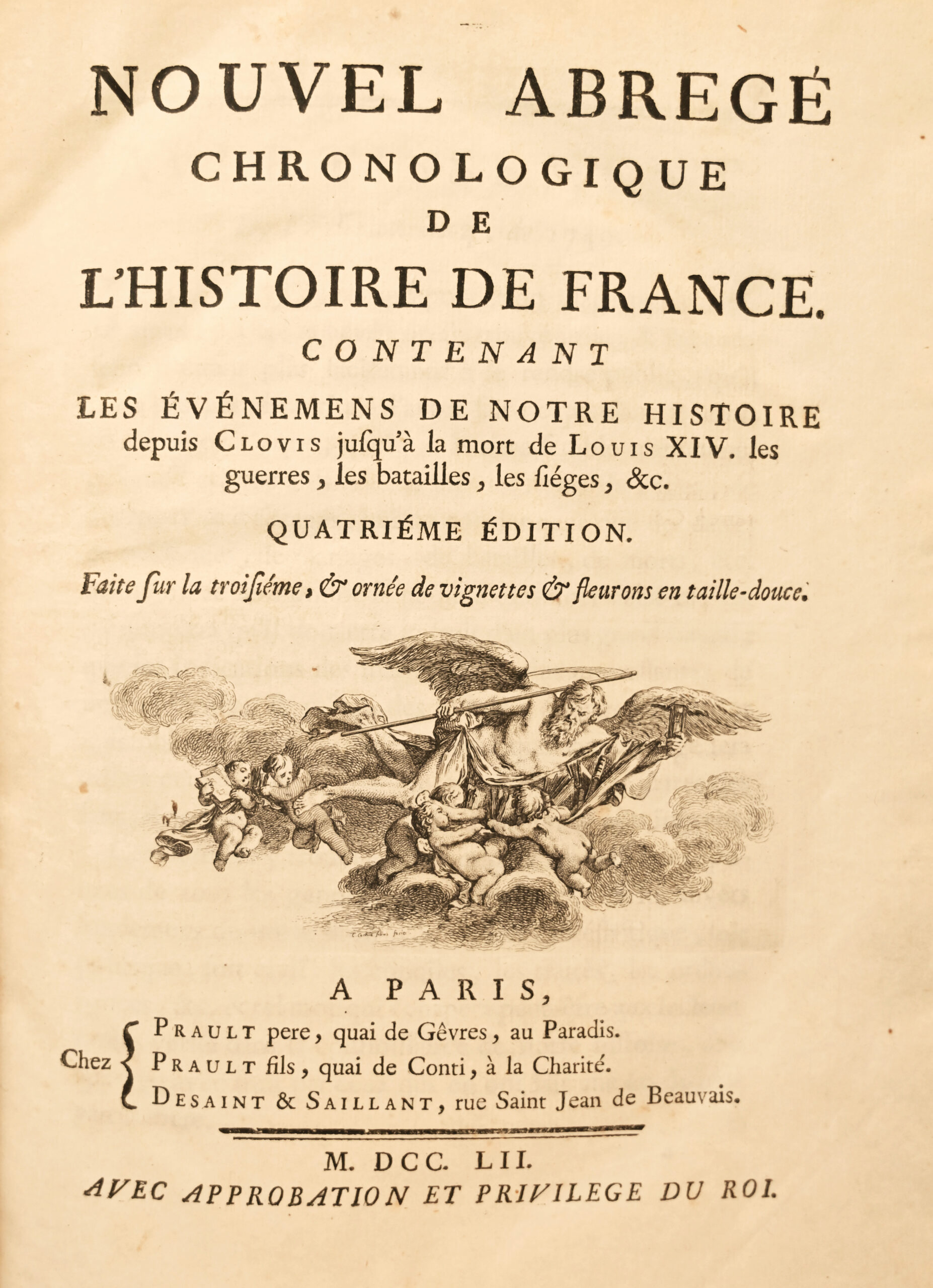
Paris, Chez Prault père & fils, Desaint & Saillant, 1752.
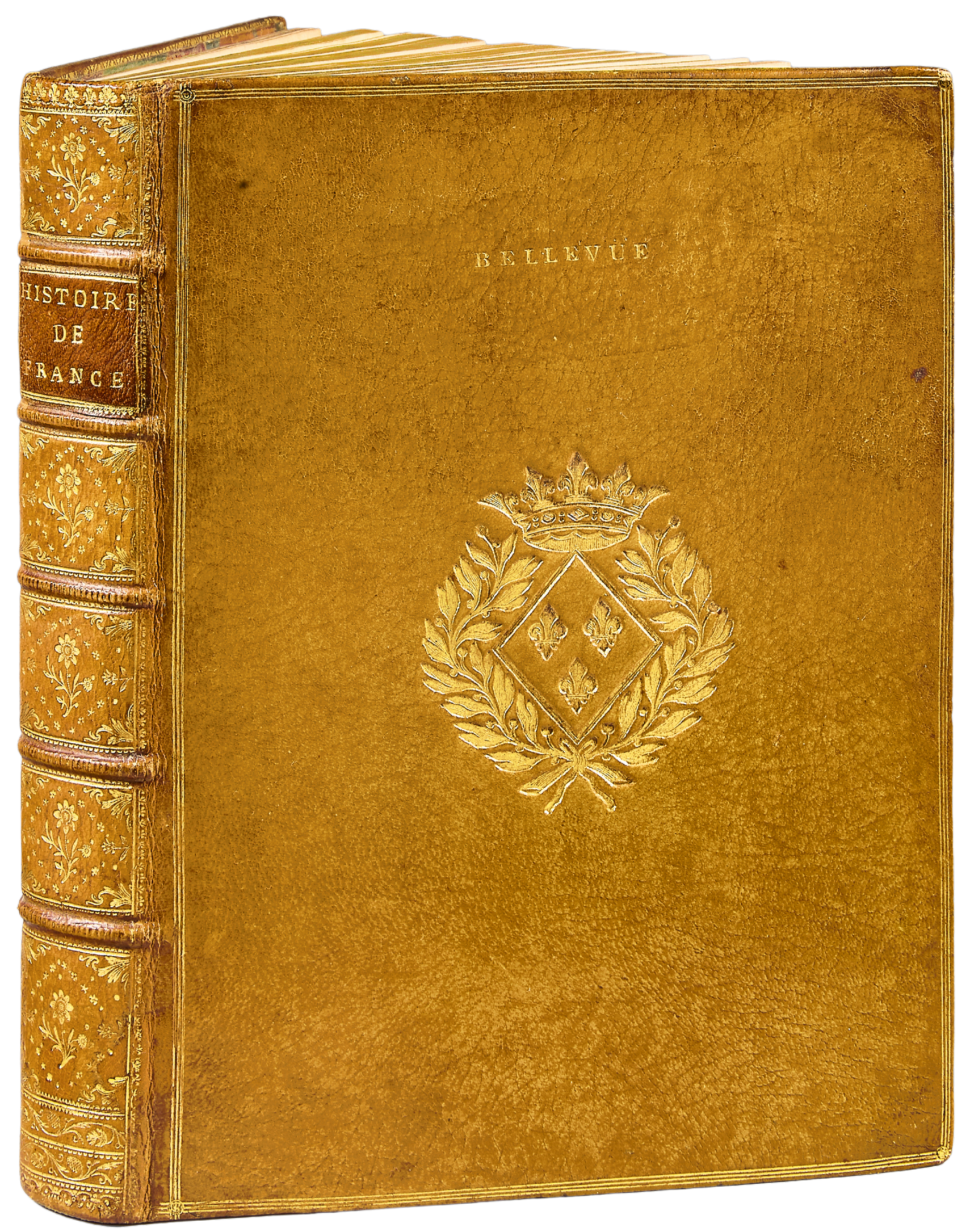
Quarto of (2) leaves of half-title and title, viii pp. of warning, 636 pp. of text, (28) leaves. Lemon morocco, triple gilt fillet around the boards, gilt-stamped coat of arms in the center, “Bellevue” gilt-stamped on the upper board, spine decorated with fillets and fleurons, gilt edges. Lemon morocco armorial binding of the period.
255 x 194 mm.
Magnificent edition of the history of France by President Hénault.
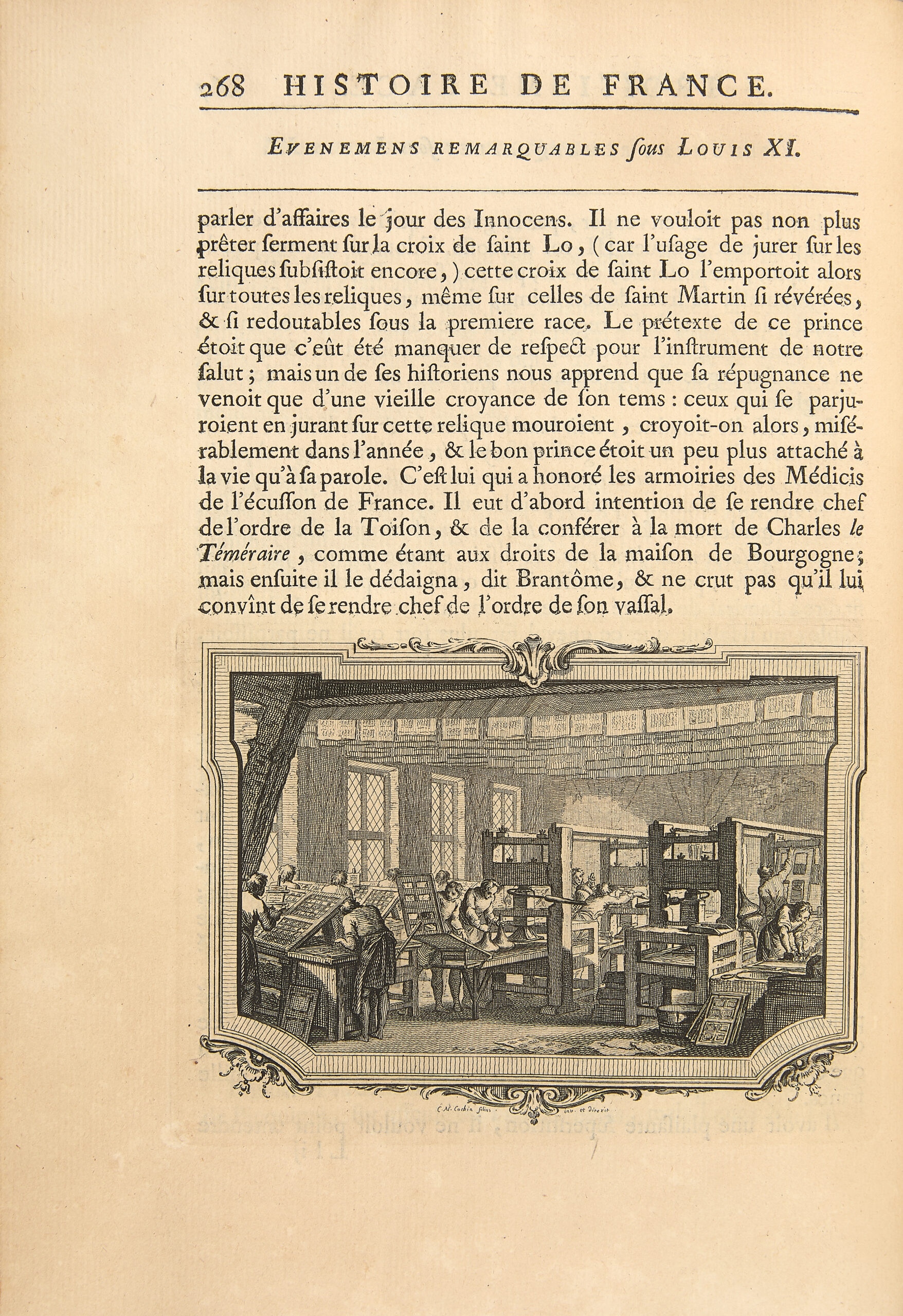
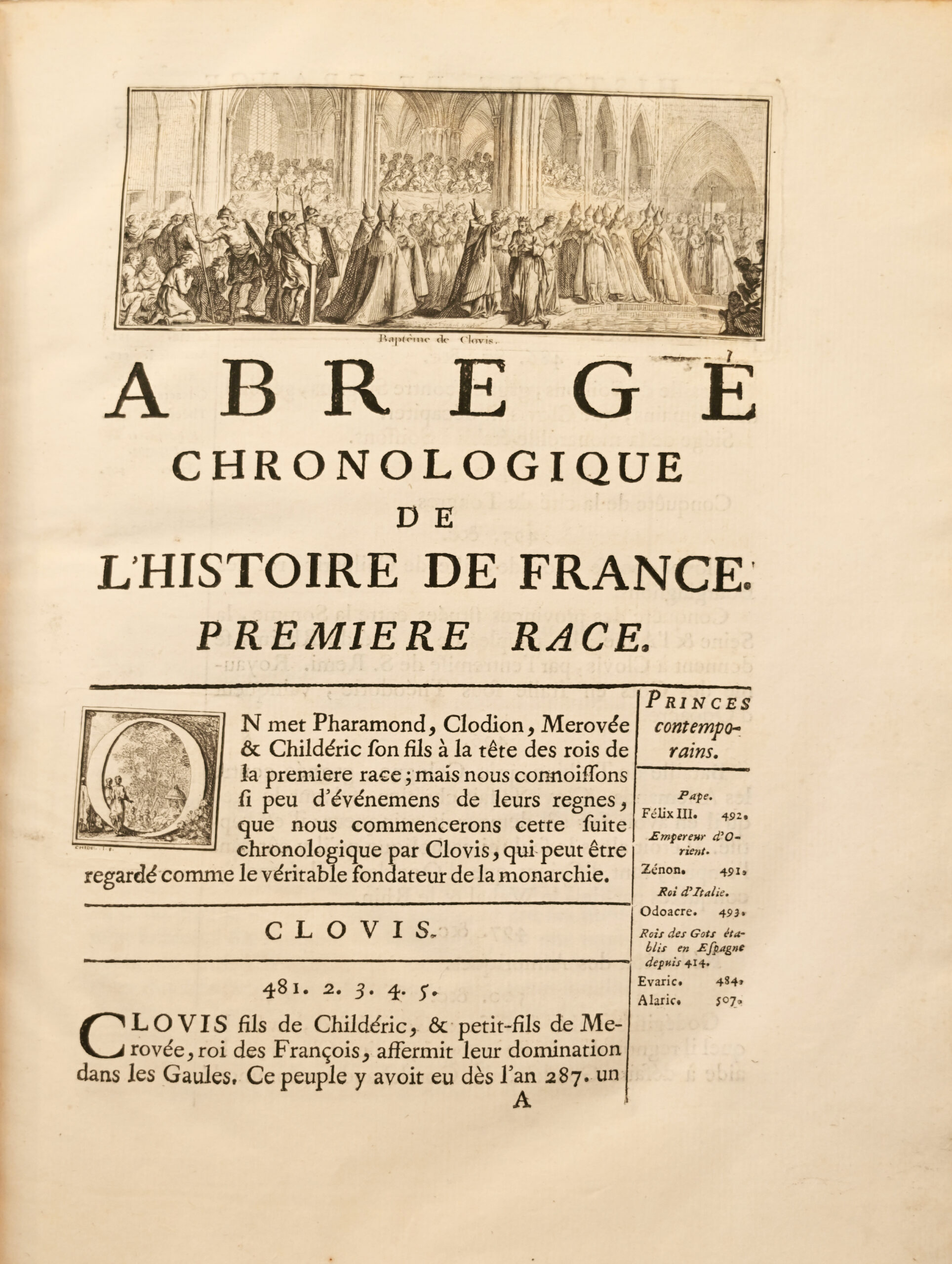
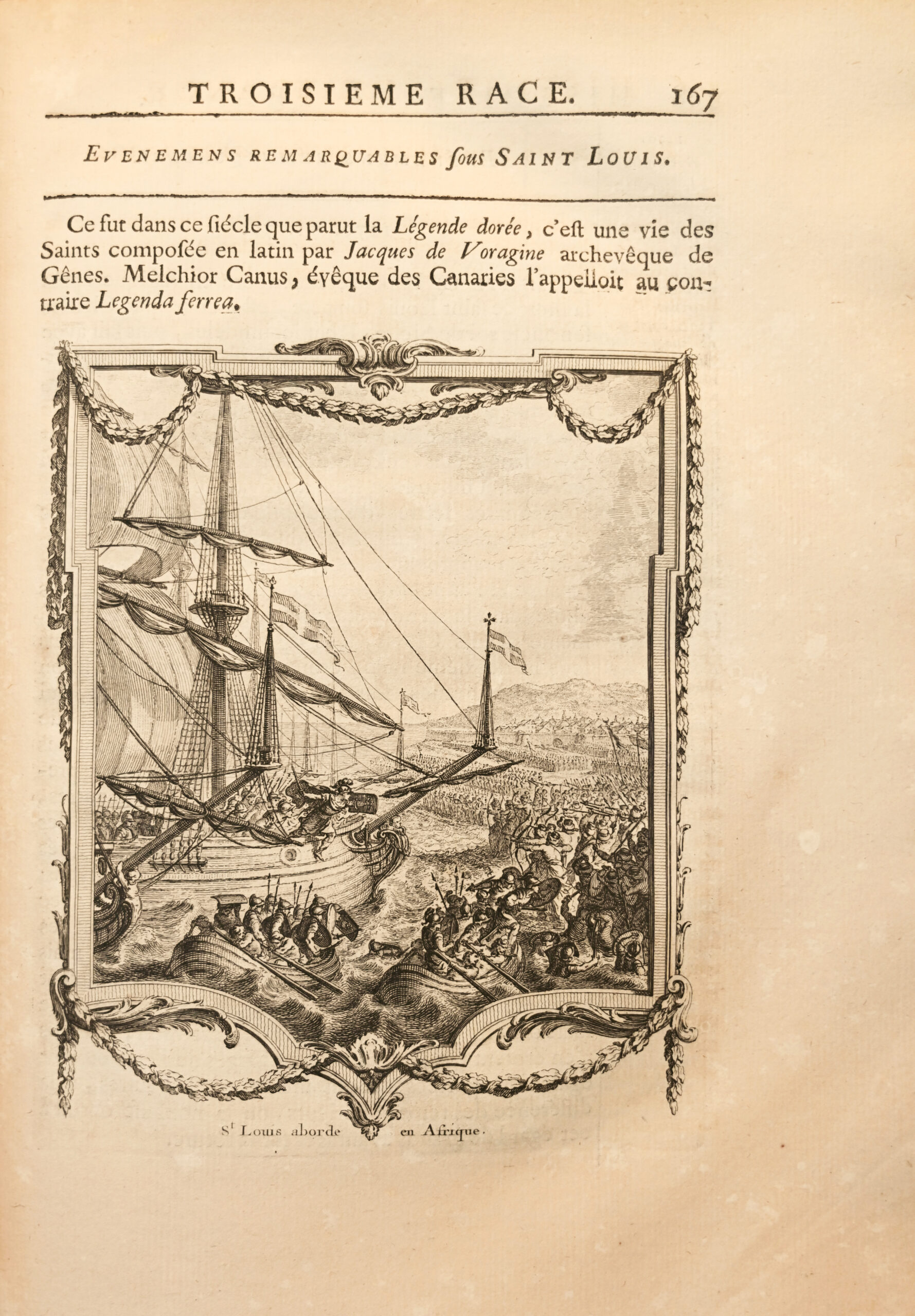
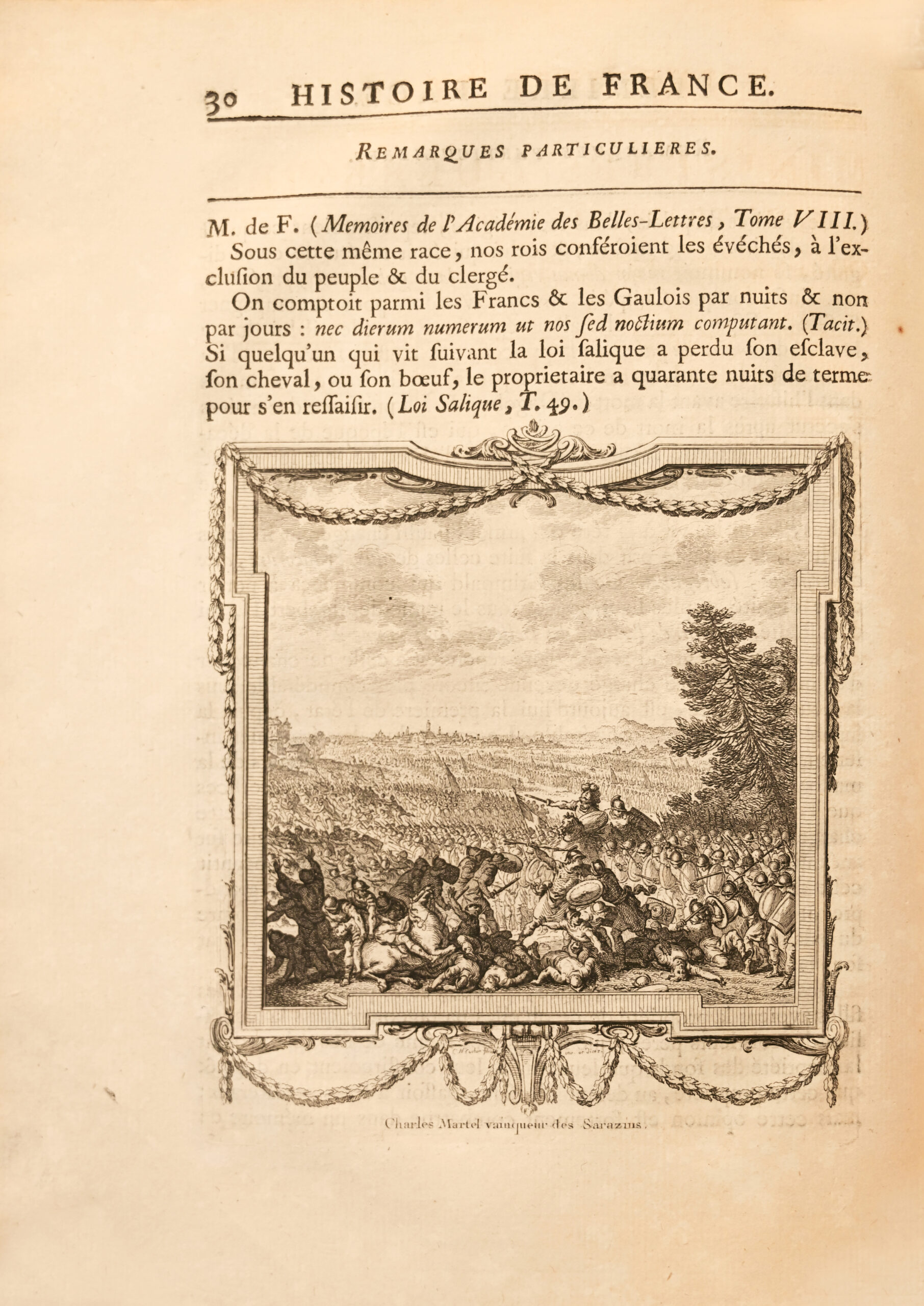
It is adorned with 1 fleur-de-lis on the title by Cochin, 3 ornate letters by Chedel, 3 vignettes and 36 tailpieces by Cochin.
Through his fortune, his soirées, his conversation, and his wit, Hénault quickly acquired illustrious friendships; he was a friend of the Duke of Bourbon, the Duchess of Maine, Madame deffand, Marie Leczinska. He thus frequented the most influential and intelligent salons of his time.
His “Chronological Abridgment” was met with unanimous favor and achieved tremendous success. This success is due to two causes: a general state of mind and the merit of the work.
Educators of youth did not then include history in their curricula. Even the Oratorians, who were nonetheless innovators, did not recognize its eminent virtue in shaping children’s minds, and, strangely, most contemporary reformers, who demanded a more scientific classical education, were quite ungenerous in their regard for history education. Yet, a very marked movement irresistibly drove, in our view, men in the midst of the 18the century towards the study of national antiquities. Descartes had made the world doubt, and gradually the world began to doubt everything; philosophers sought in the critique of holy books the proof of the falsehood of dominant religions; they sought to discover not only the evolution of beliefs but the evolution of peoples; they hoped to find in the critique of past centuries arguments against certain contemporary institutions, which they deemed harmful, against papal supremacy: the expansion of Gallican ideas contributed more than is supposed to the spread of historical ideas. But these men of 1740 had no books to satisfy their curiosity; they had only compact volumes, where attention strayed, and whose form was no more in line with the taste of the day than their spirit, or unintelligent, poorly informed, arid breviaries that, despite their desire to learn, had to be soon abandoned.
Hénault’s book appeared at a time when history fascinated respectable people, and this was the first reason for its success; but it must also be recognized that it was far superior to competing works, and the favor with which it was received is justified by its merits. Undoubtedly, today, the Chronological Abridgment can no longer be of service, and reading it is not recommendable: science has progressed astonishingly over 250 years. But in its time, and for its time, the Abridgment was a truly remarkable and genuinely new work. Like Voltaire, Hénault aimed to write a history of civilization while also recounting historical events; one of the first in France, if not the first, to include, in his book, despite its modest size, the study of manners and customs; he emphasized institutions. Moreover, he did not accept, as Gospel truth, the accounts of his predecessors; he wished to inform himself; he conducted a rather extensive and meticulous investigation; he compared acts and official documents, and it is from the comparison of all the texts he gathered that he illuminated his views. He dismissed certain errors that prevailed before him, thus making a serious critical effort. What further demonstrates his conscientiousness and desire for accuracy is the care with which he corrected, in successive editions of his work, the mistakes that initially eluded him, and the perseverance with which he continued, throughout his life, to document and reflect. A book that occupies an entire lifetime deserves some respect and should offer some utility when authored by a man like Hénault, and when this man lived to be 85 years old; and what proves the truth of this hypothesis is that, for more than half a century, the Abridgment was used, it was not replaced. Léon Cahen.
Precious copy from the Bellevue library bound in citron morocco with arms of Madame Sophie-Philippine-Elisabeth-Justine de France, the eighth child of Louis XV, born in Versailles on July 27, 1734, called Madame Cinquième until 1745, when she took the name Madame Sophie; very shy, she lived a very withdrawn life and died in Versailles on March 3, 1782, leaving part of her library to the Marquise de La Porte de Riants, her lady-in-waiting.
The volumes that belonged to the Mesdames de France, daughters of Louis XV and Marie Leczinska, are distinguished only by the color of the leather on which their arms are embossed. Madame Adélaïde had hers in red leather, Madame Victoire in green, and Madame Sophie in citron. These works, which were bound by Fournier in Versailles and by Vente, mostly concerned religion, literature, history, and travel.
Very beautiful copy.