

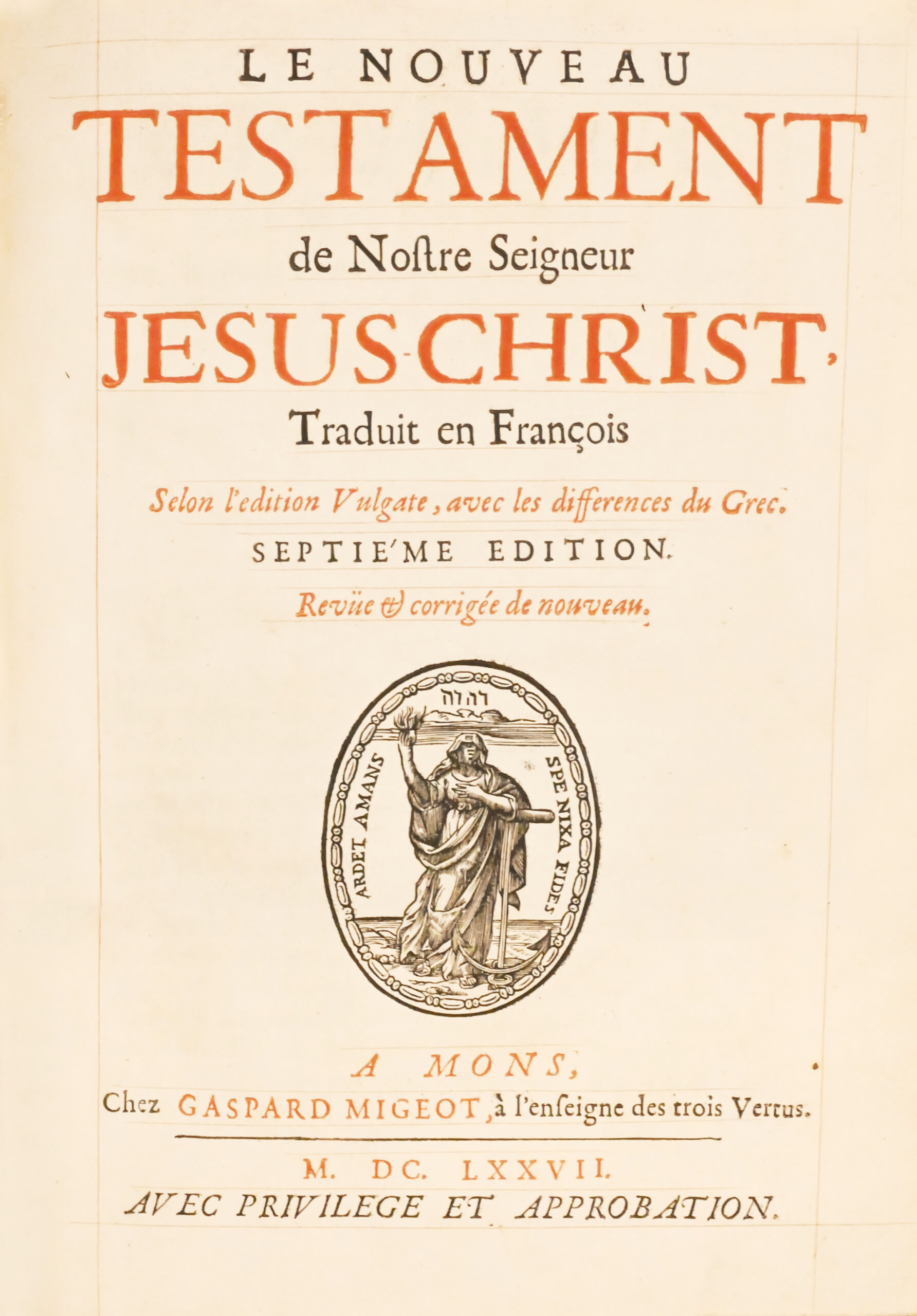
Mons, Gaspard Migeot, 1677.
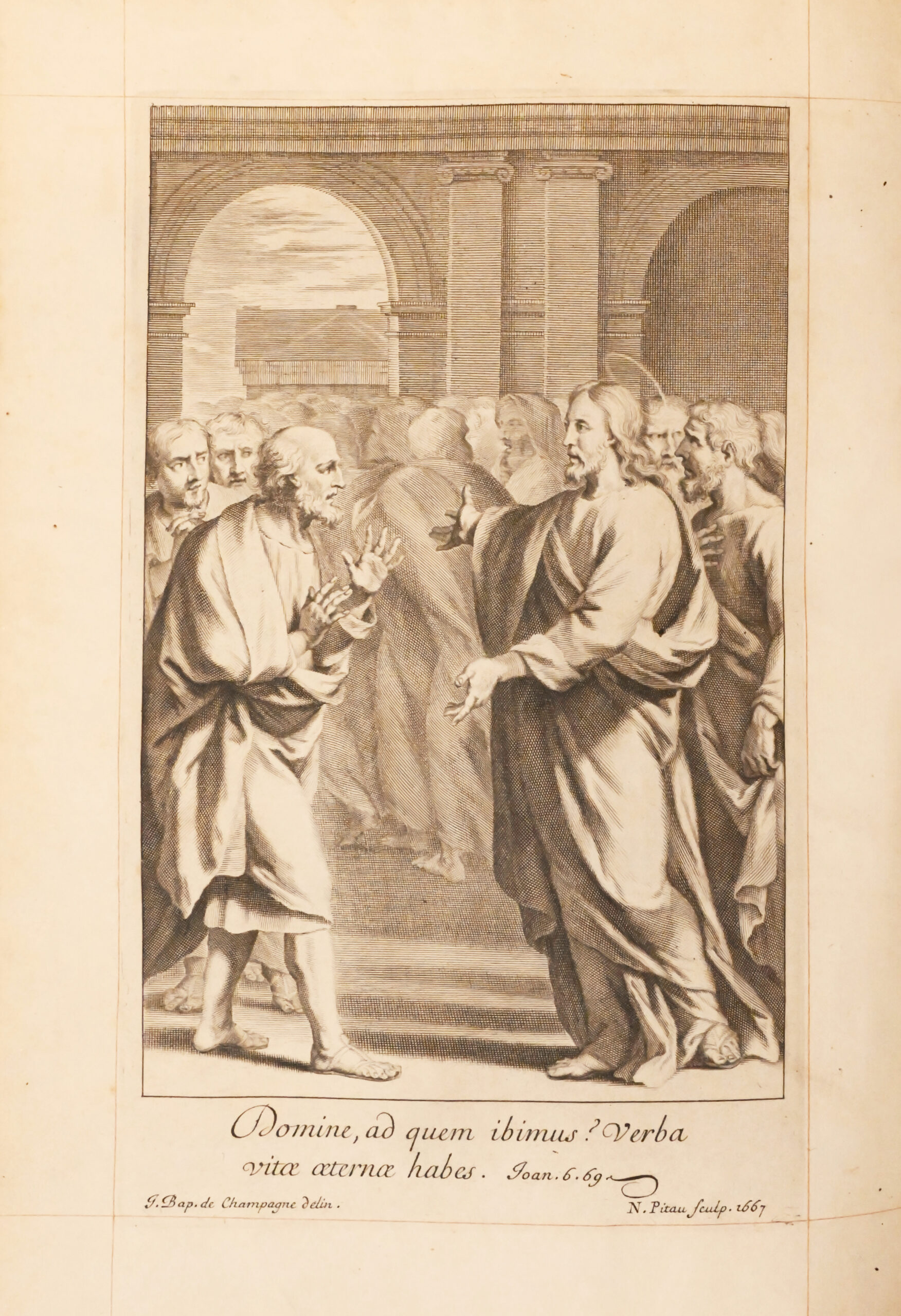
Two works in one 4to volume containing 1 frontispiece, (20) leaves, 503 pp., (1) blank leaf, (2) leaves, 408 pp., (3) leaves of table, (1) blank leaf. Ruled copy.
Salmon-red morocco, with the emblem of the Golden Fleece stamped in the corners and center of the covers and on the spine, raised bands, decorated edges, gilt inner roll, gilt edges over marbling. Contemporary binding.
257 x 180 mm.
The finest and most prestigious edition of the Port Royal “Nouveau Testament,” several privileged copies of which were bound at the time in armorial morocco and presented to the principal figures of the court of King Louis XIV. (Ref.: Copy of the marquise de Montespan, no. 54 in Librairie Sourget catalogue no. 31).
This celebrated translation, produced by the Jansenists, gave rise to one of the most intense controversies of its time; Father Maimbourg and the Archbishop of Paris, Arnauld, Nicole, and numerous anonymous writers attacked and defended this considerable work. The first letter of Fr. Maimbourg (Lettre d’un docteur en théologie sur la traduction du N. T. imprimée à Mons, s.l., n.d. [1667, quarto]) is of particular interest; it informs us that, in order to secure a favorable reception for this translation in society, a large number of finely bound copies were distributed to persons of rank: “The volume is convenient and easy to carry,” he says, “the finest paper has not been spared, the printing is so correct and the type so beautiful that it makes one eager to read it.” (Brunet, V, 744).
Known under the name Nouveau Testament de Mons, this translation was particularly esteemed by the Jansenists.
Until the beginning of the reign of Louis XIV (1661), French translations of the Bible had seen little innovation. Catholics such as François Véron and Michel de Marolles produced translations of the New Testament based on Erasmus’s Greek text, both insisting on the necessity of reading the Bible in the vernacular rather than in learned languages. Their innovative approach provoked strong reactions from ecclesiastical authorities, limiting the impact of their work. Protestants, for their part, continued to use the Geneva Bible in its 1588 version.
Around the abbey of Port-Royal, a profound interest in the Bible developed among reform-minded Catholics strongly influenced by Augustine’s thought. The central role of the Bible was reflected both in the spirituality of these men and women and in their desire to bring to all humanity this Scripture “whose sole subject is Jesus Christ” (Blaise Pascal). Within the Port-Royal circle, scholars worked not only in Latin but also in Greek and Oriental languages. The reading of the Church Fathers did not exclude contemporary commentaries, including works produced in Calvinist circles. In 1653, Antoine Le Maître, one of the Solitaires of Port-Royal, completed a translation from the Vulgate of the four Gospels and Revelation. A small circle of scholars, including Blaise Pascal and Antoine Le Maître’s brother, Isaac Lemaître de Sacy, began work in 1657 to revise this translation, compare it with the Greek text, and complete it. After the death of his brother Antoine in 1658, Sacy coordinated the team’s efforts, drafting and revising the translation. However, because of the threats hanging over Port-Royal, the manuscript remained unpublished. Realizing that uncontrolled copies were beginning to circulate, Sacy decided to publish the work.
The royal chancery refused to grant the privilege required for publication, and it was therefore necessary once again to turn abroad in order to have the text printed.
The work appeared in 1667 under the title Nouveau Testament de nostre Seigneur Jésus-Christ, Traduit en François Selon l’édition Vulgate, without an author’s name and with a fictitious publisher: Gaspard Migeot in Mons.
This Nouveau Testament, known as the “Mons” Testament, enjoyed exceptional success for its time: nearly five thousand copies were sold within six months. In 1668 it was reprinted four more times. In his preface to the first edition, Sacy justified the necessity for Christians to be nourished by Holy Scripture in these terms: “We are the children and disciples of Jesus Christ. If we truly cherish these two admirable qualities and regard them as constituting all our dignity and glory, how precious must this sacred Book be to us, since it is at once the collection of our Master’s divine teachings and the Testament that assures us of our Father’s inheritance.”
To counter the authority of the Nouveau Testament de Mons, several bishops forbade its reading within their dioceses, and even Pope Clement IX threatened excommunication against anyone who made use of it. Nevertheless, Sacy undertook the translation of the Old Testament with the same desire to produce a text that facilitated access to Scripture without sacrificing the rigor of translation. Imprisoned in 1666 because of his ties to the Jansenist movement and the abbey of Port-Royal, he continued his work even during the two years he spent in the Bastille. His Bible was published in separate books between 1672 and 1693. Many readers appreciated this exceptional translation of Scripture, which avoided rigid literalism without falling into the excesses of precious literature. Owing to this intelligent balance, the Bible of Sacy ranks among the masterpieces of classical literature.
Precious and magnificent copy bound in contemporary red morocco bearing the emblems of the baron de Longepierre (1659–1721), one of the most refined bibliophiles of the Grand Siècle.
Hilaire Bernard de Requeleyne, baron de Longepierre, was born in Dijon on Wednesday, 18 October 1659, into a family of the high Burgundian nobility. His privileged education enabled him to master Greek and other languages at an early age and to acquire vast learning. A great admirer of Sophocles and Euripides, he became known as comte de Longepierre or Hilaire de Longepierre through his French verse translations of Greek poets and through the publication of the Odes of Anacreon and Sappho in 1684, the Idylls of Bion and Moschus in 1686, a comparison of Corneille and Racine, and a discourse on the ancients in 1687, clearly marking his position in the quarrel between the Ancients and the Moderns. Longepierre’s comparison did more than simply prefer Racine for the regularity of his style and emotional sensitivity; it revealed how, at the end of the seventeenth century, the aging Corneille remained for younger authors both a model and a burdensome rival. The eternal rivalry between master and disciple! Although Longepierre’s writings were not especially successful among his contemporaries, he distinguished himself through his courageous defense of the Greek poet Sappho, born six centuries before Jesus Christ, a feminist, lover, and lesbian, a woman who “loved in every way that one can love, even going far beyond the bounds that modesty and decency naturally prescribe to her sex.” She would die of love for the handsome and fickle Phaon by throwing herself into the sea from a promontory at Leucade in Acarnania. He wrote several tragedies, including Médée and Électre, in the manner of the Greek poets, whom he imitated without equaling them. His Médée was first performed on 13 February 1694 at the theatre on rue des Fossés-Saint-Germain by the troupe of the Comédie française.
Jean Viardot dwells at length on Longepierre, whose “bindings are of unheard-of refinement,” and whose requirements “ultimately all relate to refinements concerning […] the nature and shade of the covering material (fawn calf, marbled calf, etc., red, blue, lemon morocco…), the workmanship and decoration of the binding…”
Provenance: Longepierre (1659–1721); Charles Van Der Elat, with his bookplate (Cat. 1985, no. 142, “Very fine copy.”).
Roger Portalis, Bernard de Requeleyne baron de Longepierre, 1905, pp. 1, 20, and 21; Chambers, II, 1439; E. Hublard, Le Nouveau Testament de Mons. Histoire d’un livre. Mons, 1914; Viardot J., Histoire des bibliothèques françaises, 1988, vol. 2, p. 282.