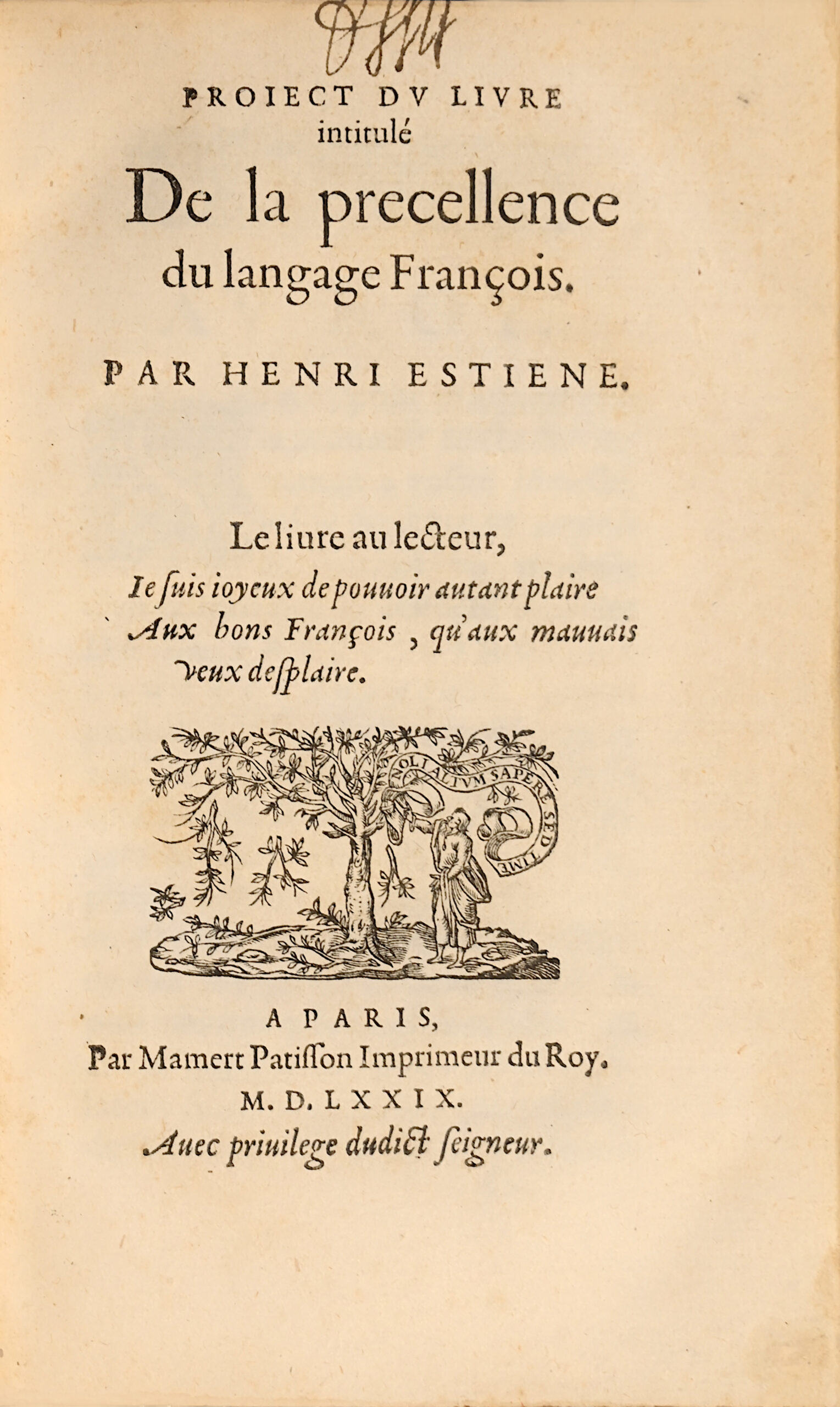
Paris, Mamert Patisson, 1579.
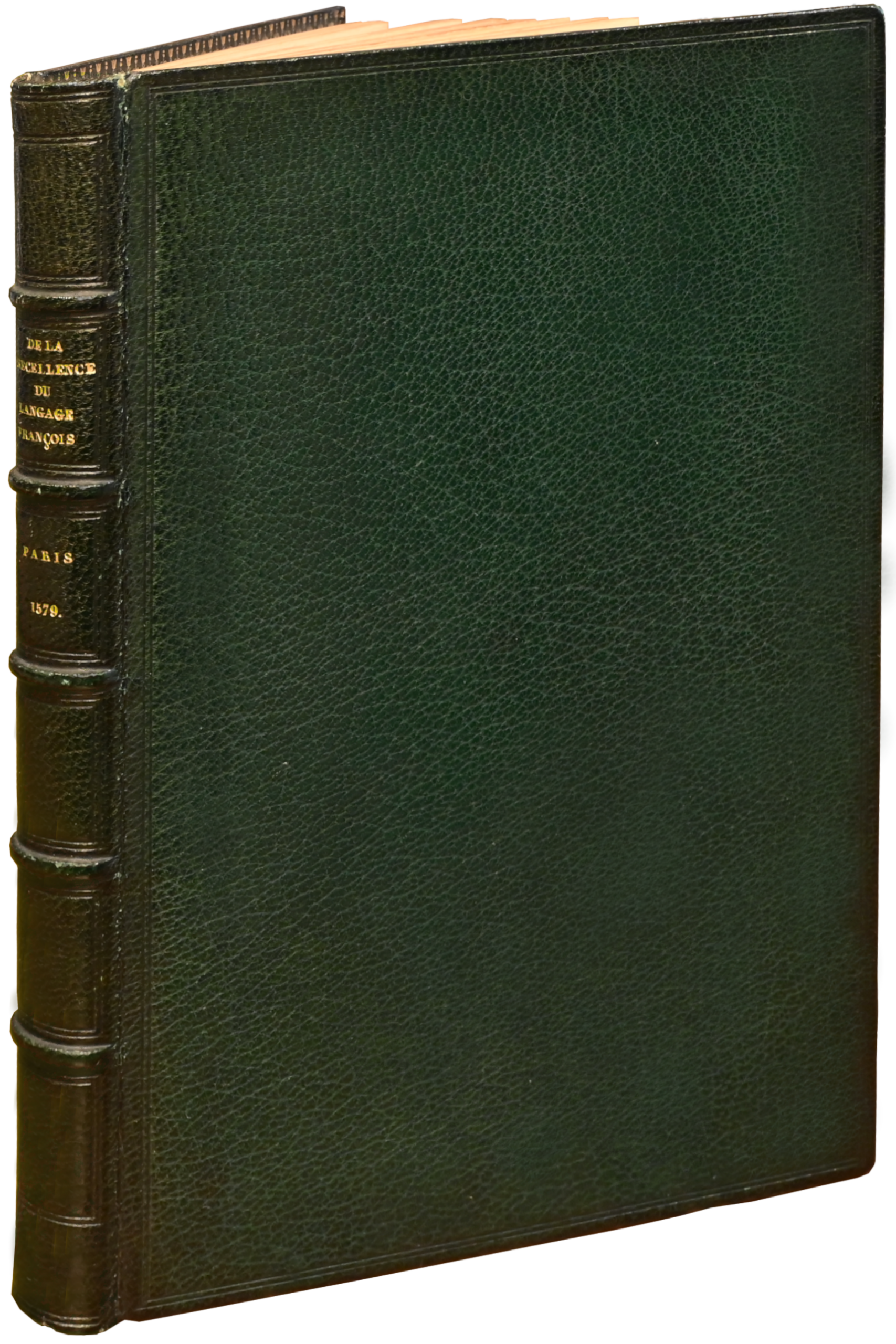
Octavo of (16) leaves, 295 pages and 1 blank leaf. Roman type, headpieces, running titles, Estienne’s device on the title page. Green morocco, double blind fillet around the boards, raised bands on spine, inner dentelle, gilt edges. *Niédrée*.
164 x 104 mm.
Original edition of “this sought-after volume”(Bulletin Morgand and Fatout, No. 8187) dedicated to Henry III, of this famous treatise by the great Henri Estienne.
Cioranesco, 9616; Adams, S-1786; Renouard,Estienne, 181, No. 3.
This book was written in less than three months and from memory, in response to Henry III’s keen desire to see such a work published. It earned its author a pension of a thousand livres and intimacy with the king.
Henri II Estienne, nicknamedthe Great, lord of Grière, was a typographer, philologist, scholar, satirical author, polemicist, first-rate grammarian.
Estienne’s French works place him among the foremost defenders of the language, following a Joachim du Bellay and an Estienne Pasquier. He even surpasses them in his fervent love for the language of his birthplace. He holds a true doctrine on this point. And this doctrine has been reduced to a rigorous syllogism: 1° there has never been and will never be a more beautiful language than Greek, 2° yet, French is of all other languages the closest to Greek, 3° therefore, French is superior to all modern languages.
This “.Project of the book titled De la précellence du langage françois“, Mamert Patisson, 1579is a very remarkable work. Estienne does not merely recommend the use of French, as du Bellay, Pasquier, and Ronsard had done, he refutes the Latinists and wants the qualities of French to bestow it the right to live as a literary language, not only alongside butabove Latin: ” My intention, he says, is not merely to show that the French language is more capable of eloquence, or capable of greater eloquence than others when it comes to speech-making; but that generally in all things where one wants to use it, much greater conveniences are found. »
Original edition, dedicated to Henry III by a long letter. – In his fight for the defense of the French language, Estienne had published hisDeux Dialogues du nouveau langage français italianizéin Geneva in 1578. There, he stigmatized the abusive use of Italian words at the French Court. Condemned by the Grand Council of Geneva, Estienne fled to Paris where he was to print this new work, commissioned by the king, the most detailed and complete of the three he dedicated to the French language. The humanist takes up his earlier writings on the value of French opposed to Italian, Latin, and even Greek. To support his demonstrations, he invokes Dante, Petrarch, Boccaccio, Bembo, and Ariosto, and the French Desportes, Baïf, Belleau, Du Bellay, and Ronsard. – Renouard,Annales Estienne, p. 181, No. 3. – Schreiber,The Estiennes, 250.
An interesting analysis leads Estienne to compare the translation of Virgil’s verses by Ariosto and by himself; he cites five successive versions of different passages to show the superiority of the French language over the Italian one: It is certain that one could translate them in such a way that they would have even more gravity : but I hope it will be confessed that of these five, the one that has the least, still has more than Ariosto’s Italian. He then shows how Ronsard undertook to retranslate verses of Virgil, previously rendered into Italian by Ariosto. This was the time when Ronsard, always delaying, in expectation of a royal reward, completing hisFranciade, would circulate fragments in manuscript form; the fourteen verses reproduced by Estienne are part of the prolegomena of this work (cf. Exposition Ronsard, Paris, Bibliothèque nationale, 1985, 11° 176).
To show the shift in the meaning of many proverbs, Estienne analyzes the successive replacement of one by another: To go from Wisdom to Science, our ancestors also taught us to say, Science has no enemies but the ignorant.Item, Science without fruit is worth little. Item, There is no treasure like knowledge. Or, wealth like knowledge. Nonetheless, they also said Diligence surpasses knowledge. But some today say, Patience surpasses Knowledge.
Among the proverbs thus examined, many inform about the mindset of the time Might is not right ; Friends are worth more than money; He who is hated by his subjects is not the lord of his land, etc.
Beautiful copy of this rare book from the library of Viollet le Duc, with ex libris. Signature from the period on the title, not identified.