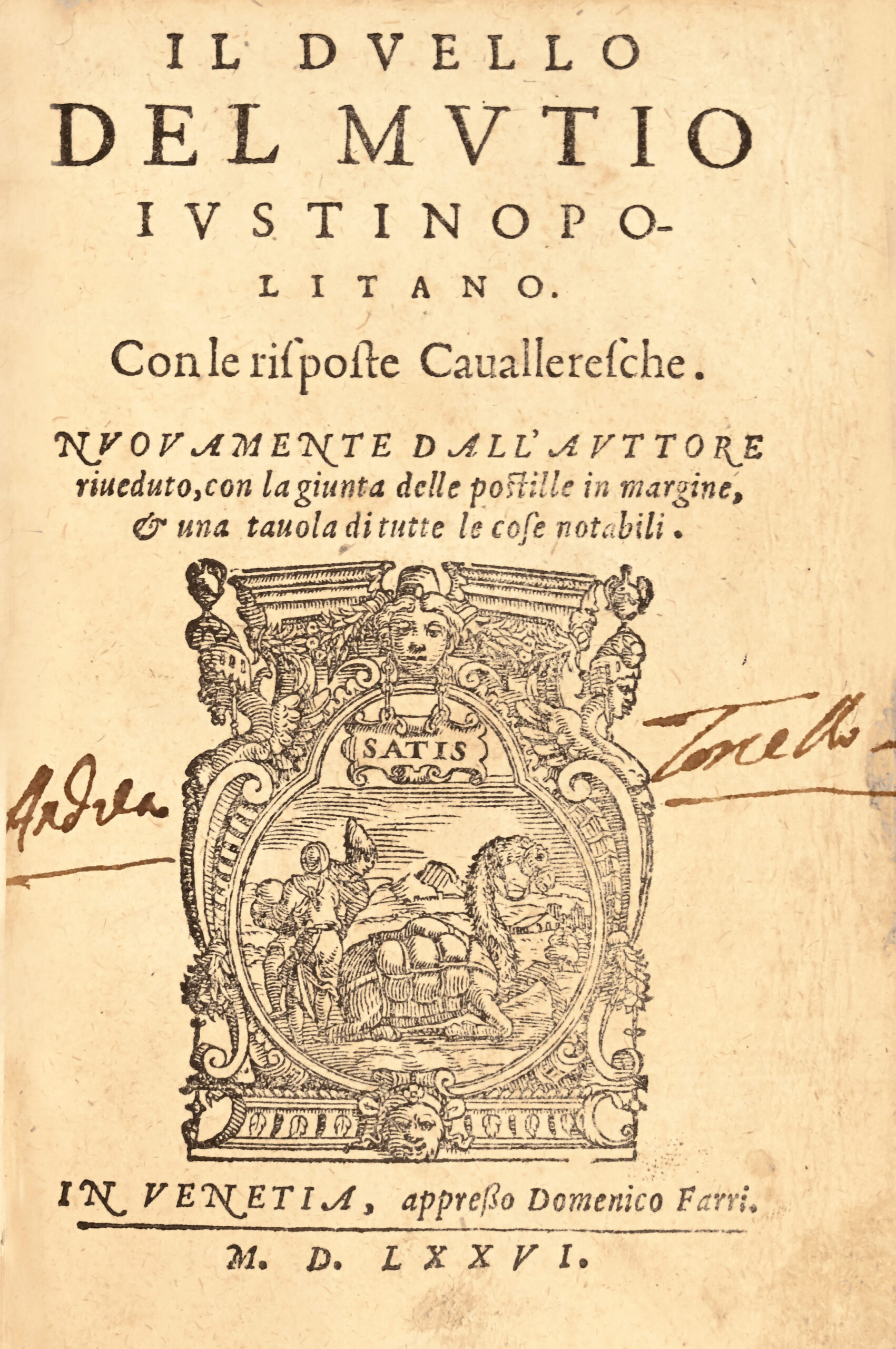
Venice, Domenico Farri, 1576 and 1575.
2 parts in 1 volume octavo of (16) leaves, leaves 9 to 223, small tear at the upper corner of leaf 156, printer’s mark on the titles, handwritten inscription Andrea Torcello on the first title and on the last leaf.
Binding dimensions: 147 x 102 mm.
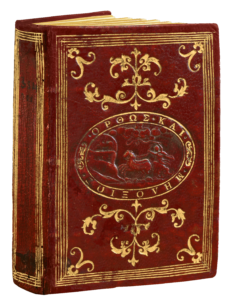
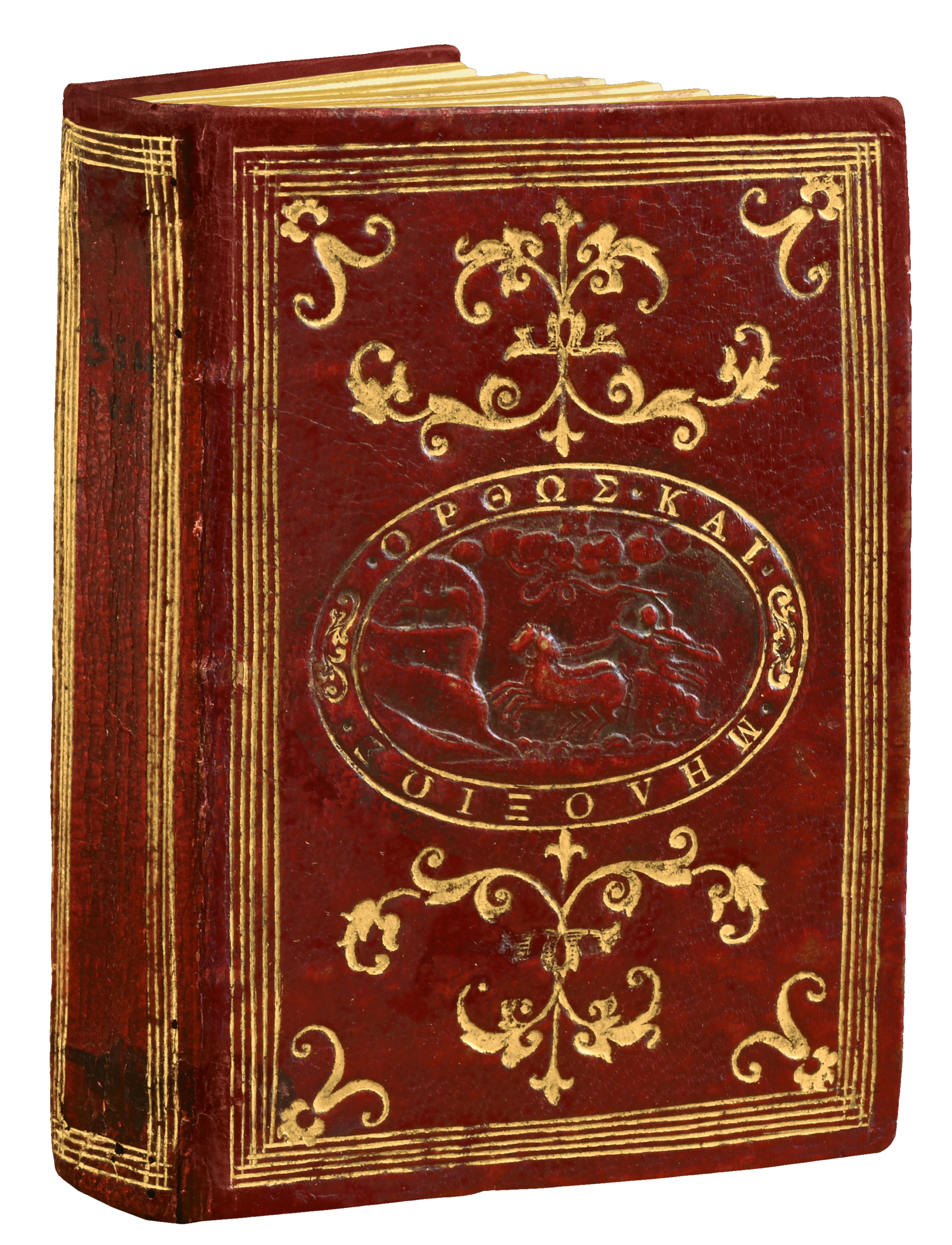
Italian binding from the period in red morocco, cold and gold decoration on the covers in the style of the famous “Grimaldi bindings.” Covers adorned with five gilt fillet frames, at the center of the covers, Apollo and Pegasus embossed in cold within a horizontal oval encircled by a Greek motto in golden letters, on either side of the oval, gilded scrolls and fleurs-de-lis, gilded scrolls in the corners, smooth spine framed with four gilt fillets.
The bindings stamped with the distinctive medallion of Apollo and Pegasus were famous long before their original Renaissance owner was identified as the Genoese Giovanni Battista Grimaldi. Their fame prompted at least two, if not more, binders to produce counterfeit or forged Apollo and Pegasus bindings between the late 19th century and the first quarter of the 20th century.e century and the first quarter of the 20the century. The best-known forger of Apollo and Pegasus from the late 19the century was Vittorio Villa, from Bologna and Milan, acting in concert with Monte. As Nixon pointed out, these were more often forgeries than counterfeits, meaning 16th-century bindings with little or no decoration to which Villa would add the medallion and other decorations.
For these bindings, Villa maintained the visual distinction between modern and ancient literature in the Renaissance library of Grimaldi; modern literature was bound in red leather, while ancient literature in darker colors.
(H.M. Nixon, ‘Binding Forgeries’, e century with little or no decoration to which Villa would add the medallion and other decorations.
For these bindings, Villa maintained the visual distinction between modern and ancient literature in the Renaissance library of Grimaldi; modern literature was bound in red leather, while ancient literature in darker colors.
(H.M. Nixon, ‘Binding Forgeries’, Proceedings of the VIè International Congress of Bibliophiles, 1969, Vienna, 1971, pp. 73-76).
Beautiful example of the famous Grimaldi binding by the renowned Bolognese binder Vittorio Villa (died in 1892), active around 1870-1883. The version of the horizontal medallion with only four rays for the chariot wheel and the motto being part of a block rather than stamped separately with more irregular lettering than here are obvious signs.
Moreover, Villa preferred adding his “stamping art” to existing old bindings, thus, in our case, to a beautiful period morocco.
Old editions of Duello by Muzio with Le Riposte Cavalleresche. Both works are rare, as they were published together for the first time in 1558.
Girolamo Muzio was born in Padua in 1496 and studied there. He was honored by Pope Leo X with the title of knight and served the Marquis del Vasto; after the latter’s death, he entered the service of Don Ferdinando Gonzaga, managing affairs in several Italian courts. The Duke of Urbino then appointed him governor of his son, the future Duke Francesco II. Later, he served Cardinal Ferdinand de Medici. He died in 1576. In 1551, he published, along with other Italian poems, his Arte Poetica, in three books, composed in blank verse. In addition to letters, histories, moral treatises, he wrote several treatises against reformers, particularly those of the Italian nation, who were numerous at the time. He first attacked Vergerio. He then opposed Ochino and Betti, followed by Bullinger, Viret, and others. To counterbalance the Protestant authors of ecclesiastical history, known as the Magdeburg Centuriators, Muzio published in 1570 a Roman Catholic history of the first two centuries, compensating with polemical zeal for what it lacked in solid scholarship.
These very rare bindings, involving the Grimaldi family, are now considered artistic specimens and are actively sought after.