
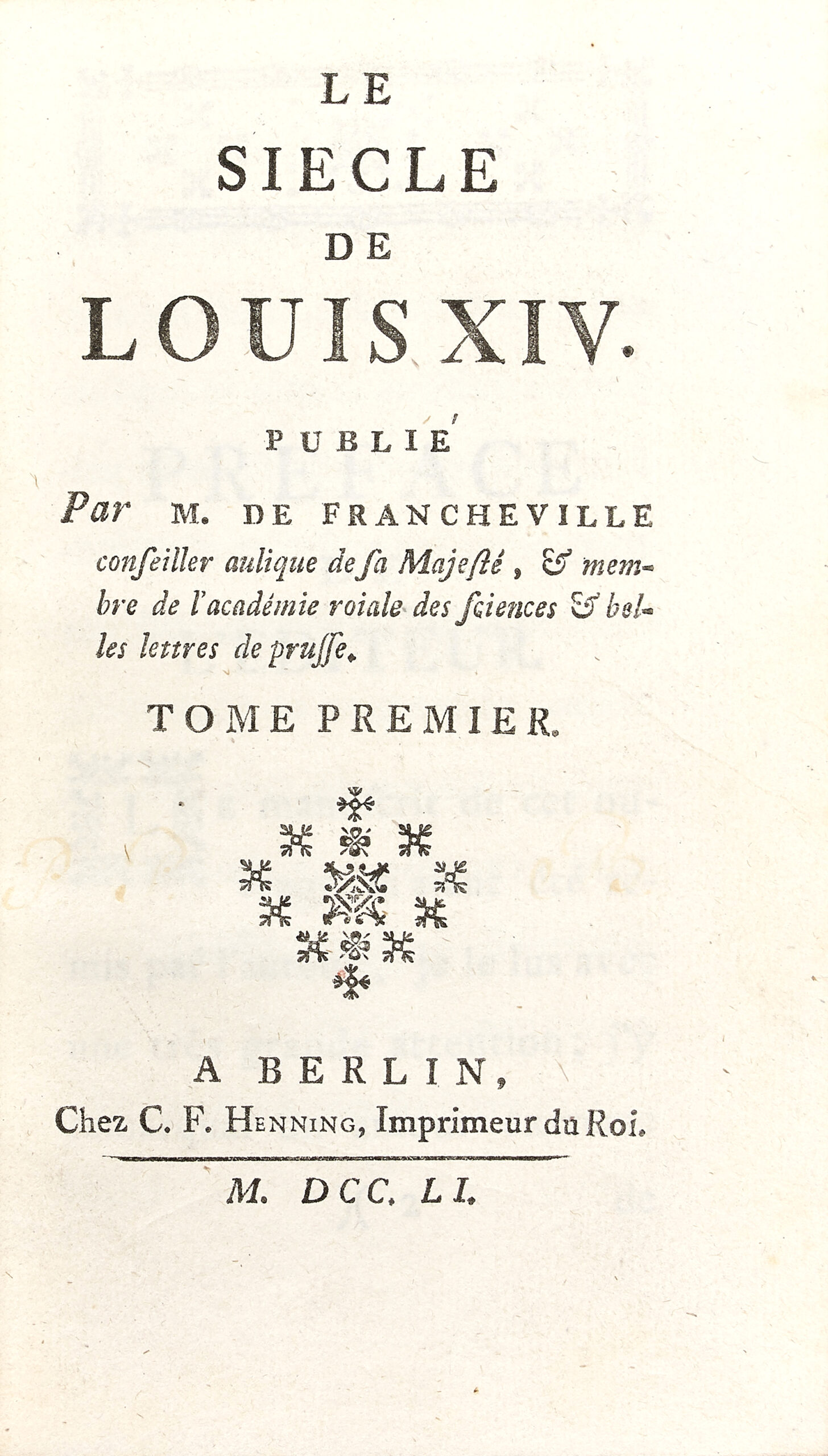
Berlin, C.F. Henning, 1751.
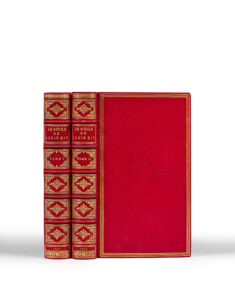
2 parts in 2 volumes, 12mo: I/ (7) ll., 488 pp., (1) errata leaf, small tear restored without loss p. 191; II/ (2) ll., 466 pp., (1) errata leaf. Red morocco, triple gilt fillet framing the covers, spine with raised bands decorated with gilt fillets and fleurons, double gilt fillet on the edges, gilt inner roll, gilt edges over marbling. Binding signed by Chambolle-Duru.
143 x 85 mm.
True first edition “very rare and sought after” of one of Voltaire’s major works, printed in 3,000 copies (Letters of Voltaire to Walther, December 28, 1751).
Bengesco, no. 1178.
“The 1751 edition, the original, presents two particularities: there is not a single capital letter throughout the work except at the head of paragraphs (…) It is the first book printed entirely with Voltaire’s spelling.” (Bengesco, no. 1178).
Having contemplated it since 1732, Voltaire undertook this historical work at Cirey, at the request of the Marquise du Châtelet, who wished to be able to read modern history without fatigue.
This gallant gesture in fact answered the author’s deeper purpose: to explain the world of history in the light of eternal reason.
He said that he spent thirty years acquainting himself with the principal facts of this reign.
“His eventful life had brought him into contact with a great number of direct witnesses and prominent figures of the reign of Louis XIV, thus making especially vivid the intrigues and anecdotes revealed to the public for the first time, such as ‘the Man in the Iron Mask’ or ‘the Affair of the Poisons,’ and so richly charged with the atmosphere and spirit of the age.”
The long maturation of the work then led Voltaire toward a study of the progress of the human mind and of the history of manners. “It is more the history of a great century than of a great king that I write.”
Le Siècle de Louis XIV is at once the most important of Voltaire’s historical works and one of his finest creations. In it Voltaire shows himself the equal of the great writers of the seventeenth century whose brilliant superiority he here proclaims (Dictionnaire des œuvres).
“Voltaire here reveals himself as one of our first historians” (R. Pomeau, En Français dans le texte).
Le Siècle de Louis XIV astonished Voltaire’s contemporaries.
As early as June 17, 1738, Frederick II wrote to Voltaire: “I beg you earnestly to continue Le Siècle de Louis XIV. Never will Europe have seen such a history; and I dare assure you that no one has even conceived of a work as perfect as the one you have begun.”
The initial intention was to demonstrate the superiority of the seventeenth century, “so fertile in great minds,” and of Louis XIV, over the government of Louis XV. Great was Voltaire’s audacity in undertaking such a work in 1732.
The writer preferred to publish the work in Berlin, under the unofficial patronage of Frederick II, and it was in that city that the first edition was printed, by C.F. Henning, the king’s printer. Voltaire’s name does not appear on the title page.
“First modern historian, Voltaire thus produced the first great historical work in which the central figure is the nation and the interest is focused on manners rather than on battles. There was both audacity and courage in undertaking, around 1732, such a work. The memory of Louis XIV was detested; people remembered only the miseries of the end of the reign, the austerity of its final years. What is remarkable is that he attempted to anticipate the judgment of History and that he, on the whole, succeeded admirably; each chapter is a masterpiece of lucidity, rapidity, intelligence, and synthesis” (Dictionnaire des Œuvres).
Attractive copy finely bound by Chambolle-Duru in an elegant red morocco binding.
Provenance: Genard (cat. 1882, no. 858) and Léon Rattier (cat. 1920, no. 196), with bookplates.