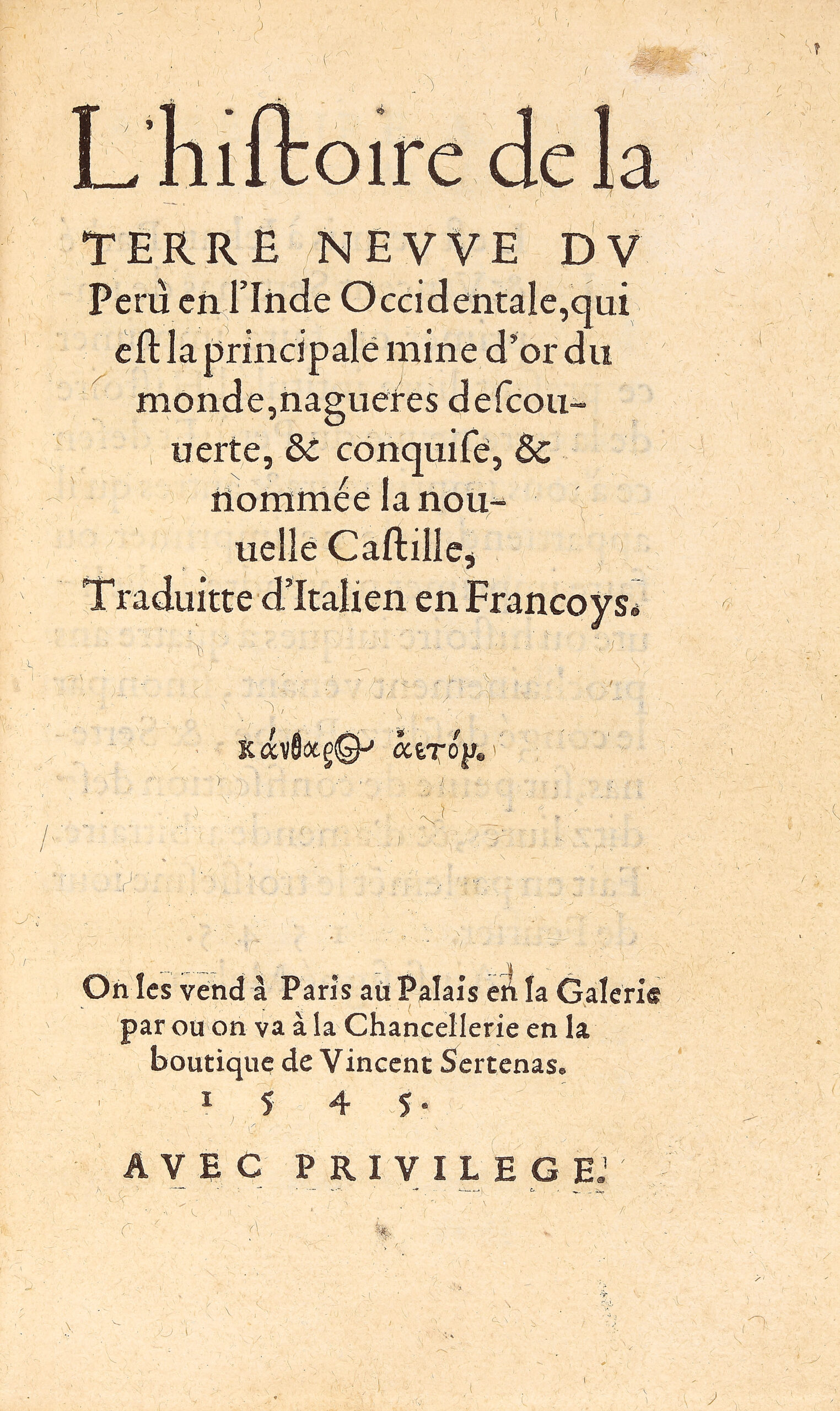
Sold in Paris at the Palais, in the gallery leading to the Chancellerie, at the shop of Vincent Sertenas. 1545. With privilege.
[Colophon:] Printed in Paris by Pierre Gaultier, for Iehan Barbé & Vincent Sertenas. 1545.
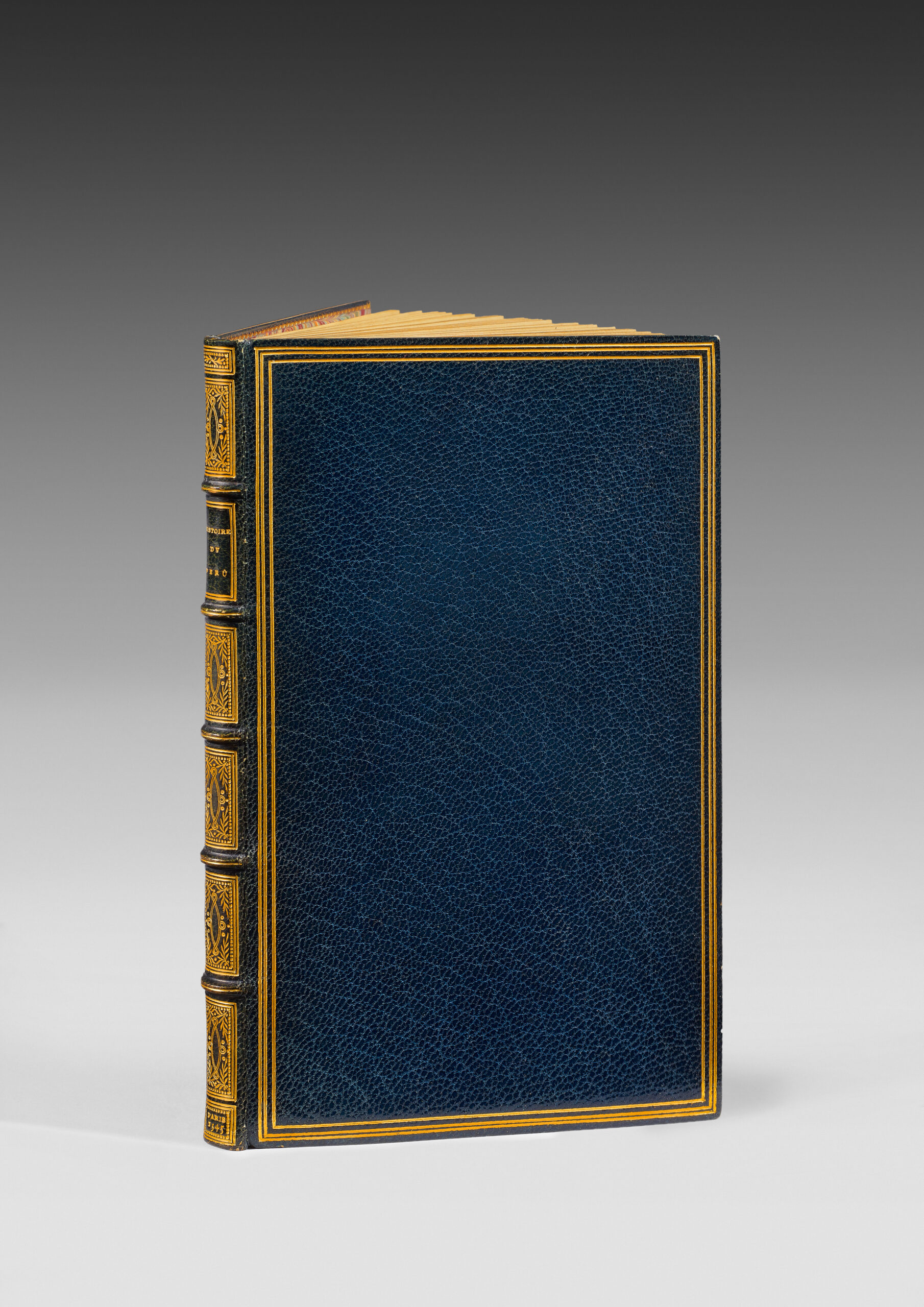
Small quarto. A-O4, (4) leaves, (52) leaves, 56 leaves in all, the last blank. Blue morocco, triple gilt fillet border, raised-band spine decorated with gilt tooling, red morocco doublures bordered with gilt fillets, red moiré endpapers, gilt edges over marbling. Lortic fils.
166 x 101 mm.
The first edition, attributed to Jacques Gohory, is so rare that Sabin, as well as Alden and Landis, record only 53 leaves. Chadenat does not mention it at all.
“In 1545 there was published in Paris a pamphlet of fifty-six leaves which bore the following title: ‘L’histoire de la Terre Neuve du Pérù en l’Inde Occidentale, qui est la principale mine d’or du monde, naguères descouuerte, & conquise, & nommée la nouuelle Castille’.
[Printed in Paris by Pierre Gaultier for Iehan Barbé and Vincent Sertenas, 1545. Copies of this rare book are in the Bibliothèque Nationale, the John Carter Brown Library in Providence, and the New York Public Library].
This short treatise is the first substantial account in French of Francisco Pizarro’s conquest of Peru (1531–1533). Published anonymously, the French account translates an Italian work, also anonymous, itself translated from a Spanish original first published in 1534 without an author’s name.
[Peru is mentioned in a translation of P. Martire d’Anghiera, Extraict ou Recueil des Isles nouvellement trouvées en la grand mer Océane (Paris, Simon de Colines, 1333). There is also a translation of a letter sent by Hernando Pizarro to the Audiencia Real de Sancto Domingo, published under the French title Nouvelles certaines des Isles du Peru (Lyon, Françoys Juste, 1534).]
The Italian work on which the French translation was based was printed in Venice in 1534 under the title Libro Ultimo del summario delle Indie Occidentali. It formed the third volume of a series entitled Summario de la generale Historia de l’Indie Occidentali.
The entire series was published in Venice in 1534. According to Alexander Pogo, whose article “The Anonymous La Conquista del Peru and the Libro Ultimo del Summario delle Indie Occidentali,” published in the Proceedings of the American Academy of Arts and Sciences, vol. LXIV, no. 8 (Boston, July 1930), was my starting point, the printer was probably Nicolo d’Aristotile detto Zoppino (op. cit., pp. 195–197).” (Istor).
“The last two lines of leaf Bij contain the following statement: ‘The author is Gonzalo Ferdinando del Oviedo, a native of Madrid, who wrote the general history from which this summary is drawn’. Title corrected from our no. 32018. The translation is thought to be by Jacques Gohory. See [Hartisse], no. 264.
“Oviedo’s work, written by a man who lived in America for more than twenty years, is the source from which most later authors drew their accounts of the earliest events in the New World.” — Rich.
“Among those who went to America in the early days and left important accounts of their adventures and their times, Gonzalo F. de Oviedo was one of the most notable.” — Ticknor, Hist. Spanish Lit., I, p. 561. “Despite his obvious shortcomings, Oviedo showed an enlightened curiosity and a keen eye for observation that place him well above the average chronicler.” — Prescott, Hist. of the Conquest of Mexico, II, p. 293, note. Las Casas makes this observation: ‘Oviedo should have written at the beginning of his history: “This book was written by a conqueror, a thief and a murderer of the Indians, whose entire populations he sent to the mines, where they perished.”’ — Gén. Hist. de las Indias, ms., chap. XXIII. See also our vol. I, no. 1565.” (Sabin 57994).
The date “1333” has been retained as it appears in the supplied text. Ticknor’s name has been restored in the bibliographic reference.
The blank lower margin of leaves B1 and B2 was restored by Lortic around 1880.
From their first encounters with Indigenous peoples, religion was a central concern for Europeans. Evangelizing missions began as soon as political authority was established.
Missionaries first baptized the elites, then a substantial portion of the population. These peoples did not passively accept the new religion. Some rebelled; others embraced it and adapted it to their values. Hybrid cultures thus emerged, blending the languages and practices of different worlds.
For the Catholic Church, the question of the very nature of Native Americans became central. In 1550, Emperor Charles V decided to convene a debate in Valladolid, Spain, to settle the matter. He brought together Bartolomé de Las Casas, who defended Native Americans and their humanity, and Juan Ginés de Sepúlveda, who argued that their alleged savagery and cannibalism justified their conquest and enslavement. At the end of the debate, it was accepted that Native Americans had souls.
Colonization through trade: merchants and landowners.
As soon as the conquest was complete, Europeans set about seizing the wealth of the conquered territories. Spaniards and Portuguese flocked to the colonies. The discovery of precious metals (jewelry, religious objects, etc.) attracted young nobles who dreamed of making their fortunes. They plundered the empires’ treasures and exploited gold and silver mines, such as the one at Potosí in Peru (1545). Europeans founded new cities and established farms and ports. The Spanish Crown imposed forced labor (Encomienda) on Native Americans, a practice that continued after the Valladolid debate. Crops suited to the climate, such as sugarcane, were introduced to Brazil and the Caribbean. Plantations were established to produce sugar, a commodity in great demand in Europe. These plantations initially relied on the enslavement of Indigenous peoples and then, as Native American populations gradually declined, on enslaved Africans, who began arriving in the Americas by the late 16the century. This economic system led to the establishment of the triangular trade and the forced transport of approximately 13 million Africans between the 16the and the 19the century.
A complete copy, with exceptionally wide margins, of extraordinary rarity—the market appears to record no other copies, and the standard bibliographers are mistaken in stating that it contains 53 leaves when it should have 56.
The map in the B.n.F. copy does not appear to be part of the edition and is not mentioned by Sabin.
The digitized copies held by the Austrian National Library and the Bibliothèque de l’Arsenal do not contain a map. Nor does the copy in the B.nF. Rare Books Reserve.