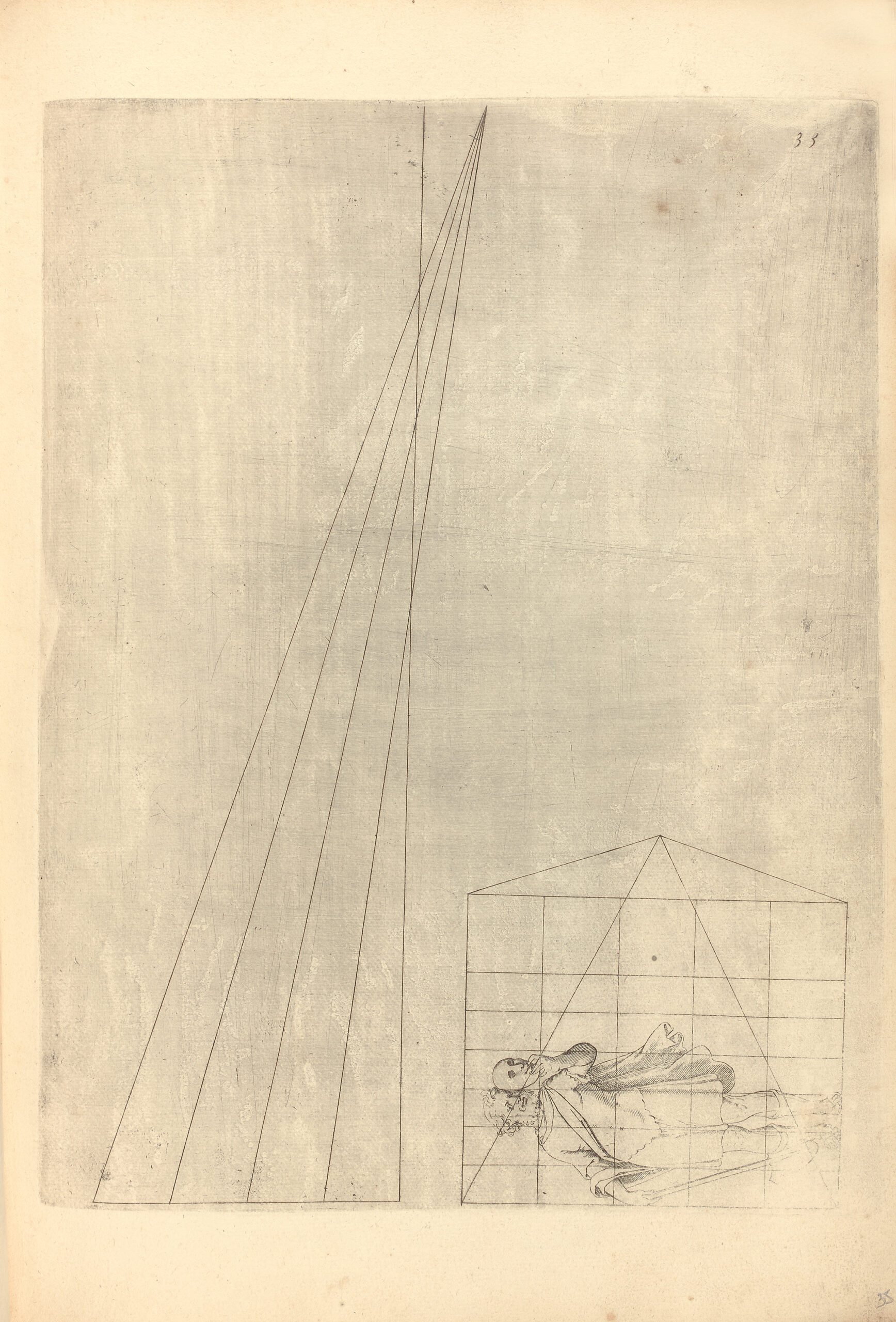
In Paris, from the Printing House of Iehan le Royer, 1560.
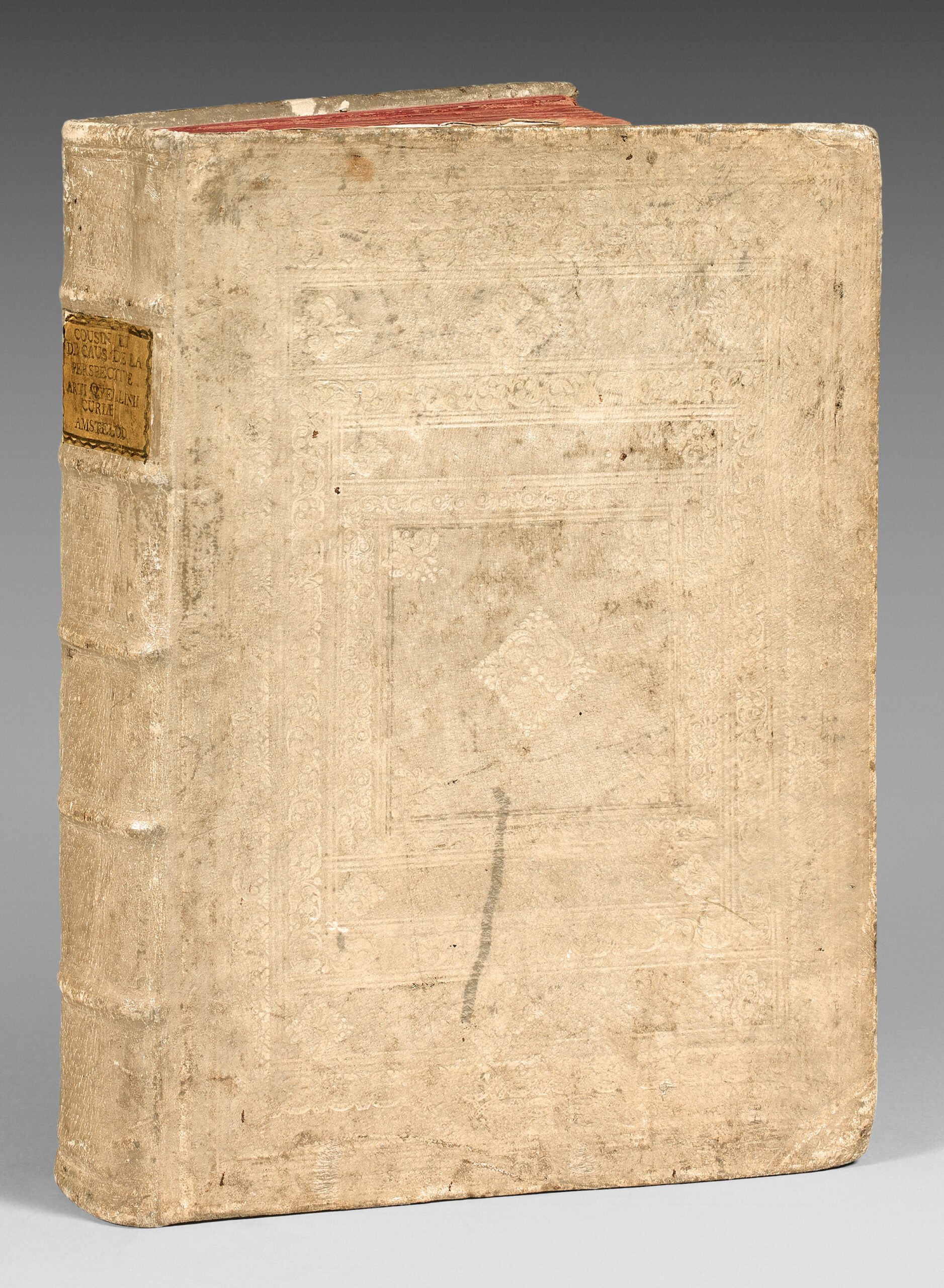
Folio of (72) leaves signed A5, B-I4, K6, L4, M5, N-R4, blind-stamped pigskin with central decoration, spine with raised bands, red edges. Binding of the period.
399 x 268 mm.
Original edition.
A protean artist of the Renaissance, Jean Cousin (circa 1490 or 1500 – after 1560).
Originally from Soucy near Sens, Jean Cousin worked as a surveyor before gaining attention for his paintings at the abbey of Vauluisant and as a designer of stained-glass cartoons for the Saint-Etienne Cathedral of Sens… the Saint-Florentin church of Saint-Florentin (Yonne)… Around 1538 he moved to Paris, then worked for weavers (tapestries of Saint-Mammès in 1543 for Cardinal de Givry, of which three elements are preserved in Langres and at the Louvre Museum), for glassmakers, and once more created stained-glass cartoons including grisaille ones for the Anet Castle, and painted full-length portraits of Francois Ist and Henri II for Vincennes Castle…
We also know of his engraving works, including two signed burins (The Entombment, The Annunciation), goldsmithing, embroidery, and illustration.
The Book of Perspective is a treatise inscribed in the movement initiated at the beginning of the 15the century in Italy where arts and science merge.
Through a simple and rigorous approach, the author contributes to the idea that the construction of an image in perspective adheres to a corpus of geometric rules that must all be systematically applied. Although influenced by Viator, Cousin sets himself apart by offering an innovative theory that consists notably of distinguishing two planes of different nature to trace a figure in perspective.
An aesthetic of the book in the service of a theory.
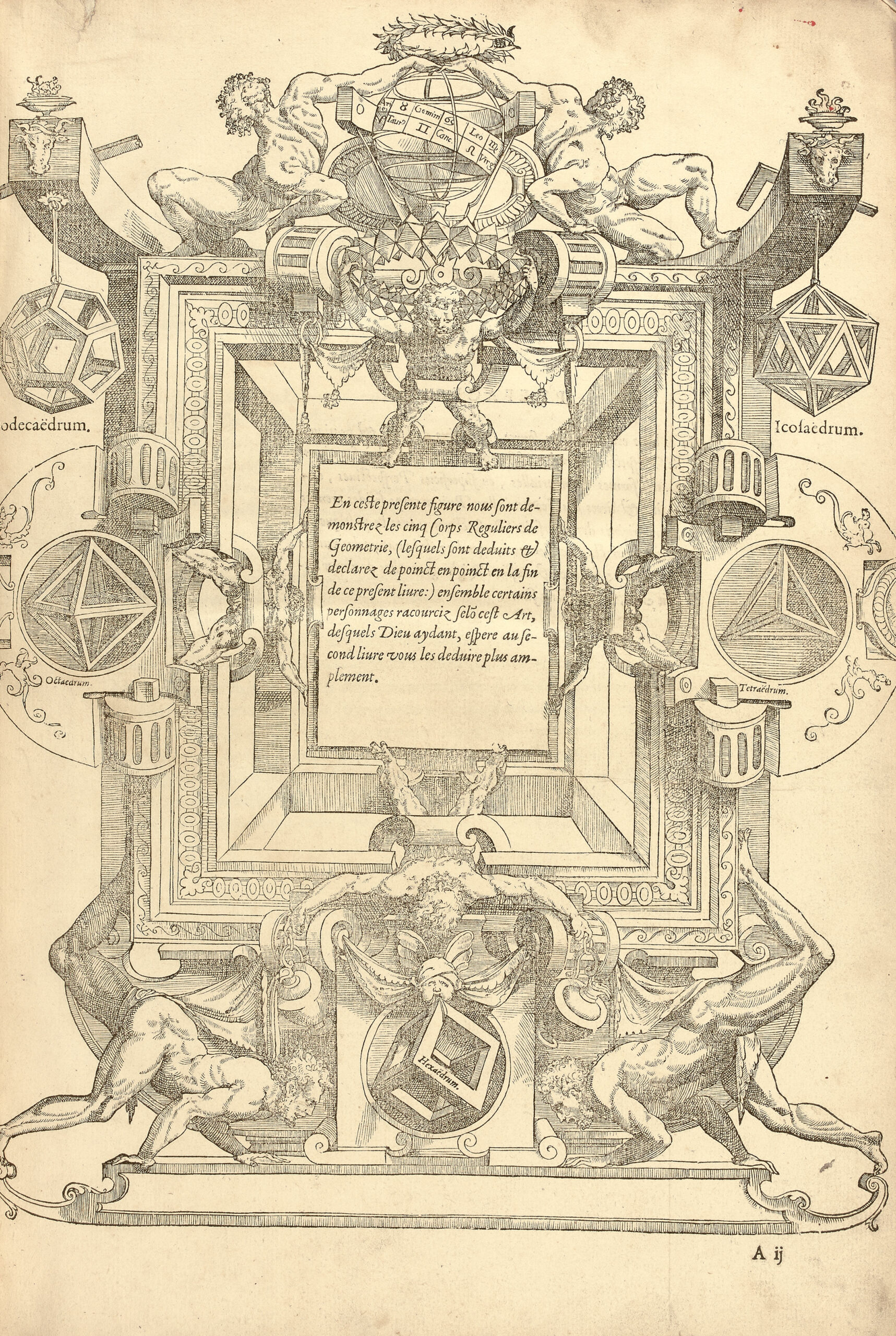
Its format, layout, typography, and diagrams, from the author’s own hand, contribute to the clarity of the demonstrations. The work met the expectations of its readership perfectly, artists and art enthusiasts. It is found in many inventories established after death.
The drawings were interpreted on wood by Jean Le Royer, the King’s printer in mathematics, and his brother-in-law Aubin Olivier. Five of the 58 engravings were printed on double leaves.
A very well-preserved copy of a rare book, especially in fine condition.
It is complete with the cardboard folio C3.
A very attractive and genuine copy of the first edition (and only early one) of this work – rarely found complete – on perspective, which Updike calls “one of the handsomest volumes of its time.”
It is through this work that Jean Cousin became known as the major theorist of artists’ perspective in sixteenth-century France, and was credited with perfecting the tiers points technique that was somewhat confusingly described by Pelerin at the beginning of the century. In his hands the tiers point technique “became a reliable, comprehensive and substantially accurate method for tackling the construction of space and the foreshortening of solid bodies” – Kemp, The Science of Art Cousin’s work was not republished again until 1974.
“Cousin’s book is oriented toward the artist and the craftsman in the fields of painting and architecture…Cousin’s is the first treatise to include material on the drawing of the architectural orders” (Millard, French Books, 57), a fundamental skill in the toolkit of Renaissance architects.
Mortimer Harvard French, 157 (for two volumes bound in the 19the century) ; Updike, Printing Types, I, p. 202 (“One of the Handsomest volumes of its time“); Mark J. Millard,French Books57 (for a copy in modern binding); Brunet, II, 339; Bibliothèque nationale de France,French Engraving during the Renaissance,p. 468 (“Jean Cousin the Elder has long been considered one of the major figures of the French Renaissance“); DidotCousinpp. 113-118, Architectura Architecture,Texts and Images, XVIè-XVIIè centuries, Cousin; A. de Vitry,2002, no. 158 (for a copy in ivory vellum of the period, dimensions: 411 x 280 mm); P. Berès, 2002, no. 23 (copy bound by Lemardeley, missing the last leaf).
Bound at the end:
1. Caus, S. de.Perspective, with the reason for shadows and mirrors by Salomon de Caus,Engineer to the Most Serene Prince of Wales.
London, Robert Baker, 1611, folio of (69) leaves including the engraved title. The engraving positioned at the top of leaf 10 was printed in reverse.
True original edition, extremely rare.
In 1612, a second edition was released, known in two issues; it is often presented as the original.
An architect-engineer, Salomon de Caus (1576-1626), in the service of European courts. Born to a Protestant family from Dieppe, escaping his predestined fate as a sailor, de Caus embodies the archetype of the architect-engineer at the end of the 16th century.è Close in concerns to his contemporaries such as Simon Stevin of Bruges (1548-1620), Albert Girard (1595-1632), and Girard Desaegue (1591-1661).
To perfect his knowledge, de Caus stays in Italy, then serves as an engineer to Archdukes Albert and Isabella, in Belgium, from 1610, at the court of Henry of Wales until the latter’s death, to whom he teaches a course on perspective, an education that would form the framework of his book published in 1611. He would have participated with James Irfrom England to the design of the gardens of Richmond, Greenwich and Somerset House, a talent he employed between 1612 and 1619 for the realization of the gardens of Heidelberg Castle, then the property of the Elector Palatine Frederick V. The latter, forced into exile in 1620 in Sedan, compelled de Caus to return to France, who then sought the protection of Richelieu.
On March 30, 1621, he was appointed architect and engineer to the king. He oversaw sanitation works in Paris, and died in this city in 1626, two years after publishing his treatise on gnomonics.
The Perspective, with the reasons for shadows and mirrors..,first treatiseon perspective printed in Great Britain.
Dedicated to Henry, Prince of Wales, the work follows a four-part plan. The first part covers preliminary generalities, the second, the most substantial, deals with the perspective rendering of flat and solid figures, trompe-l’œil (a fictional garden extending a real garden), anamorphoses, and various inscriptions in non-frontal situations. The third describes the perspective setting depending on the nature (shadows in the sun, shadows by torchlight) and the position of the light source. The last part is concerned with the perspective rendering of reflections of objects in flat mirrors.
The author distinguished himself from his predecessors by the almost exclusive use of the rendering method known as “double projection,” unlike what can be found in earlier or later treatises. Another major originality is the significant importance he gave to several ancillary or related aspects of this science: reflections in a mirror, anamorphoses, and trompe-l’œil.
His sources are diverse: Euclid, Vitruvius, Hero of Alexandria, Archimedes, Serlio, Alberti… he also cites himself some authors: Euclid, Vitruvius, du Bartas, Cousin whom he corrects in chapter 12, Sirigatti…
The illustration, a modelof clarity.
It features a beautiful allegorical title, 79 figures and plates interpreted on copper, some equipped with movable pieces, their number varying according to the copies we have consulted.
In our copy, we count 4, the one from Gonse, now at ENSBA, presents 5, Harvard’s has 3, the ideal number would seem to be 6. This technique is said to have been used here for the second time for an English book.
Very well-preserved copy, with very wide margins.
ESTC, S. 124665 (cites 3 copies); STC, 48687; Brunet, I, 1691; Architectura, Architecture, Texts and Images, XVIe-XVIIèth centuries, Salomon de Caus; J. Baltrusaitis, The Distorted Perspectives, T2, Anamorphoses, pp. 19, 55, 56, 57, 59, 60, 63, 65, 86, 89, 99, 123, 128, 151, 153 and 156.
2. Quellinus, H. Praecipuarum effigies ac ornamentorum… Prima Pars-Secunda Pars. l. s. e. 1655-[1663], 2 parts in one vol. with an engraved title leaf, a portrait, (3) dedication leaves, a table leaf, a privilege leaf, 5 large folding plans and views, 49 plates including one unlettered; an engraved title leaf, a table leaf, 51 plates including one unlettered. Some plates yellowed.
This iconographic ensemble represents the Amsterdam town hall with its facades and sculptures attributed to Artus Quellinus, the engraver’s brother.
Fowler, The Fowler Architectural Collection, no. 274 (for an incomplete copy); Berlin Catalogue, 4210 (only the first part) – 4211 (1665 edition).
Interesting and rare compilation of two of the most important treatises in the history of perspective in France in the XVIeth and XVIIe centuries.
The copy was bound at the time in a Northern European workshop.
Provenance: Henry de La Tour d’Auvergne.