Paris, Mr. le Noir, 1502.
Sig. A2: The Book of Beufues of Hantonne | At end: Here ends the book entitled Beufues of Hantonne newly printed in Paris by Michel le Noir, bookseller residing on the Pont Saint Michel at the sign of Saint John the Evangelist. The eighth day of October | The year one thousand five hundred and two. | [two leaf Table follow, woodcut on last page, above which is]: Here ends the book of Beufues | And of the Beautiful Iosienne.
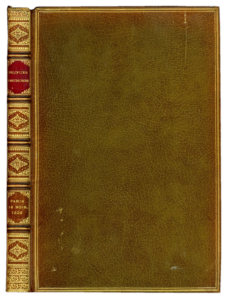
In-4 of A-T6, U8, (122) ff. Gothic letter, double columns of 43 lines. Olive morocco, triple gilt fillet around the boards, spine with raised bands richly adorned, red morocco title piece, double gilt fillet on the edges, gilt inner roll, gilt top edge. 19th century binding.
248 x 168 mm.
First edition with a certain date, as rare as the undated Verard edition which was printed perhaps a year or two before.
This romance is that of the famous Sir Bevis of Hampton; in French, Beufves de Hantonne; in Italian, Buovo d’Antona.
Beuve de Hanstone, or Beuve de Hantone, or Beuves de Haumtone or Boeve de Haumlone, Sir Bevis of Hampton in English, is an Anglo-Norman chanson de geste from the 12the century.
The title is in two lines of large gothic letter, above a large woodcut. On reverse is a cut showing an author in his study. Another at end represents “La Belle Josienne” walking in a garden, and accosted by Death: a mansion in the background. It is apparently copied from Le Caron’s edition of Le Triomphe des Dames (about 1498) see Claudin Hist. de l’Impr. II. 91.
Numerous ornamental initials throughout.
Large copy, with several leaves uncut (measuring 9 3/4 x 6 6/4 inches).
“This edition is hardly more common than the first given by Vérard, also printed at the beginning of the XVIè century“. (Brunet)
“This chanson de geste in decasyllables relates the story of Beuve, the son of Guy, Count of Hampton (Southampton) and his young wife, a daughter of the King of Scotland. The countess asks Devon, a former suitor and Emperor of Germany, to send an army to assassinate her husband Guy in the forest. The deed done, she marries Devon. When her son, aged ten, threatens to avenge his father, she decides to finish him off as well. Saved from death by a faithful tutor, the child is sold to pirates and reaches the court of King Hermin. Follow the exploits of Beuve, his love for Princess Josiane, his revenge against Devon, his recognition, the recovery of his inheritance, then his exile, his separation from Josiane, their reunion, and his death.”
The great success of this work inspired numerous versions in French in the 13the century, in English, in Welsh, in Italian, in Dutch, in Norwegian, in Belarusian, Serbo-Croatian, and Russian at the end of the 16the century, and even in Yiddish (Bovo-Bukh).
The first edition of this chivalric romance was published by Vérard between 1499 and 1503. This second version is the first dated one.
It is illustrated with a large woodcut on the title showing the knight Beuves d’Anthonne on horseback at the head of his troops, a woodcut on the verso with the author in front of a lectern bearing a book, another large woodcut on the verso of the last leaf representing the beautiful Josienne threatened by death in a garden, and numerous initials.
One of the rarest romances of chivalry, the only one listed on the market, the only one described by Brunet (Roxburghe, London 1812, auctioned at the then considerable price of 13 pounds 13 shillings, and one of the two listed by Bechtel: B.n.F. and this one; the Fairfax-Murray, FB 35.
![Eufues newly printed in Paris | [woodcut below and another on verso.]](https://www.camillesourget.com/wp-content/uploads/2026/07/Reliure.png)
![Eufues newly printed in Paris | [woodcut below and another on verso.] - Image 2](https://www.camillesourget.com/wp-content/uploads/2026/07/Planche-1-3-scaled.jpg)
![Eufues newly printed in Paris | [woodcut below and another on verso.] - Image 3](https://www.camillesourget.com/wp-content/uploads/2026/07/Planche-2-3-scaled.jpg)
![Eufues newly printed in Paris | [woodcut below and another on verso.] - Image 4](https://www.camillesourget.com/wp-content/uploads/2026/07/Planche-3-3-scaled.jpg)
![Eufues newly printed in Paris | [woodcut below and another on verso.] - Image 5](https://www.camillesourget.com/wp-content/uploads/2026/07/Planche-4-2-scaled.jpg)
![Eufues newly printed in Paris | [woodcut below and another on verso.] - Image 6](https://www.camillesourget.com/wp-content/uploads/2026/07/Planche-5-scaled.jpg)