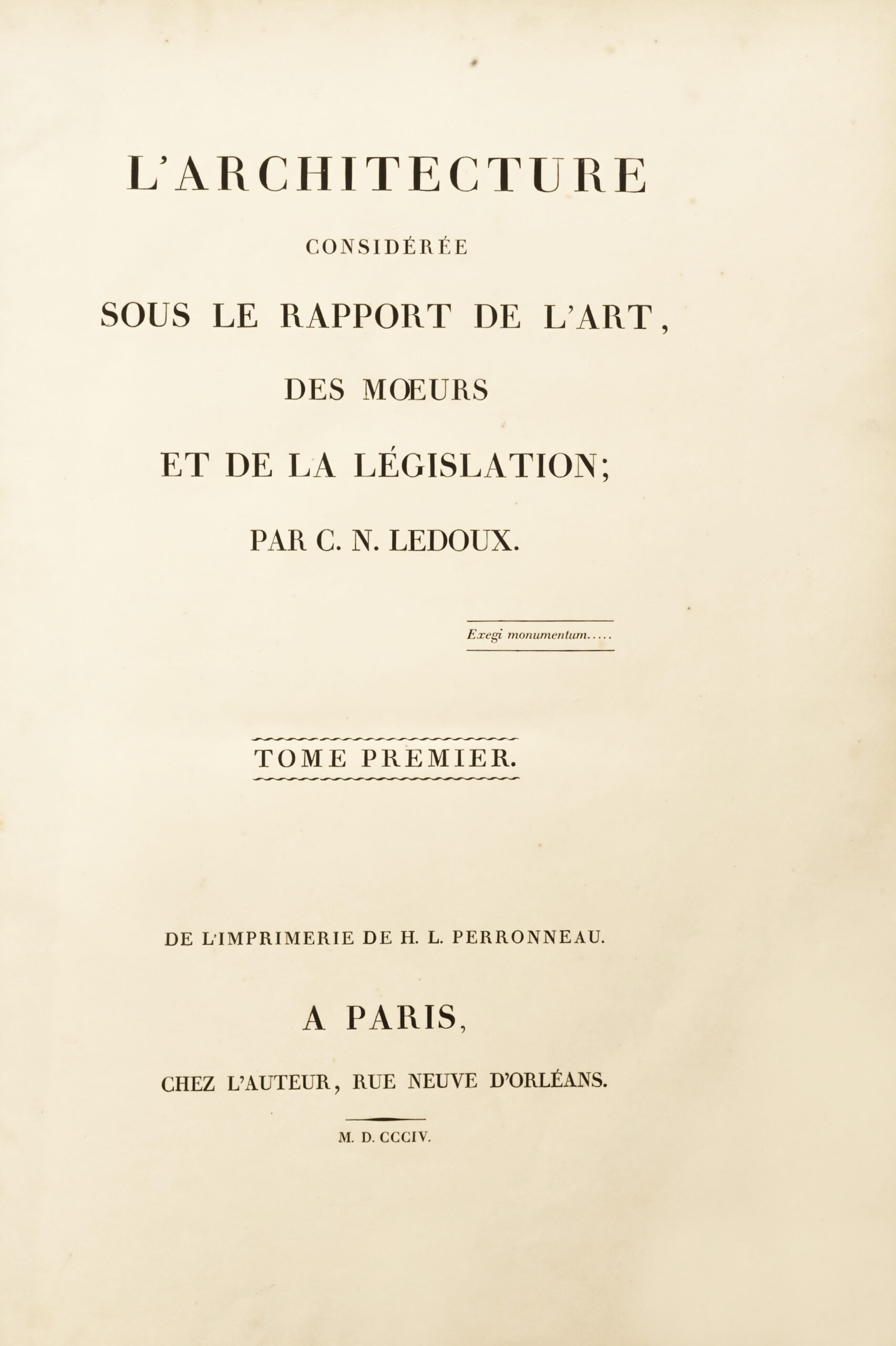
Paris, from the Printing House of H. L. Perronneau, At the Author’s, 1804.
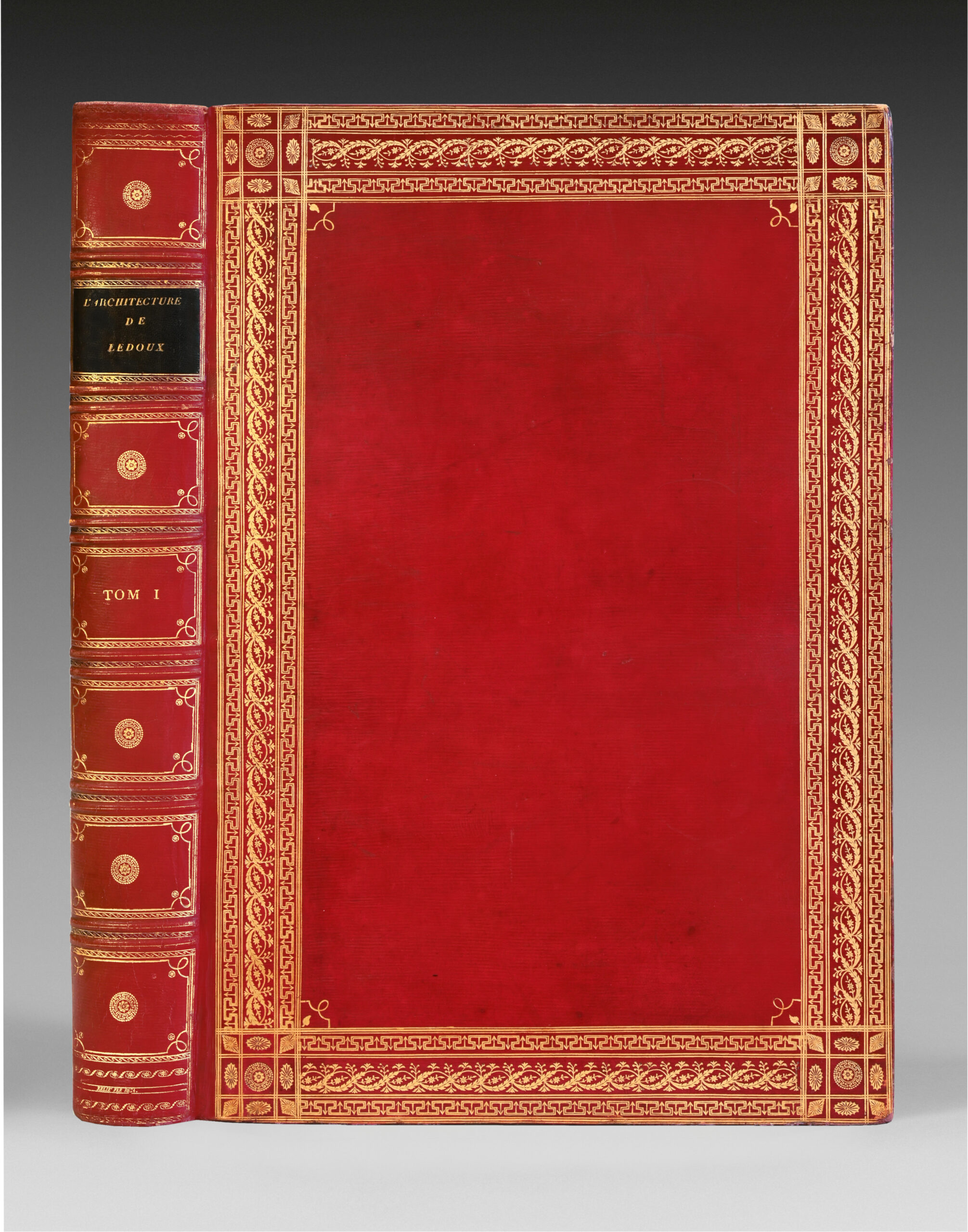
Large folio of (3) leaves, 204 pages of text and 125 engravings on 114 plates outside the text, red morocco, wide gilt border forming lace, spine with raised bands inlaid with green morocco, green moiré lining and endpapers, gilt edges. Binding in decorated morocco of the era signed “Rosa.”
566 x 397 mm.
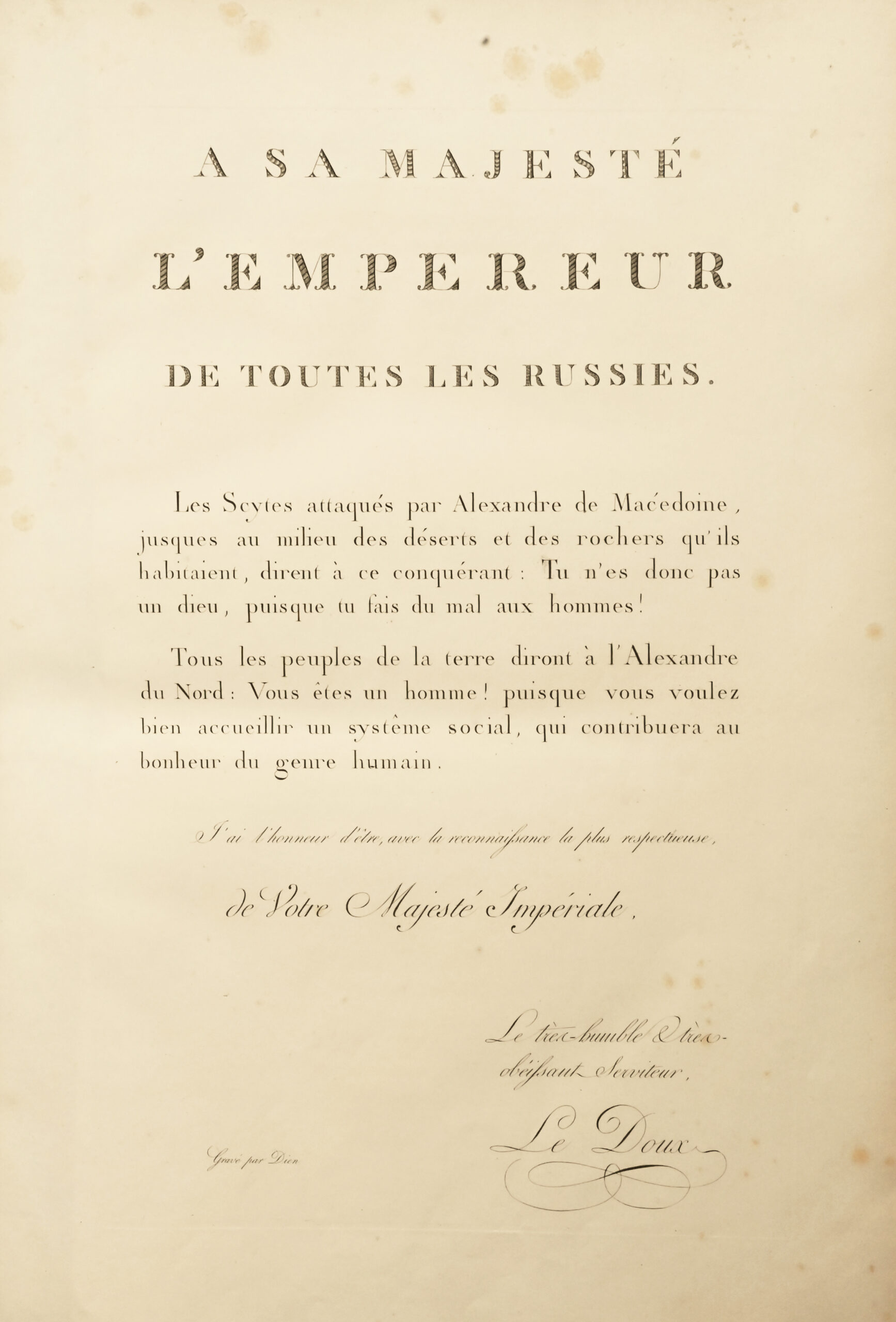
Wonderful dedication copy, printed on very large paper, original edition and the only volume published during the author’s lifetime, dedicated ” to His Majesty the Emperor of All the Russias, Alexander 1st Pavlovitch ” (1777-1825), originating from the Hermitage Palace, with a label on the inside cover and a repeated small dry stamp; sumptuously bound at the time in Paris in red mosaic morocco and decorated, signed by the great bookbinder “Rosa.”
“Published in 1804, two years before the death of architect Claude-Nicolas Ledoux (1736-1806), Architecture Considered in Relation to Art, Customs, and Legislation is one of the most fascinating texts in all of European modern architecture. Ledoux worked for thirty years on its illustration (nearly 500 plates, of which 125 were published in 1804) and nearly ten years on the writing of the 240 pages of text.”
” Magnificent illustrated book, in spectacular format, it includes 125 remarkable quality etchings. They mix architectural views, narrative plates, and plans, with Ledoux employing engravers specializing in each type of representation. However, as shown by its programmatic introduction, Ledoux aspired to publish a didactic book presenting his conception of architecture. ” [Museum of Decorative Arts].
On May 18, 1804, Claude-Nicolas Ledoux (1736-1806) released the first and only volume of a book serving as his artist’s testament: Architecture Considered in Relation to Art, Customs, and Legislation. Beneath a title that, in the abstract manner of a Royer-Collard and the Doctrinaires, proposed a political discourse making architecture the product of society and institutions, this folio gathers magnificent engraved plates with a text famous for the symbolism of its writing.
“Beyond images and allegories, what is at stake? From the genius that the Enlightenment era seeks to bestow, the creator draws a pretension: that of being a prophet and guide. The architect, more than anyone, is called by his art to transform society, or better yet, to create new ones. He inspires and shapes utopias, bringing them into the realm of possibility, he is a guide whose action leads his contemporaries to happiness.
Ledoux began writing this book around 1794, when the Terror had thrown him in prison for “aristocracy.” For a year, dramatic political events followed, and in his personal life, things did not fare better: projects were halted, one of his daughters passed away, and the other initiated a lengthy lawsuit to reclaim her mother’s fortune, compromised by the publication project and the expenses it entailed. Later came the time of betrayals: Barthélémy Vignon, architect of La Madeleine, would not keep his promise, as executor, to publish the continuation of the work. Then came oblivion: despite the 1804 printing of a set of unpublished engravings, a thick veil fell over this strange and difficult work.
In 1933, Austrian Emil Kaufmann produced a sensational ‘From Ledoux to Le Corbusier’: to stage the enfant terrible of the Modern Movement, the author used in a teleological discourse the one who claimed to revolutionize the world through the genius of the forms he created. Since then, the author of the customs barriers and the saltworks of Arc-et-Senans has been firmly anchored in contemporary culture, due to the ambition of his politico-poetic project, and the brutal elegance of his architectures.” (Jean-Michel Leniaud, professor at the École nationale des chartes, director of studies at the École pratique des hautes études, 2004).
“Theorist of narrative iconography in the art of building, deeply influenced by the morals of J.-J. Rousseau and the sensualist philosophy of Condillac, Ledoux shares with his colleague E.-L. Boullée (author of a manuscript entitled “Essay on Art“, written between 1781 and 1793) an altruistic and educational vision of the art of architecture put in the service of society. In 1804, two years before his death, Ledoux published one of the five announced volumes of Architecture… A second posthumous volume, published without text by D. Ramée in 1847, revealed the unpublished engravings left by his heirs. The first engravings of Architecture… appeared as early as 1773; for thirty years, Ledoux oversaw about twenty engravers who carried out this unique editorial project on his behalf. In his metaphorical style worthy of an epic, where narrative and mythological poetry intervene, Ledoux writes a hymn to architectural creation. Utopia is combined with a collection of information on the work actually realized and projected. This book is indeed a work of art in itself, rather than a treatise in the usual sense of the term; yet its encyclopedic nature (as Ledoux claims) is intended for the edification of initiated artists. Daniel Rabreau.
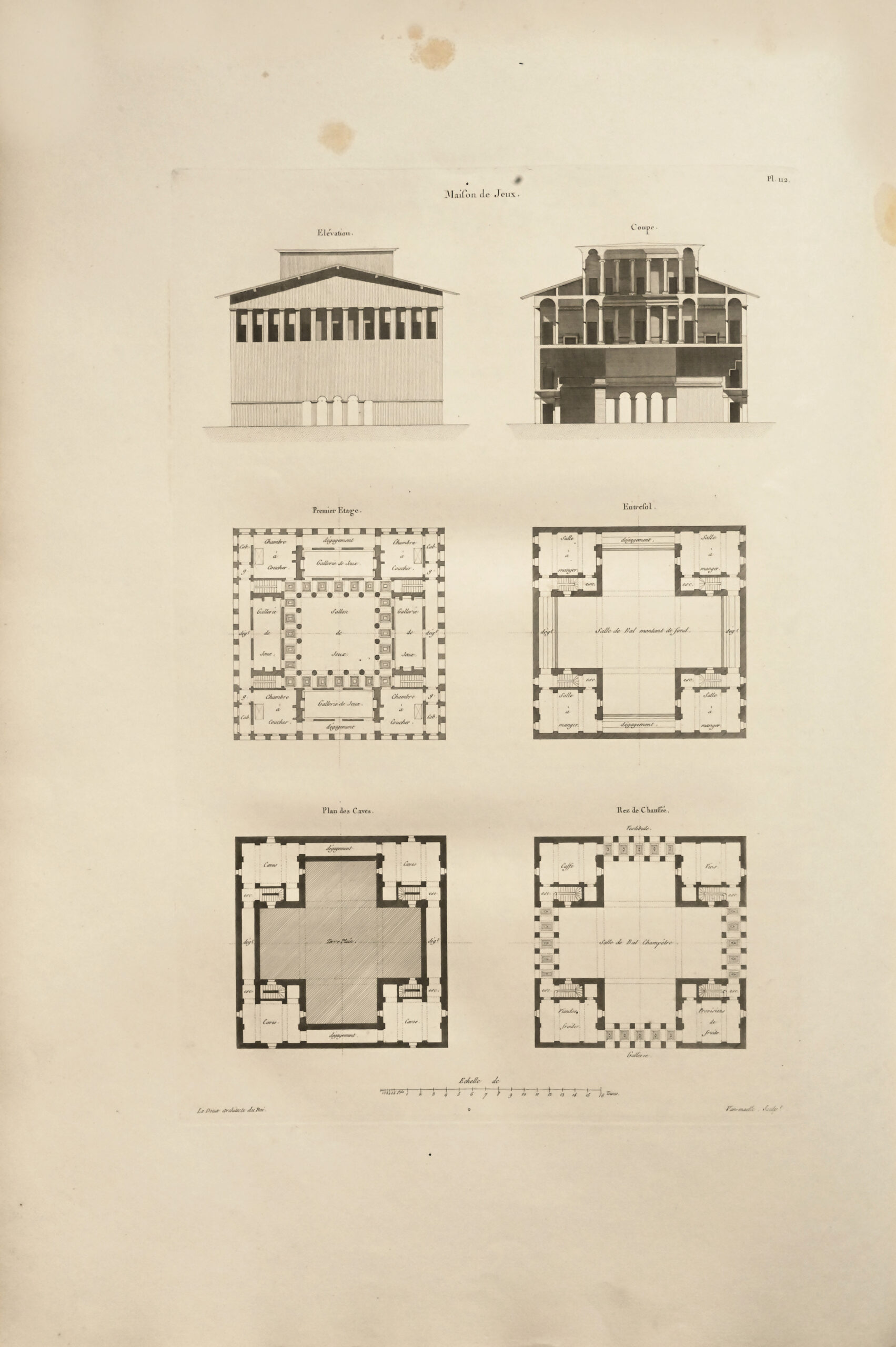
Illustrations: engraved title plate (pl. 2), title on draped cloth held up by 2 exotically dressed female caryatids, supporting a frieze with classical figures and coats of arms (note: similar frieze in pl. 77, “Fragment of the Propylées of Paris“), bust of the author below with architectural implements, plans, and laurel branches, signed “C. N. Varin Sculp“; 123 engraved plates, numbered 3-125, on 114 leaves (105 full-page, 18 half-page plates printed 2 to a page), all but 1 plate signed by Ledoux as designer (“Le Doux Architecte du Roi“).“; pl. 110 is dated 1778). The principal engravers include Sellier (32 plates; 1 dated 1775, 3 dated 1776); Van Maelle (12 plates, plus 9 with Simon and 2 with Maillet); Varin (10); Ransonnette (7); Bovinet (2, plus 3 with Coquet); Berthault (3); Coquet (2, plus 3 with Bovinet, 1 with Simon); Heluis (3, including 1 signed “Lhuis”). Other engravers include Boutrois, Coiny, Delaitre, Dupuis, Angeliq. Moitte, and J. J. de la Porte (1 plate each).
Ledoux was the most prolific and one of the most esteemed French architects of his generation.
He received his architectural education at Jacques-François Blondel’s École des Arts, and went on to produce brilliant designs for all types of buildings, from houses to palaces, from prisons to city halls. He began to form ideas for Architecture around 1780, and intended to publish a complete works. He had already begun compiling engravings of his work in 1773. He had many illustrations reengraved as his ideas on style evolved to express a new aesthetic founded on basic architectural elements – the wall, the column, and the arch. While he was in detention during the Revolution, the treatise underwent a radical change and emerged as a strong, unique statement of a new relation of the architect to society. Ledoux now linked the architect to the Creator and considered him an active instrument in the formation of a new society. In the process of this development, the engravings shifted emphasis from representations of Ledoux’s work to a subordinate position as illustrations for his unusual text.
Several early copies of Ledoux’s work were issued in the first years of the 1780s to select subscribers. In 1789, the title page was engraved and the collection was advertised for sale.
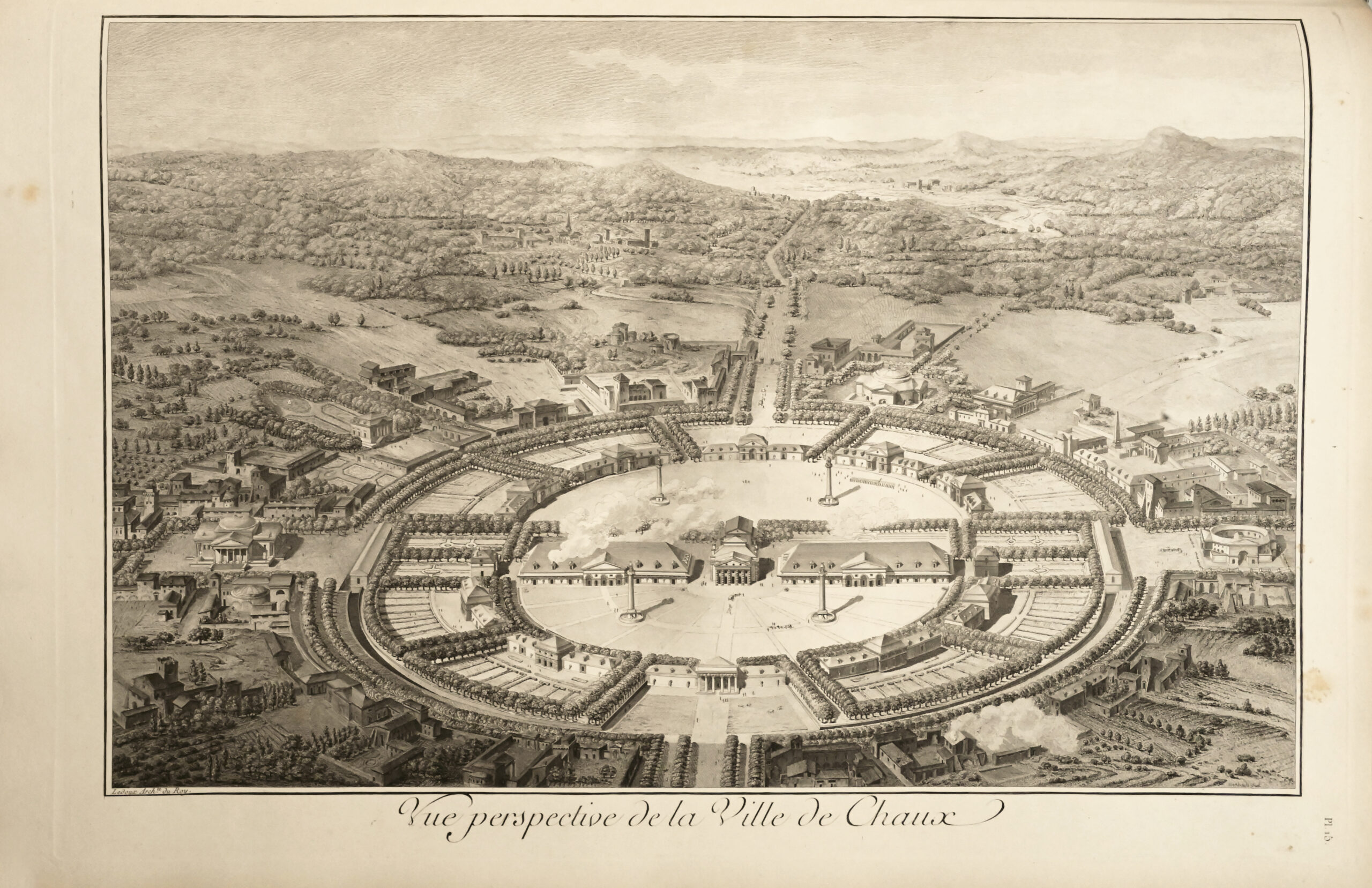
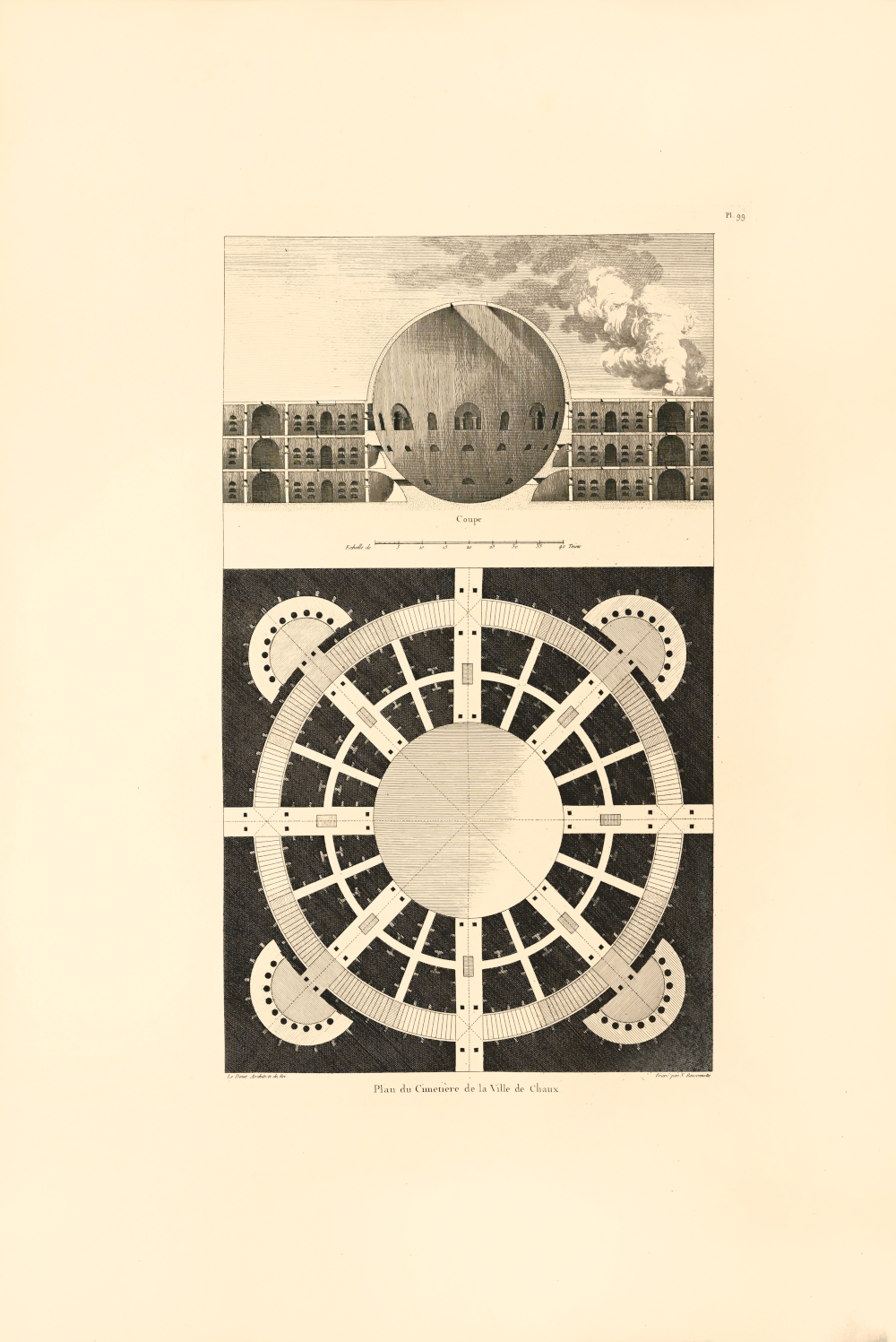
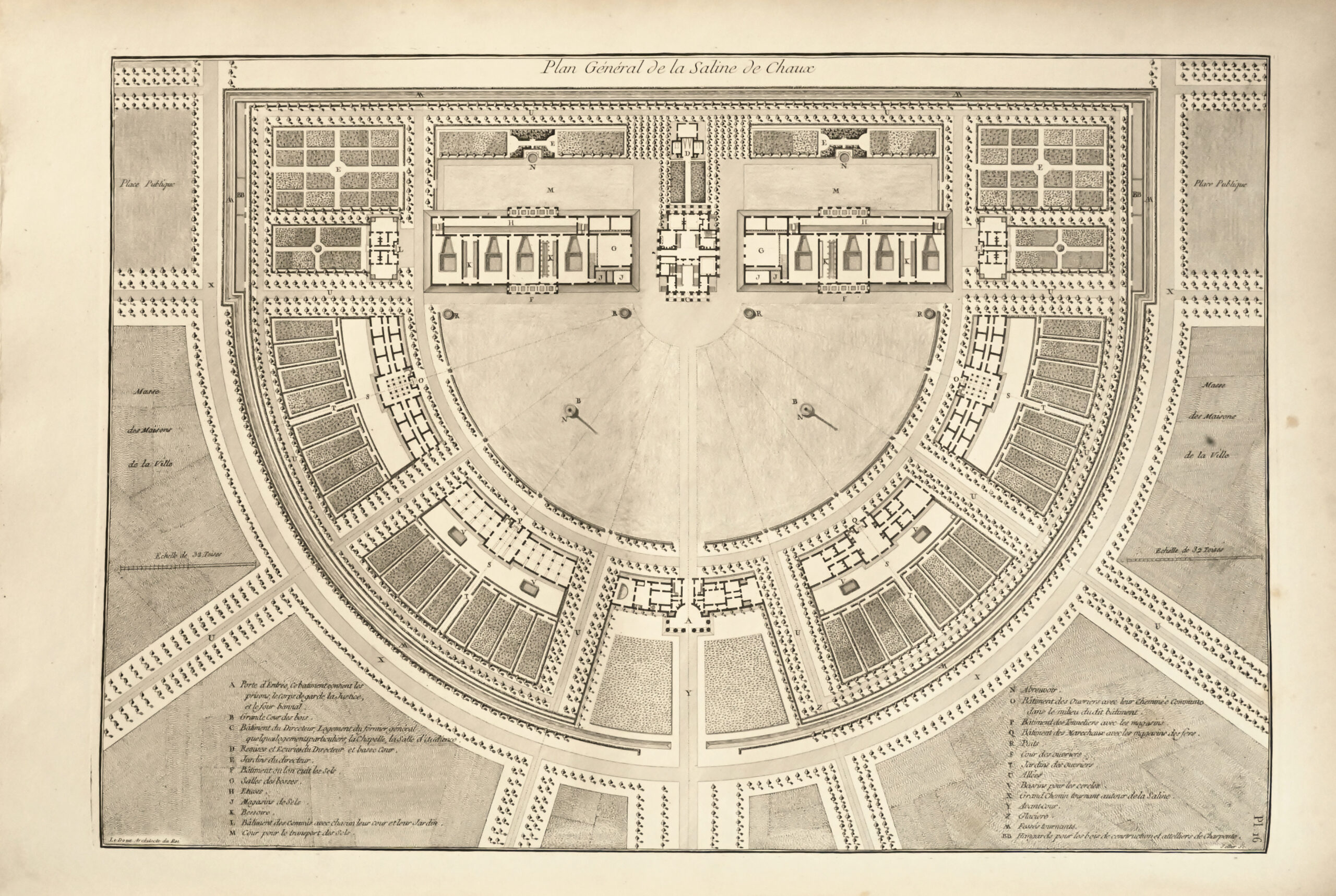
Ledoux began the engravings for Architecture in 1773, the year of his entrance into the Academy. (By 1777, Joseph II admired the first prints; he would become a subscriber several years later.) Van Maelle was the principal engraver of Ledoux’s work, and until around 1782, Louis Sellier engraved most of the plates of Ledoux’s built architecture, as well as those buildings of the ideal city of Chaux (a salt factory where workers lived, designed by Ledoux and later redesigned as a utopia), which conformed to the neoclassical style of around 1780, including the church, the public baths, and the market. Preparatory drawings were sometimes executed by artists not closely associated with Ledoux : J. B. Maréchal is responsible for a perspective drawing of the Hôtel Thélusson. Some engravers, such as Joseph and Charles-Nicolas Varin and Pierre-Gabriel Berthault, had worked on Choiseul-Gouffier’s Voyage pittoresque (cal. 51, 1985. 61. 472-474) or on other publications of this genre.
In 1782, with the discharge of Sellier, several new engravers were hired: Berthault (a specialist in perspective), Edme Bouvinet (a specialist in atmospheric effects), Nicolas Ransonnette(a conscientious interpreter who later would include several of Ledoux’s townhouses in his collaborative publication with Jean-Charles Krafft), and Jacques-Joseph Coiny and Crépy (engravers, who engraved the bas-relief friezes of the Barrière d’Enfer).
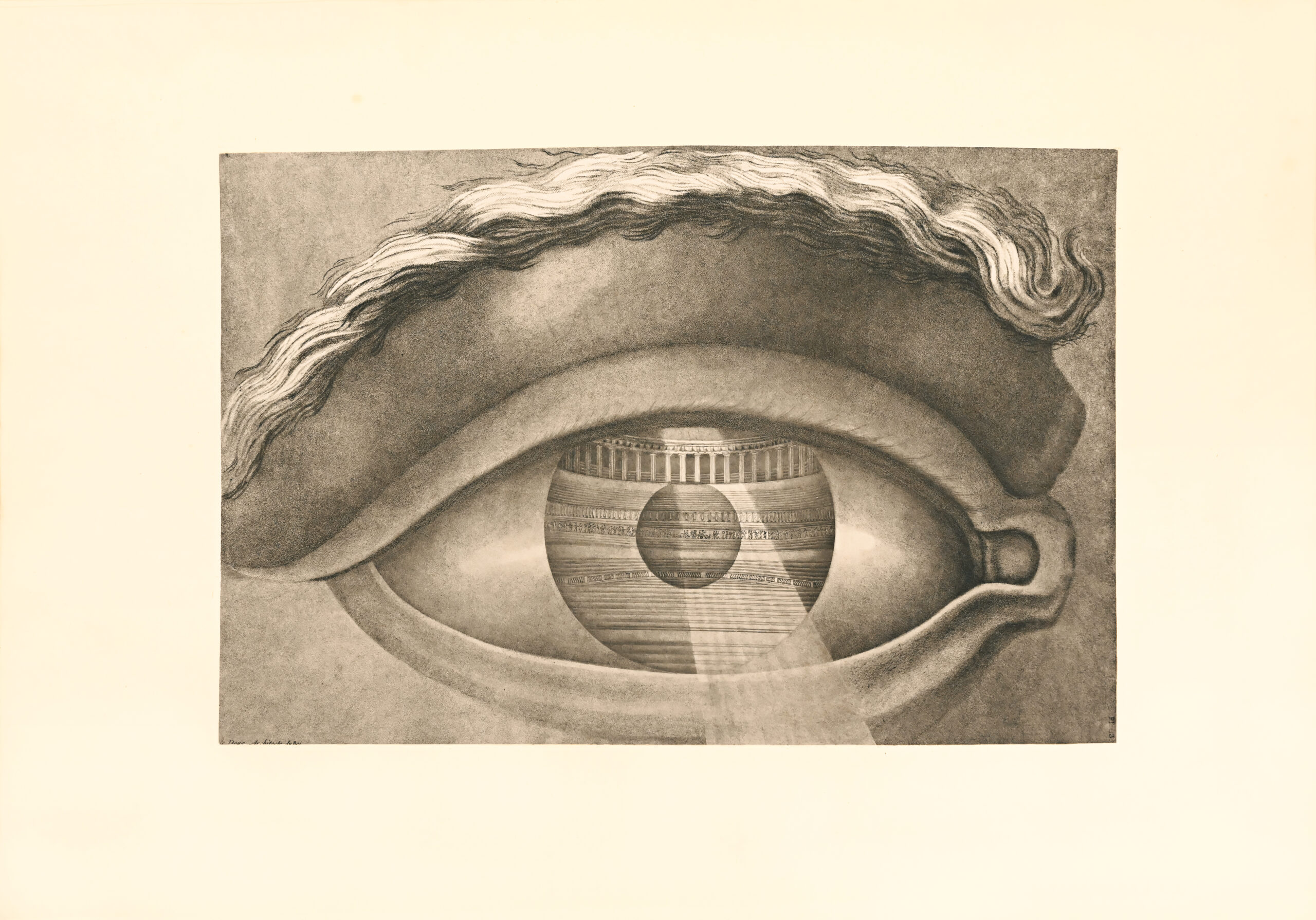
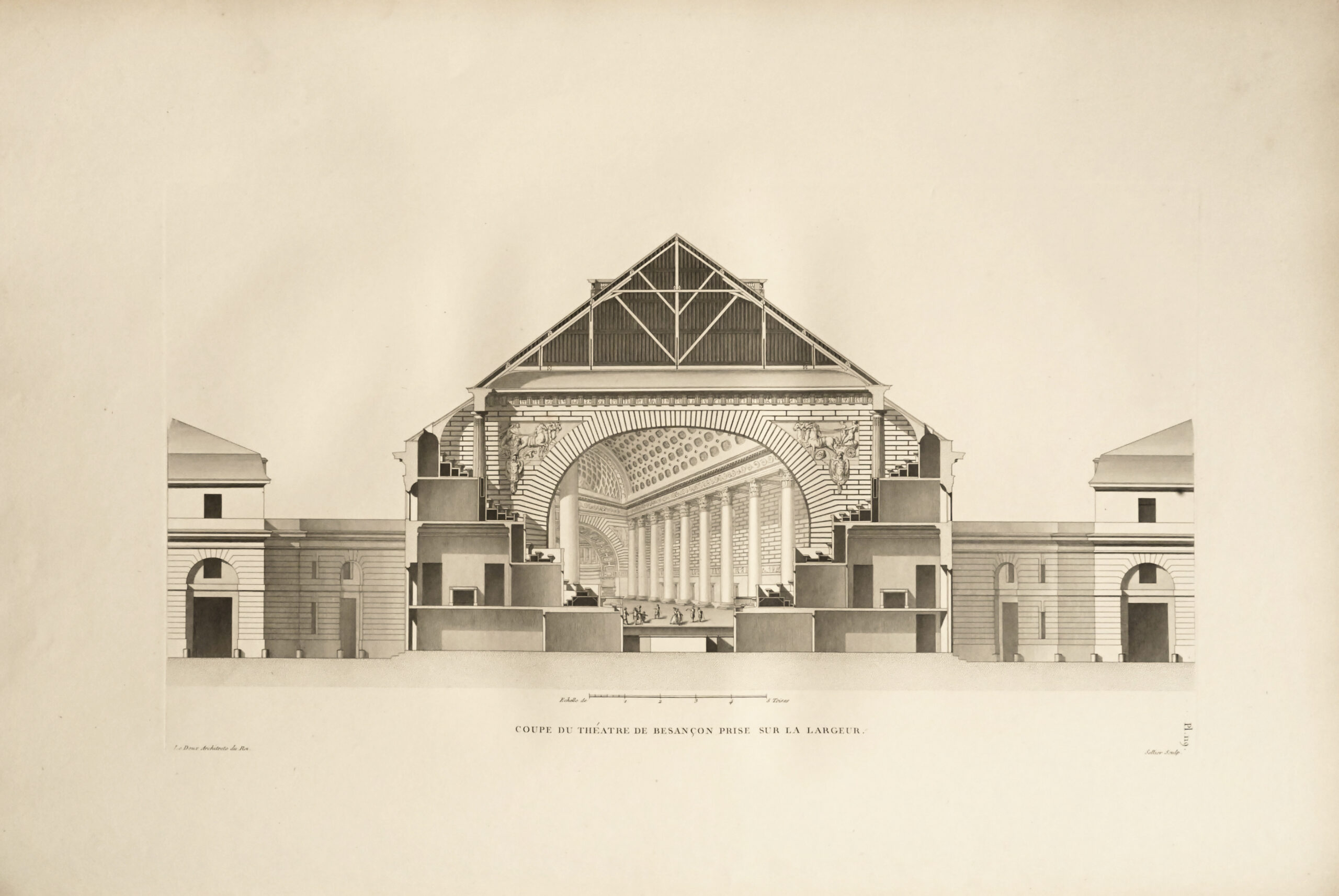
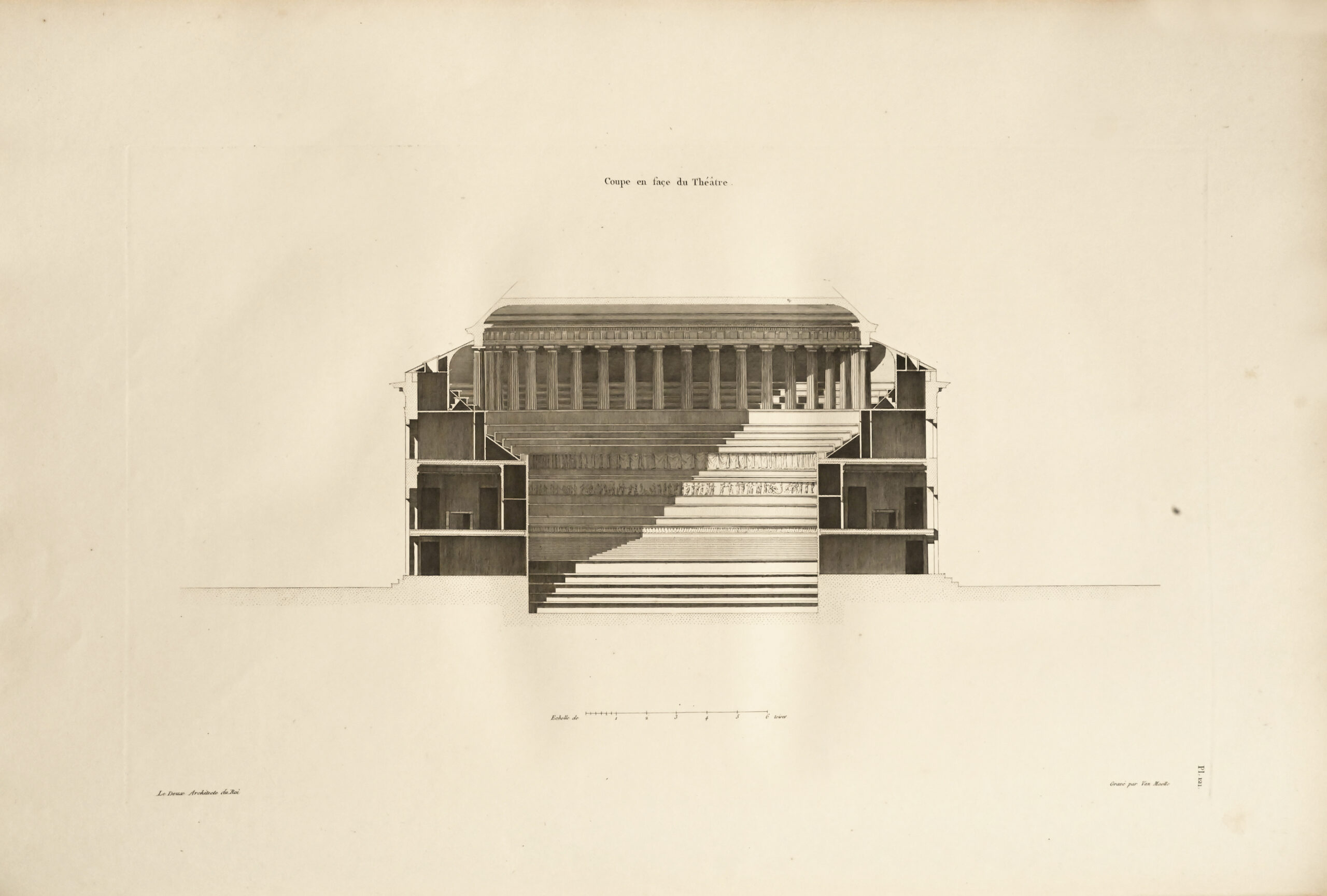
All but one plate was designed by Ledoux. In addition, he is probably the executer of the plate representing The Eye in the Besançon Theater series. It is the only mezzotint plate of the entire series of illustrations, a technique surely necessary to convey what was conceived in terms of light and reflection. The Eye reflects in its pupil the circular orchestra of the theater and the colonnade that surrounds it (like Palladio’s colonnade at Vincenza). It represents the privileged role of sight and Ledoux’s concept of all architecture as a spectacle, as well as the role of the architect as both principal spectator and author of this environment.
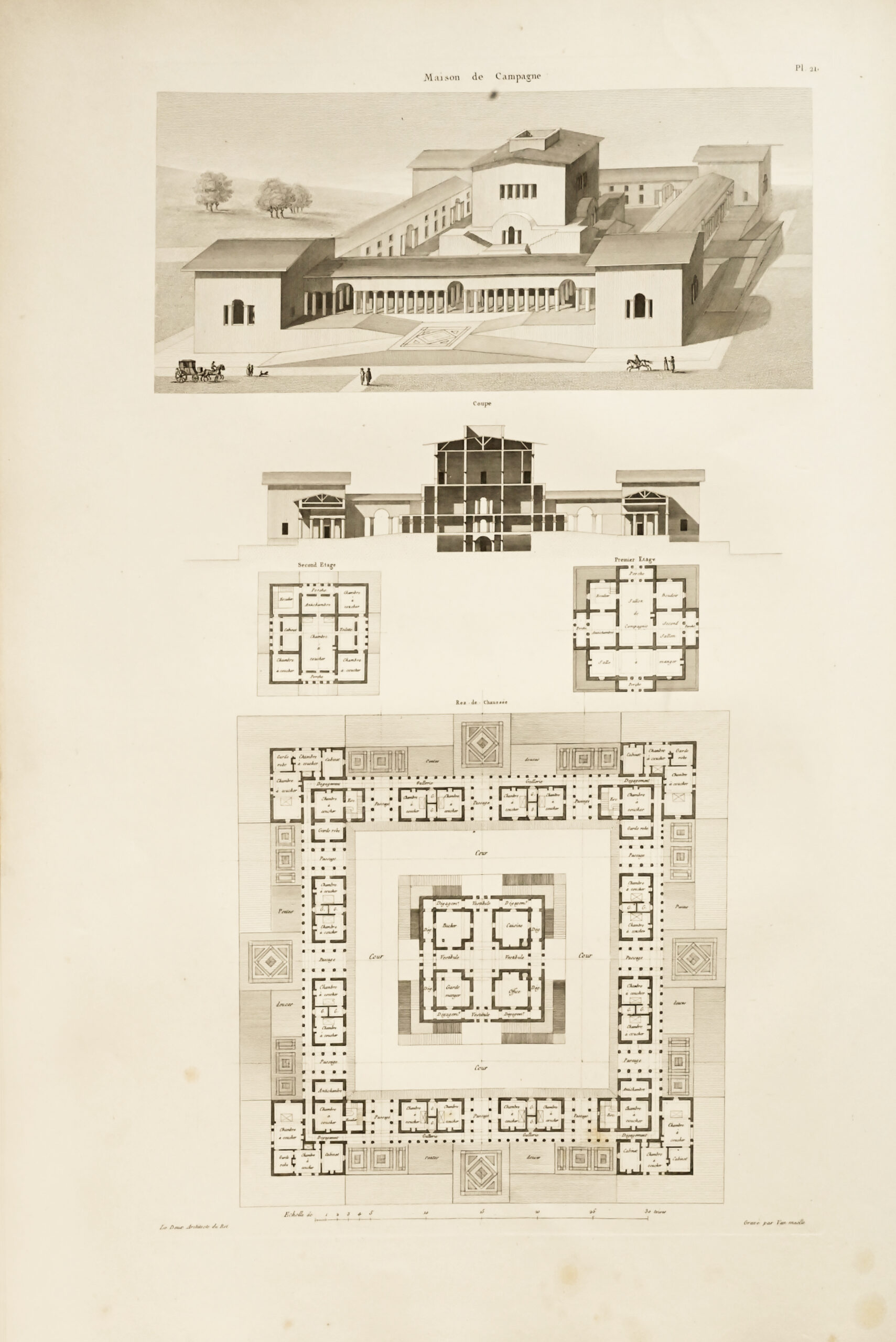
The first volume of Architecture was published only in 1804 (Cat. 91, 1985. 61. 703). In this definitive edition Ledoux has combined the format of several types of popular publications related to architecture. Thus in addition to the treatise representing an assemblage of the architect’s oeuvre, it is a comprehensive work representing all types of architecture, with an emphasis on the rural house. It is also a voyage pittoresque through an imaginary city; it is a utopian essay bringing together current ideas on society, natural and political sciences, and aesthetics; and it is a synthesis of concepts from mainstream architectural theory, including the ideas of Marc-Antoine Laugier and Jacques-François Blondel. In addition, Architecture includes masonic or pseudo-masonic ideas, and may be a unique example of the comprehensive development of these ideas in an architectural treatise.
In Architecture Ledoux develops his notions of an ideal society based on work, as it is expressed in an idealized and expanded project for the royal Saltworks (the Salines) at Arc-et-Senans, which Ledoux designed and built between 1775 and 1779. It forms the bulk of the first volume as representative of a utopian city, and as a monument to industry. In addition to an introduction there is a text for each project, including a discussion of the social-mythological context which the buildings represent. This volume includes other ideal projects and some designs for completed buildings, such as the theater at Besançon. Some of these may have been included as Ledoux became aware that he would not have time to complete his ambitious project.
Ledoux writes in an unusually florid style: he is as polemical as Le Corbusier would be in the early twentieth century, and like the later architect, he exhorts the profession to impose social significance on its work. Ledoux believed that he was developing an architecture based on an invariable social “taste” rather than on changing fashion. However, within the context of later architectural development, Ledoux’s work was expressive of a particular style with a very short period of popularity. By the early years of the nineteenth century it was condemned as grotesque. ” (Millard).
Magnificent copy from the Hermitage Palace, residence of Tsar Alexander 1st Pavlovich (1777-1825).
Grandson of Catherine the Great, the young Alexander was, from childhood, separated from his father, whom he loved despite his extravagances. The Empress took charge of his education and entrusted it, on Grimm’s recommendation, to the Swiss La Harpe, a disciple of Diderot and Voltaire. She handed over instructions to the tutor where everything was foreseen. The young prince thus received a republican education. Positioned between his father and his grandmother, he had to continuously hide his opinions and, throughout his life, he remained an enigma to those around him. He took no active part in the murder of his father but was nonetheless involved in the conspiracy where his father found his death; he would carry a deep sense of repentance throughout his life and a keen desire to make amends for his mistake.
Surrounded by Anglophiles during the first part of his reign, he dreamed of reforms, then moved closer to Napoleon at Tilsitt; but when the latter invaded Russia, Alexander Ist became the leader of the national resistance. In 1814, placed at the head of European affairs and at the zenith of his glory, he fell under the influence of Baroness de Krüdener and the Lyon visionary Bergasse and wished to base the happiness of the peoples on the Christian and absolutist mysticism of the Holy Alliance.
Sumptuous mosaic and decorated binding by the great binder Rosa.
Frédéric-Guillaume Rosa (1760?-1832) was native to Wissembourg (Bas-Rhin). Famous “bookbinder-bookseller”, he was among the significant binders of his time with the Bozérians, Lefebvre, Courteval, etc. He was licensed as a bookseller in Paris in 1812.
Provenance: Hermitage Palace, Residence of Tsar Alexander 1st Pavlovich with printed dedication ” To His Majesty the Emperor of all the Russias » (label and stamps); Baron de Rothschild; Baron Alexis de Redé.