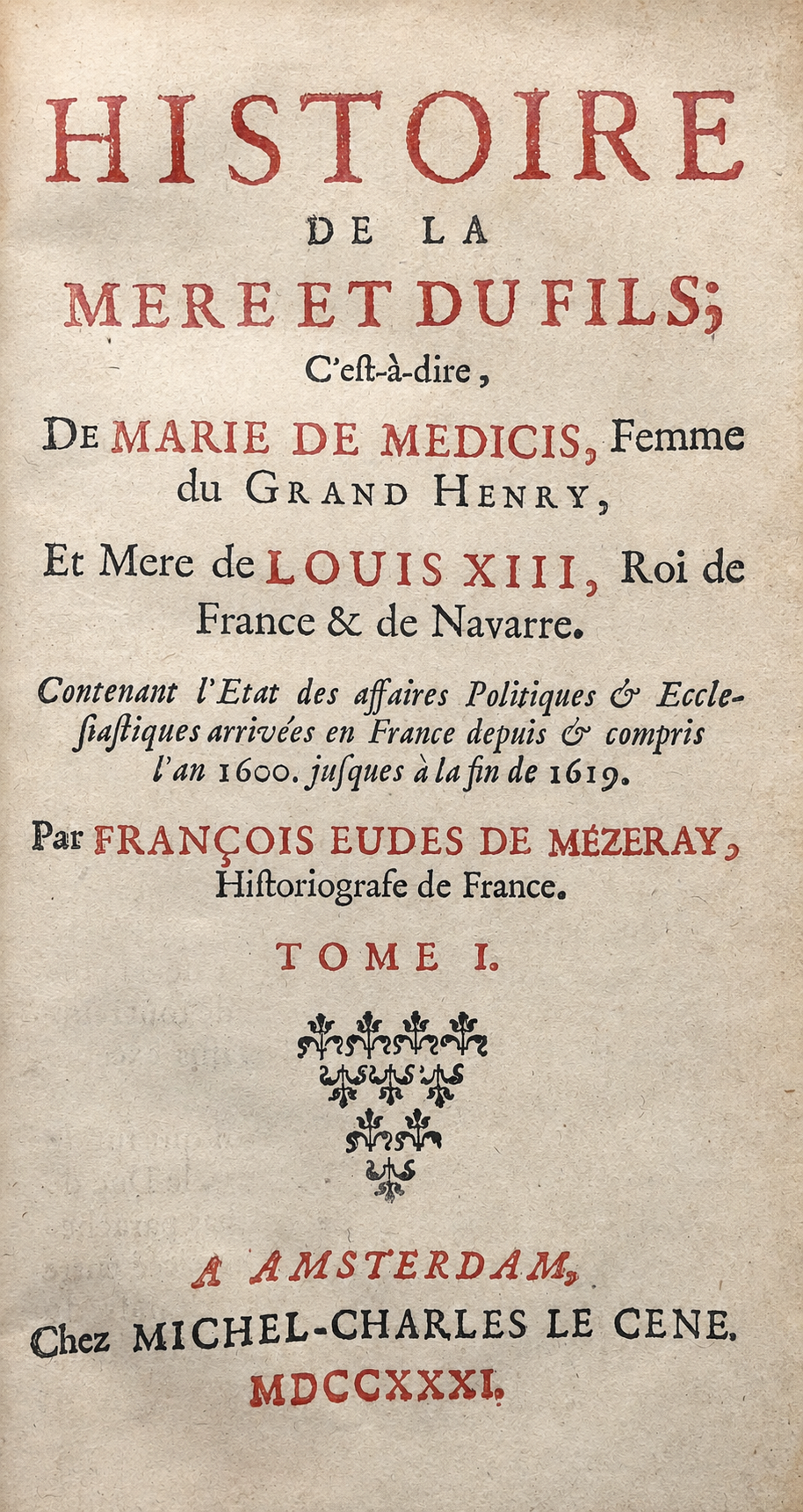
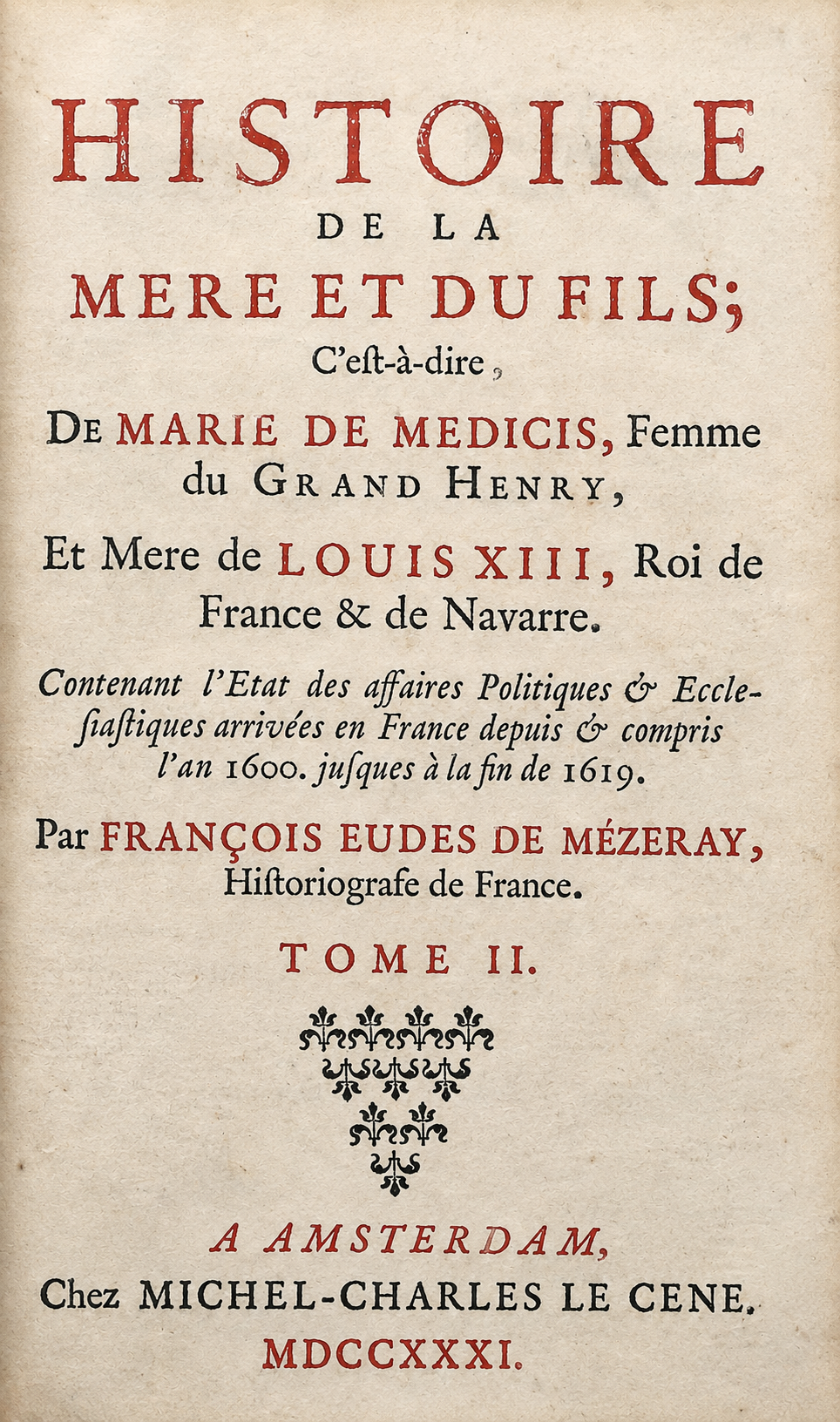
A Amsterdam, chez Michel-Charles Le Cene, 1731.
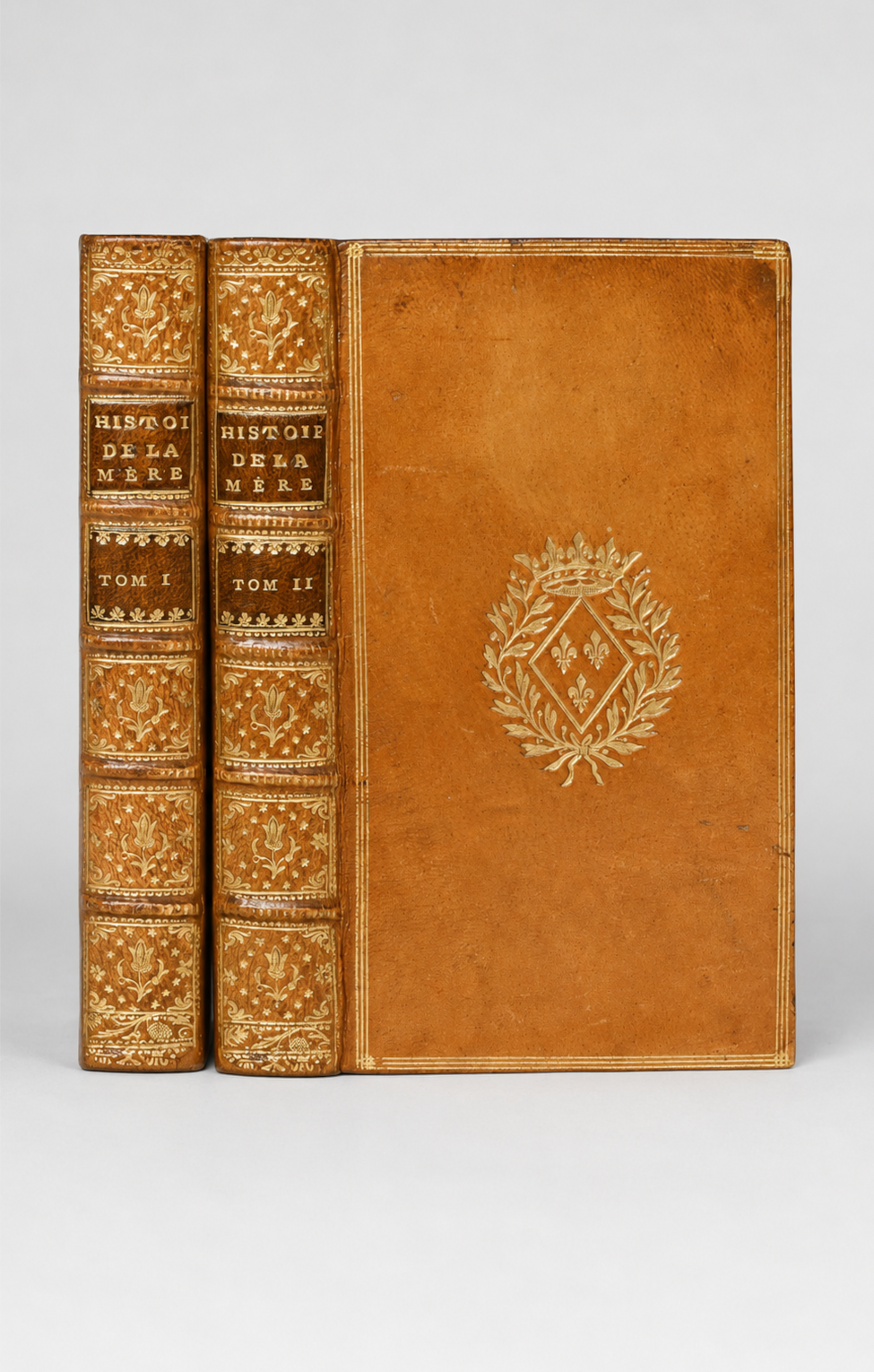
2 volumes in-12: I/ (6) ll., 388 pp.; II/ (2) ll., 438 pp. Lemon morocco, triple gilt fillet framing the covers, coat of arms at the center, spine with raised bands richly decorated, gilt edges. Contemporary binding.
160 x 90 mm.
Precious first edition attributed since 2004 to Richelieu himself.
This work recounts the political and religious events that opposed Marie de Médicis and her son Louis XIII. The author describes in detail the rise of tensions between the queen mother and her son, who had become king but was still under his mother’s influence. Richelieu explains how Marie attempted to retain the power she exercised during the regency, while Louis XIII sought to free himself from it. This book is a detailed historical chronicle of the early years of the personal reign of Louis XIII, viewed through the prism of the conflict between mother and son.
Paradoxically, it was without the family tradition’s knowledge that a first fragment of Richelieu’s Mémoires came to light. After the death of François Eudes de Mézeray, an emblematic figure of state historiography, his papers were deposited in the King’s Library on October 18, 1683. Among them was a manuscript entitled Histoire de la mère et du fils, de Marie de Médicis, femme du grand Henry, et de Louis XIIIe de ce nom. After a brief evocation of the years 1600-1615, chiefly devoted to the figure of the queen, the work dwells at length on the period 1616-1619, broadening into general politics, before stopping on the threshold of the second war between mother and son. Without realizing that they held only the beginning of a work of much greater scope, publishers decided to print it in 1730, attributing it to Mézeray and taking the initiative to alter the title according to the content. It thus became the l’Histoire de la mère et du fils, c’est-à-dire de Marie de Médicis, femme du grand Henry et mère de Louis XIII. Yet it could not have escaped them that, throughout this work, one character always speaks in the first person: the Bishop of Luçon, the future Cardinal Richelieu. From there to considering him the true author of the History was more than a presumption. Nevertheless, the editors tortured themselves to maintain the attribution of the book to the king’s historiographer, explaining that Mézeray “takes on the mask of Cardinal Richelieu. Every time this great minister acts, the author makes him speak in the first person (…). Mézeray was scarcely known in Paris before he experienced the generosity of this illustrious cardinal; it is probable that, in order to pay court to him, he believed he should introduce him onto the stage in this manner.” Even though this argument was corroborated, for lack of anything better, by Daniel Larroque, biographer of the historian, and following him in the Bibliothèque du Père Le Long (no. 8672), this laborious patchwork failed to convince, so manifest were the stylistic disparities between the work and Mézeray’s authenticated writings. As early as 1732, in his Mémoires historiques et critiques sur divers points de l’histoire de France, Camusat refuted the attribution, and Abbé Joly finally settled the matter. Many indications pointed to Richelieu as the most plausible author. The question would soon become linked to that of the Political Testament.
By identifying the references made in the Testament to another, more extensive work by the minister of Louis XIII, Foncemagne indeed thought of the l’Histoire de la mère et du fils, and announced as a well-established truth that it was “only a small part of a work of which I have heard it said that much more extensive manuscript copies have been preserved in the cabinets of certain curious collectors.” The work in question is the one whose program is clearly set forth from the very first lines of the Epistle to the King in the Testament:
“God having blessed my intentions to such a degree that the virtue and good fortune of Your Majesty, which have astonished the present age, shall be admired by future generations, I judged that the glorious successes that befell him obliged me to write his history [the ‘Histoire de Louis XIII,’ whose composition had been entrusted by the Duchess of Aiguillon to Père Le Moyne]. (…) I gathered not only with care the material for such a work [Richelieu’s ‘Memoirs’], but furthermore I arranged part of it in order and set down the course of several years [the ‘Histoire de la mère et du fils’ of pseudo-Mézeray] almost in the state in which I intended to publish it.”
Like the Testament, Richelieu’s Memoirs, as first published in their entirety in 1823, are striking for their composite character. While the early years are carefully crafted, as time progresses the writing frays and gives way to an often haphazard juxtaposition of documents. This corresponds closely to the Testament’s assessment. All that remained was to locate a manuscript confirming the identification of the History of the Mother and the Son as the beginning of the Memoirs. Voltaire having lost interest in the matter, it was Foncemagne who went to the source and discovered around 1754, in the archives of Foreign Affairs, a complete manuscript of the Memoirs. The years 1600-1619 corresponded, beyond any shadow of doubt, to the work formerly attributed to Mézeray. And it was indeed the History of Marie de Médicis and Louis XIII that Richelieu had intended to write, and not that of Marie de Médicis, mother of Louis XIII.
The discovery was of capital importance and went far beyond the mere interest of adding another piece to the dossier concerning the authenticity of the Testament. The horizon of Richelieu as an author suddenly broadened… only to narrow again almost immediately. Foncemagne had seen the manuscript in the keep of the old Louvre, as Perceval sees the Grail passing through the Fisher King’s castle, but he was not free to seize it, nor even to indicate the precise place where he had made his discovery. Power seemed determined jealously to guard its secret in the writings of the great predecessor, out of apprehension concerning the political dangers that the diplomatic documents still appeared to contain. Thus, around 1772, Charlotte Thiroux d’Arconville, who quite rightly sought to enrich her forthcoming Life of Marie de Médicis, was denied access to it, “the minister not authorizing consultation of the document,” a resistance all the more piquant since the “minister” in question was none other than the Duc d’Aiguillon, Secretary of State for Foreign Affairs and great-nephew of the cardinal. As early as 1765, in the Journal de Trévoux, an anonymous writer, still doubting that Richelieu had had the leisure to pursue his labor beyond 1619, lamented that the trace of the manuscript in the Foreign Affairs archives had already been lost, thus preventing the resolution of all ambiguity.
Nevertheless, the attribution of the manuscript to Richelieu was recognized by Foncemagne, who considered it written by a secretary but believed he had identified the minister’s handwriting in the margins. All the unfortunate scholars later turned away by the Foreign Affairs archives were therefore reduced to relying on his authoritative opinion. Such was the case for Fevret de Fontette, responsible for a new edition of the Bibliothèque historique du Père Le Long, or for Charlotte Thiroux d’Arconville.” (Laurent Avezou, 2004).
Precious copy in contemporary lemon morocco with the arms of Madame Sophie (1734-1782), daughter of Louis XV, described by Ernest Quentin-Bauchart (Les femmes bibliophiles de France, no. 37).
Sophie-Philippine-Elisabeth-Justine de France, eighth child of Louis XV, born at Versailles on July 27, 1734, was called Madame Cinquième until 1745, when she took the name Madame Sophie; very shy, she lived in great retirement and died at Versailles on March 3, 1782, bequeathing part of her library to the Marquise de La Porte de Riants, her lady-in-waiting.
The volumes that belonged to the Mesdames de France, daughters of Louis XV and Marie Leczinska, are distinguished only by the color of the morocco on which their arms were stamped. Madame Adélaïde had hers bound in red morocco, Madame Victoire in green, and Madame Sophie in lemon. These works, bound by Fournier in Versailles and by Vente, dealt for the most part with religion, literature, history, and travel.
From the libraries of James Toovey, J. M. Abdy, Archibald Brabazon Sparrow Acheson Gosford, Count of Mosbourg, with bookplates.