![La Religieuse. [Followed by :] Entretien d’un père avec ses enfants, Ou du danger de se mettre au-dessus des loix. [Followed by:] Les deux amis de Bourbonne.](https://www.camillesourget.com/wp-content/uploads/2026/05/Reliure-3.png)
![La Religieuse. [Followed by :] Entretien d’un père avec ses enfants, Ou du danger de se mettre au-dessus des loix. [Followed by:] Les deux amis de Bourbonne. - Image 2](https://www.camillesourget.com/wp-content/uploads/2026/05/Portrait-1-scaled.jpg)
![La Religieuse. [Followed by :] Entretien d’un père avec ses enfants, Ou du danger de se mettre au-dessus des loix. [Followed by:] Les deux amis de Bourbonne. - Image 3](https://www.camillesourget.com/wp-content/uploads/2026/05/Titre-4-scaled.jpg)
![La Religieuse. [Followed by :] Entretien d’un père avec ses enfants, Ou du danger de se mettre au-dessus des loix. [Followed by:] Les deux amis de Bourbonne. - Image 4](https://www.camillesourget.com/wp-content/uploads/2026/05/Planche-1-1-scaled.jpg)
![La Religieuse. [Followed by :] Entretien d’un père avec ses enfants, Ou du danger de se mettre au-dessus des loix. [Followed by:] Les deux amis de Bourbonne. - Image 5](https://www.camillesourget.com/wp-content/uploads/2026/05/Planche-2-1-scaled.jpg)
![La Religieuse. [Followed by :] Entretien d’un père avec ses enfants, Ou du danger de se mettre au-dessus des loix. [Followed by:] Les deux amis de Bourbonne. - Image 6](https://www.camillesourget.com/wp-content/uploads/2026/05/Planche-3-1-scaled.jpg)
![La Religieuse. [Followed by :] Entretien d’un père avec ses enfants, Ou du danger de se mettre au-dessus des loix. [Followed by:] Les deux amis de Bourbonne. - Image 7](https://www.camillesourget.com/wp-content/uploads/2026/05/Titre-2-1-scaled.jpg)
Together 3 works in 2 volumes, 18mo: I/ 1 portrait, (2) ll., 2 engravings, 168 pp., (2) ll., 163 pp.; II/ (2) ll., 1 engraving, 132 pp., pp. 269 to 331.
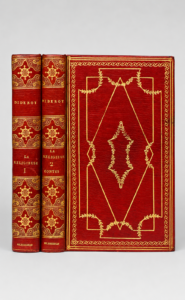
Red morocco, covers entirely decorated with gilt rolls, fillets, and fleurons, smooth spines finely decorated with dense gilt tooling, gilt fillet on the edges, inner roll-tool decoration, gilt edges. Contemporary decorated morocco binding signed Bozérian.
135 x 78 mm.
One of the rare deluxe copies of “one of the most significant novels of the 18th century” (B.n.F.), printed on fine vellum paper adorned with “a charming frontispiece with portrait and 3 plates by Chaillou, engraved by Bovinet, which may be found before letters,” as is the case with the present copy.
Cohen cites only one identical copy: “in blue morocco by Bozérian, plates before letters, vellum paper, Schuhmann collection.”
“Rather kill your daughter than imprison her in a convent against her will — yes, kill her”: thus Suzanne Simonin, an illegitimate child forced by her family to take religious vows, addresses the honorable marquis from whom she seeks assistance while recounting a life filled with trials and humiliations. A pathetic novel of an outcast in search of love, a political novel of a prisoner seeking justice, a philosophical novel of the troubled passions generated by sexual prohibitions, a pictorial novel of chiaroscuro in bodies and souls: La Religieuse is all of these at once. But through this tale of a shattered destiny, Diderot also leads his reader down the tortuous paths of dark eroticism; for Suzanne, who proclaims herself a figure of persecuted innocence, is perhaps more ambiguous than one might believe…”
“The study of the technique inaugurated by Diderot in La Religieuse abounds in shrewd and profound insights, of subtle penetration: Mr. May convincingly demonstrates how, at the cost of slight internal contradictions within the narrative, Diderot shifts here from the method of the memoir-novel, dear to his age, to that of the intimate diary, which preserves all the unforeseen vitality of life and, by abolishing recollection, plunges directly into the search for lost time.”
“This author offers very beautiful pages written in a simple, natural, truthful style; such is the little work entitled ‘Conversation Between a Father and His Children, or On the Danger of Placing Oneself Above the Laws.’”
Bound after it are two additional works by Diderot: Entretien d’un père avec ses enfants, Ou du danger de se mettre au-dessus des loix et Les deux amis de Bourbonne.
Entretien d’un père avec ses enfants ou Du danger de se mettre au-dessus des lois is a moral tale by Denis Diderot. It takes the form of a dialogue between the father of “myself” (that is, the author), his sister, his brother, and a doctor. Several ethical dilemmas are discussed in which law comes into conflict with morality; for example: “Should one save from illness a criminal condemned to death if one is a physician?” thus raises the problem of respect for laws and collective interest. The dialogue emphasizes “the ambiguities and internal difficulties of each position more than their systematic opposition.”
Les Deux Amis de Bourbonne is a tale in the form of an epistolary mystification written by Denis Diderot in August 1770. In August 1770, Diderot was in Bourbonne-les-Bains visiting his former mistress, Madame de Maux, who had brought her daughter, Mme de Pruneveaux, there for a thermal cure. To amuse themselves, mother and daughter wrote tales which they sent to their Parisian correspondents. In response, Naigeon sent them from Paris Les deux amis: conte iroquois by Saint-Lambert, which had just appeared. Diderot then decided to imitate Saint-Lambert’s tale through “a criticism so subtle that perhaps even he himself would not perceive it.” He proceeded through an “epistolary mystification” by sending Naigeon two fictitious letters: a first supposedly from Mme de Pruneveaux (“little sister”), addressed on September 5 to Naigeon (“little brother”), and a second recounting the testimony of a certain Mr. Aubert, followed by a letter from Papin, curate of Bourbonne, addressed on September 24 to Mme de Maux (“mama”). The tale concludes with a reflection upon the three kinds of tales: the marvelous in Homer, the entertaining in La Fontaine, and the historical in Scarron — or, as in this tale, strewn with “little circumstances so closely connected to the matter, traits so simple, so natural, and yet so difficult to imagine, that you will be compelled to say to yourself: Indeed, this is true; such things are not invented.”
Magnificent copy bound at the period by the great Bozérian in decorated morocco, printed on vellum paper with the plates before letters.