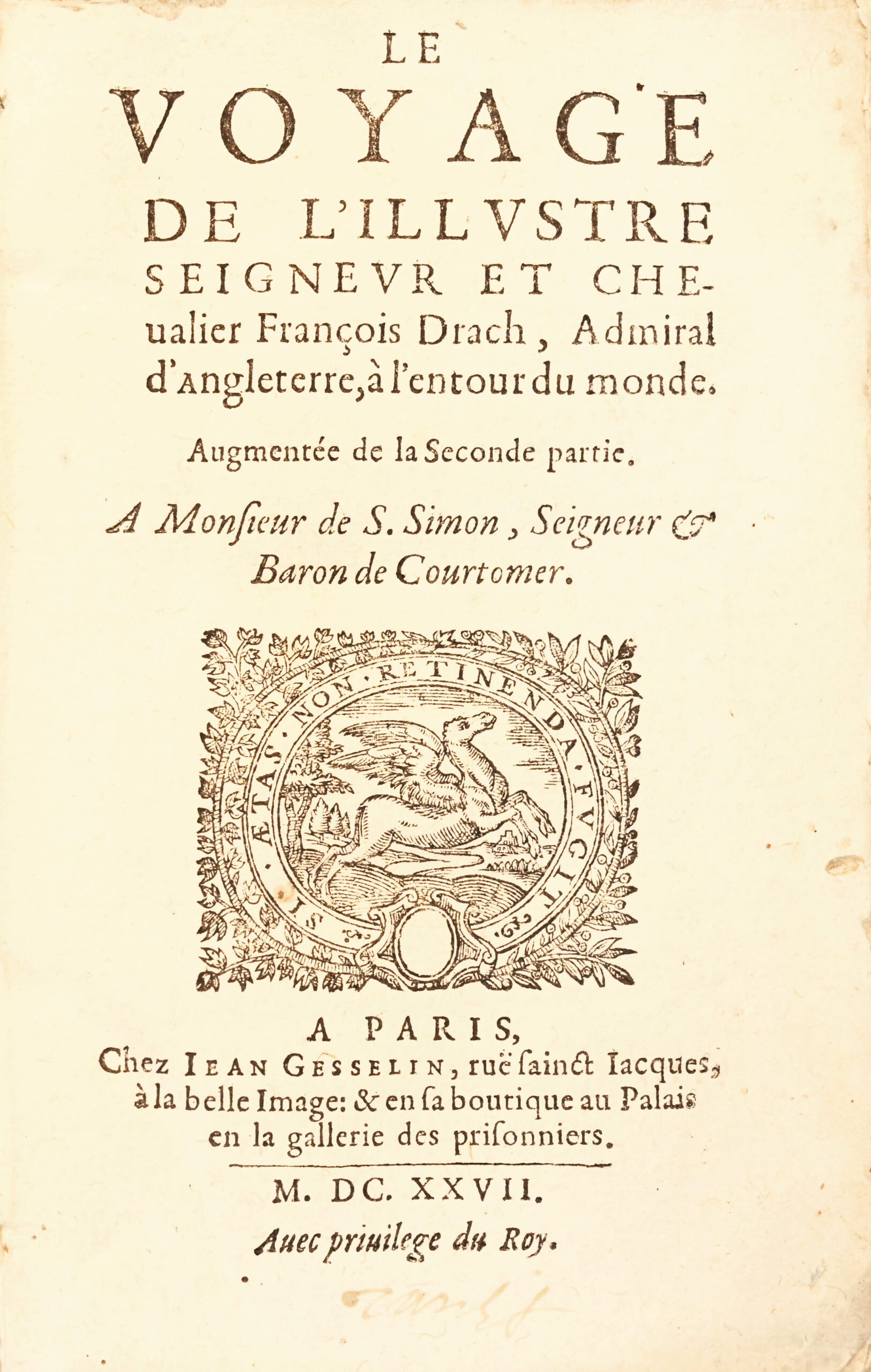
A Paris, chez Iean Gesselin, rue sainct Iacques, à la belle Image : & en sa boutique au Palais en la gallerie des prisonniers. m.dc.xxvii.(1627). Avec privilège du Roy.
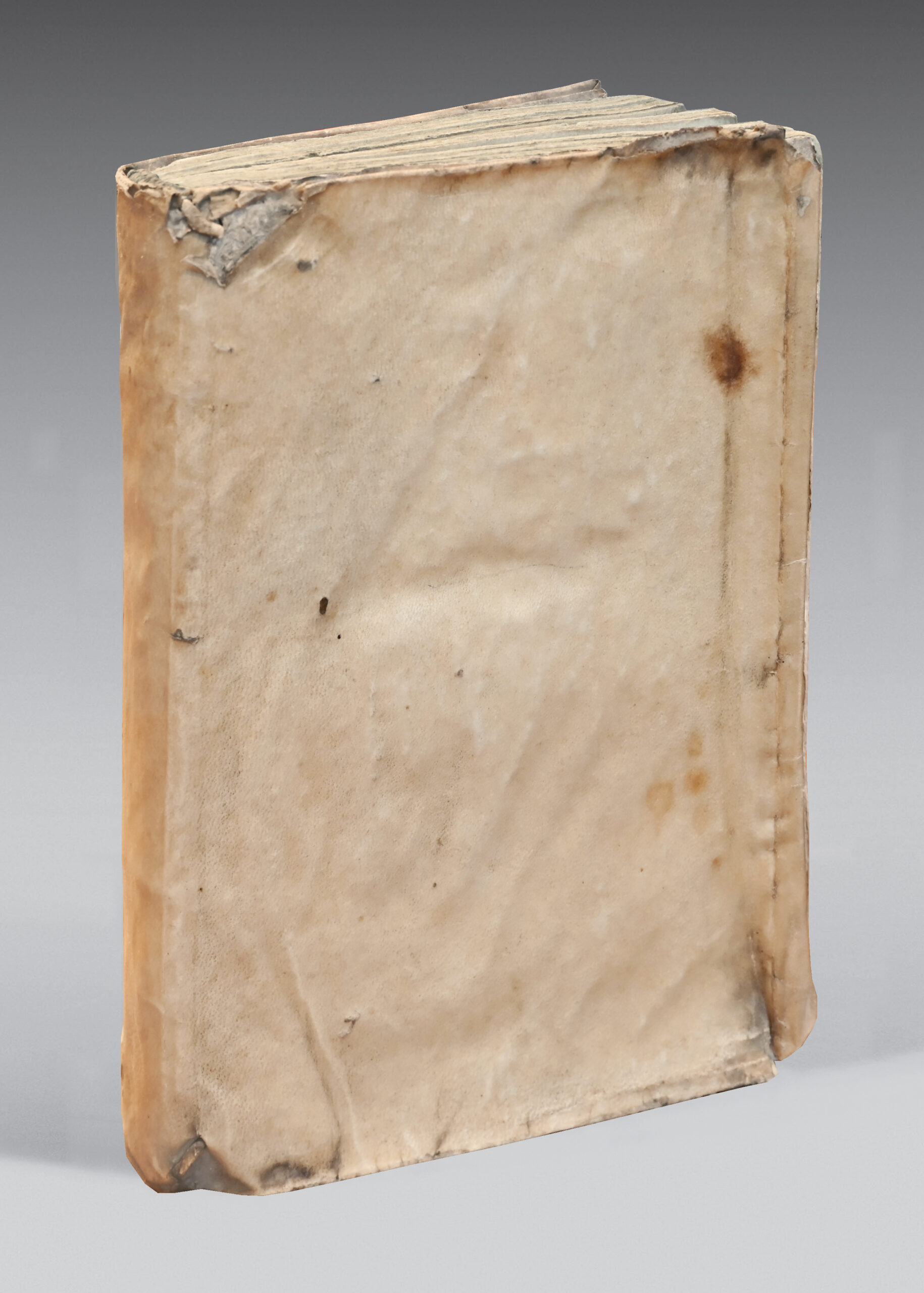
1 8to volume (166 x 106 mm) of (4) leaves (complete with the often missing blank leaf a4), 230 pages, (1) leaf, manuscript ex libris on the title, small paper loss in the margin of pages 97 to 105 not affecting the text, small wormtrack in the margin of a few leaves, full vellum, few defects to the binding, first blank flyleaf frayed. Contemporary binding.
The first English circumnavigation voyage began in 1577 translated into French by f. De Louvencourt, Sieur de Vauchelles.
Alden-l. 627/121 ; Sabin 20845 ; JCB II, 208
French first edition of reference in 230 pages, greatly expanded compared to the first of 1613 which contained only the first part in 90 pages.
The bibliography of D.B. Quinns shows that no maps were published in the French editions of 1613 and 1627.
Drake departed from Plymouth on November 13, 1577, and entered the Strait of Magellan on August 20, 1578. Upon reaching the exit of the strait on September 6, he encountered a storm the next day that drove him south. Returning to the end of the strait, he named the bay where he anchored “Parting of Friends” because one of his ships was separated from him when leaving. Further gales pushed him south again; he found himself among islands that geographers long placed on maps 800 kilometers west of America. Fleurieu demonstrated their identity with the numerous and still poorly known islands forming the southwestern part of the Tierra del Fuego archipelago and proved that Drake recognized Cape Horn, a discovery that should have brought him glory. On November 20, Drake reached the island of Mocha, south of Chile, where he had set the meeting point for his fleet. Seeing none of his ships, he continued north along the coasts of Chile and Peru, seizing every opportunity to capture Spanish ships and make land raids. His crew, somewhat sated with plunder, followed the North American coast to the 48th parallel north, hoping to find a passage to return to the Atlantic Ocean. Disappointed in this hope and forced by the cold to retreat to the 38th parallel, he named the land where he repaired his ship New Albion, took possession in the name of Queen Elizabeth, and on September 29, 1579, set course for the Moluccas. On October 13, he encountered islands inhabited by the most barbaric people he had seen on his voyage, and on November 4, he anchored at Ternate. He nearly perished near Celebes on January 6, 1580. Upon leaving Sumatra, he intended to go to Malacca, but circumstances forced him to take the route to England. He returned to Plymouth on November 3.
Drake’s circumnavigation voyage provides clear evidence of his courage, intelligence, and skill in keeping his crew in line, as all similar expeditions attempted since Magellan had failed miserably. Drake was well-versed in all aspects of nautical art. One cannot help but admire the boldness of modern navigators who first attempted to traverse unknown seas on ships whose small size is truly surprising. During his circumnavigation voyage, Drake commanded a 100-ton ship, which was the largest in his fleet. Fleurieu has provided an interesting account of the various accounts of Drake’s voyage: François Pretty, a Picard gentleman employed in Drake’s squadron, wrote an English journal of his navigation titled The Famous Voyage of Sir Francis Drake into the South Sea, and hence about the whole globe of the Earth, London, 1600, 12mo. François de Louvencourt provided a French translation titled Le Voyage curieux fait autour du monde, par François Drach, amiral d’Angleterre, Paris, 1627, 12mo; ib., 1641. In his preface addressed to Saint-Simon, Baron de Courtomer, the translator says: “I dedicate it to you because you gave it to me, having told me that you received it from one of your subjects of Courtomer, who made the same voyage with this lord.” Nuño de Sylva, a Portuguese pilot whom Drake had captured in the Cape Verde Islands, was the first to give an account of the same voyage. Hackluyt included a copy of the two previous accounts in volume 6 of his collection, printed in 1600. Théodore de Bry had printed a Latin translation of the first account (by Artus) as early as 1599 in volume 8 of his collection. This also appears in the first volume of Purchas’s collection and in all collections published in various languages of Europe.
Beautiful copy of this very rare first French edition, preserved in its original contemporary vellum binding.