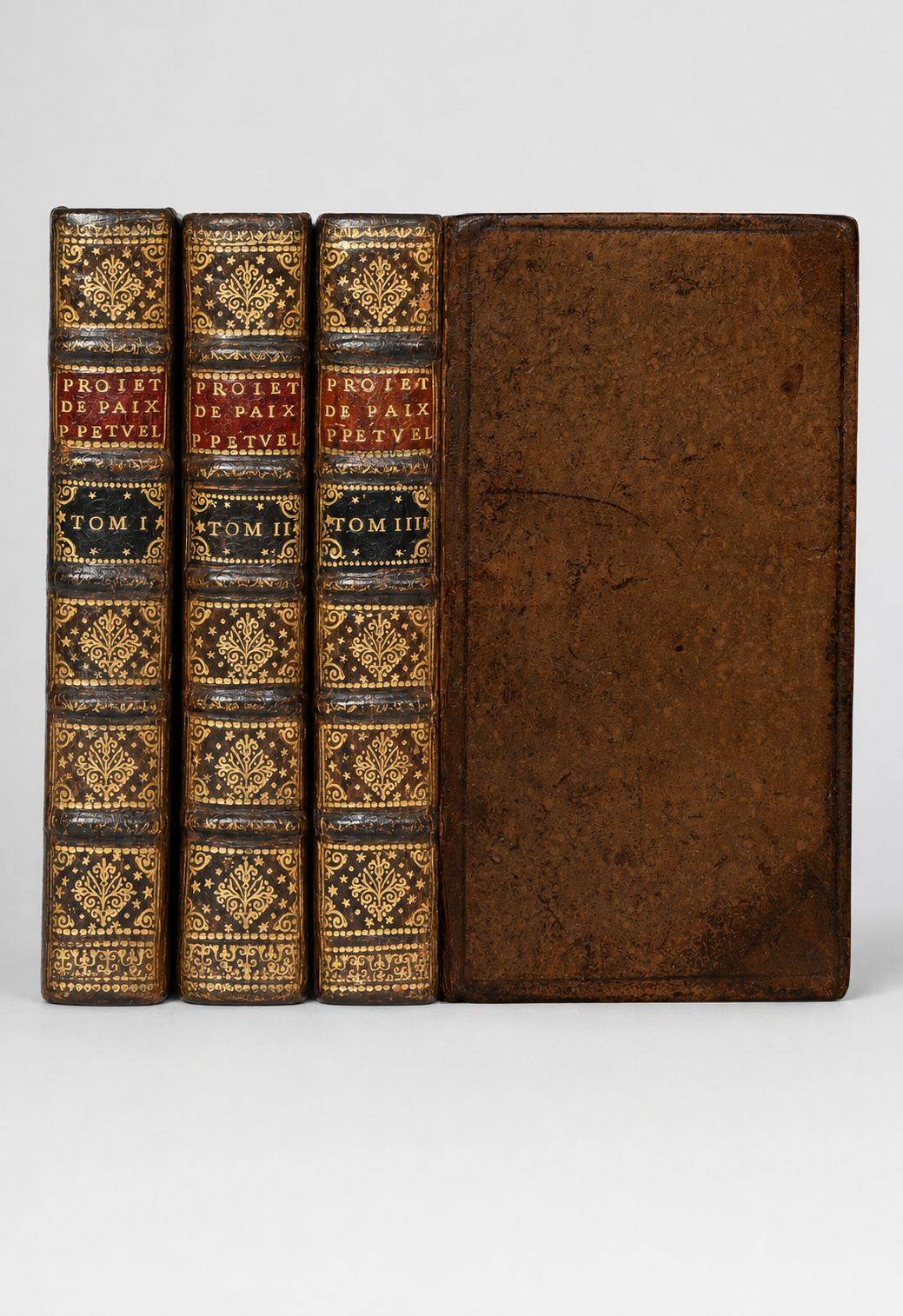
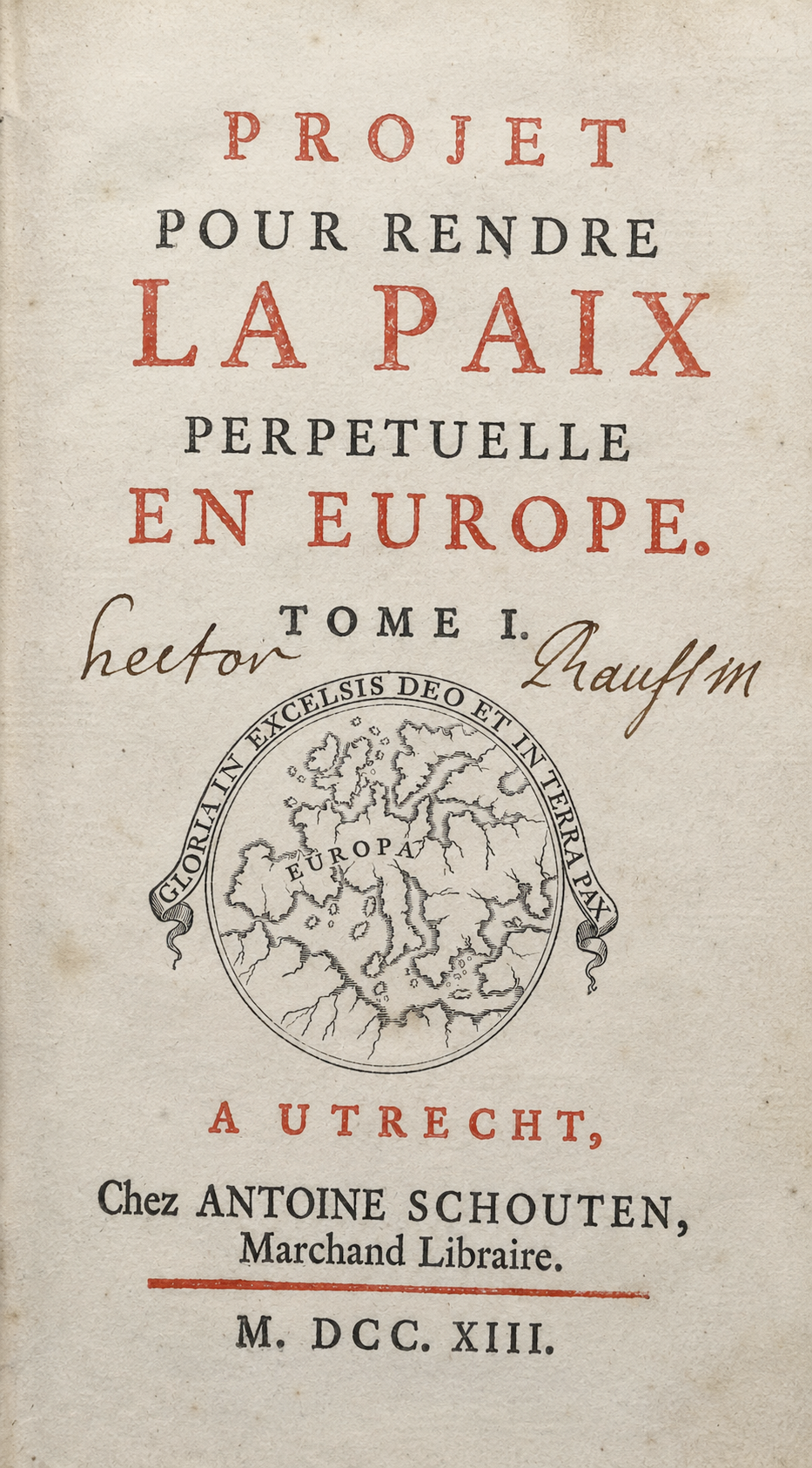
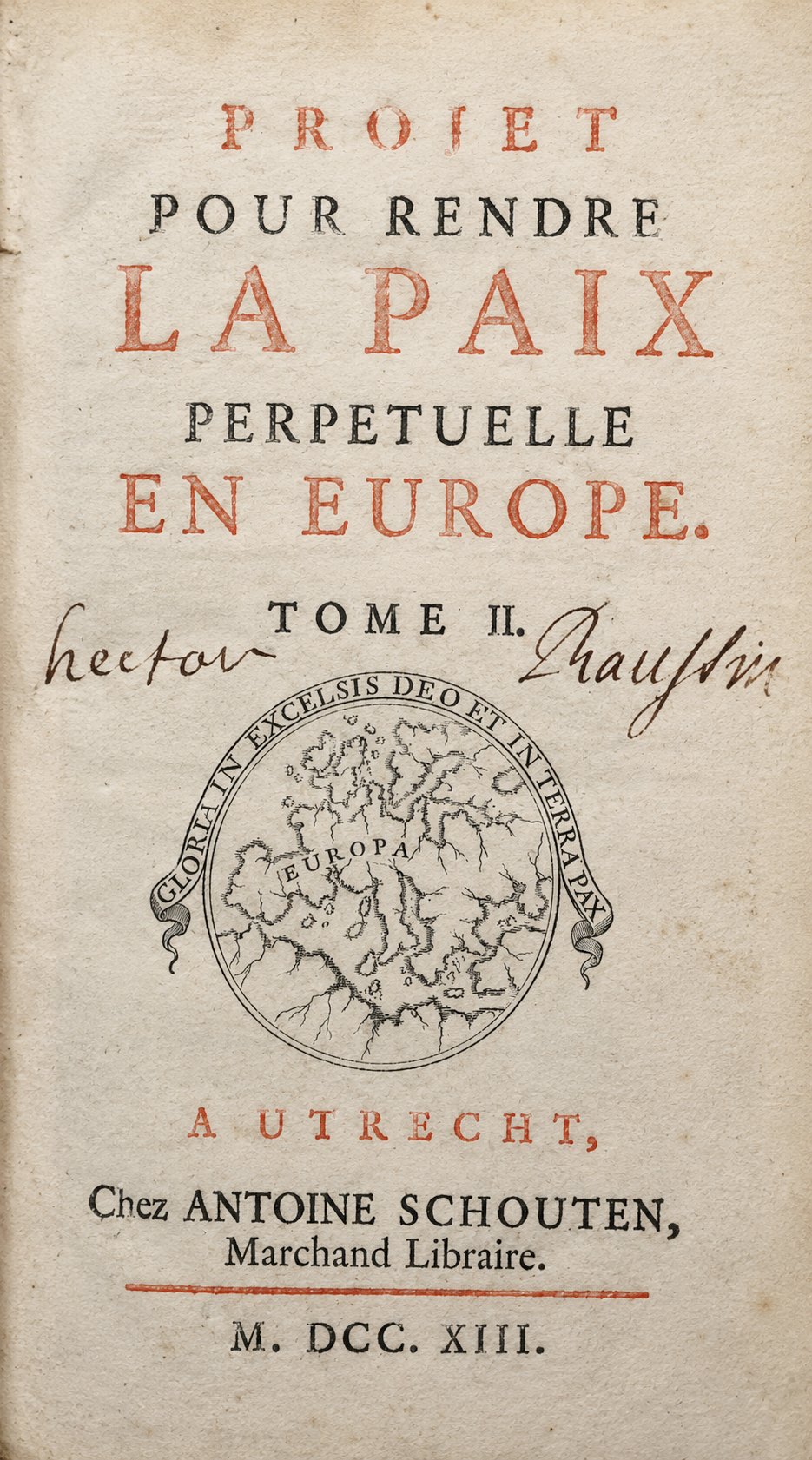
Utrecht, Antoine Schouten, 1713.
– Projet pour rendre la paix perpétuelle entre les souverains chrétiens, pour maintenir toujours le commerce libre entre les nations, pour maintenir toujours le commerce libre entre les nations, pour affermir beaucoup davantage les maisons souveraines sur le trône, proposé autrefois par Henry le grand.
Utrecht, Schouten, 1717.
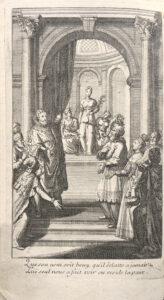
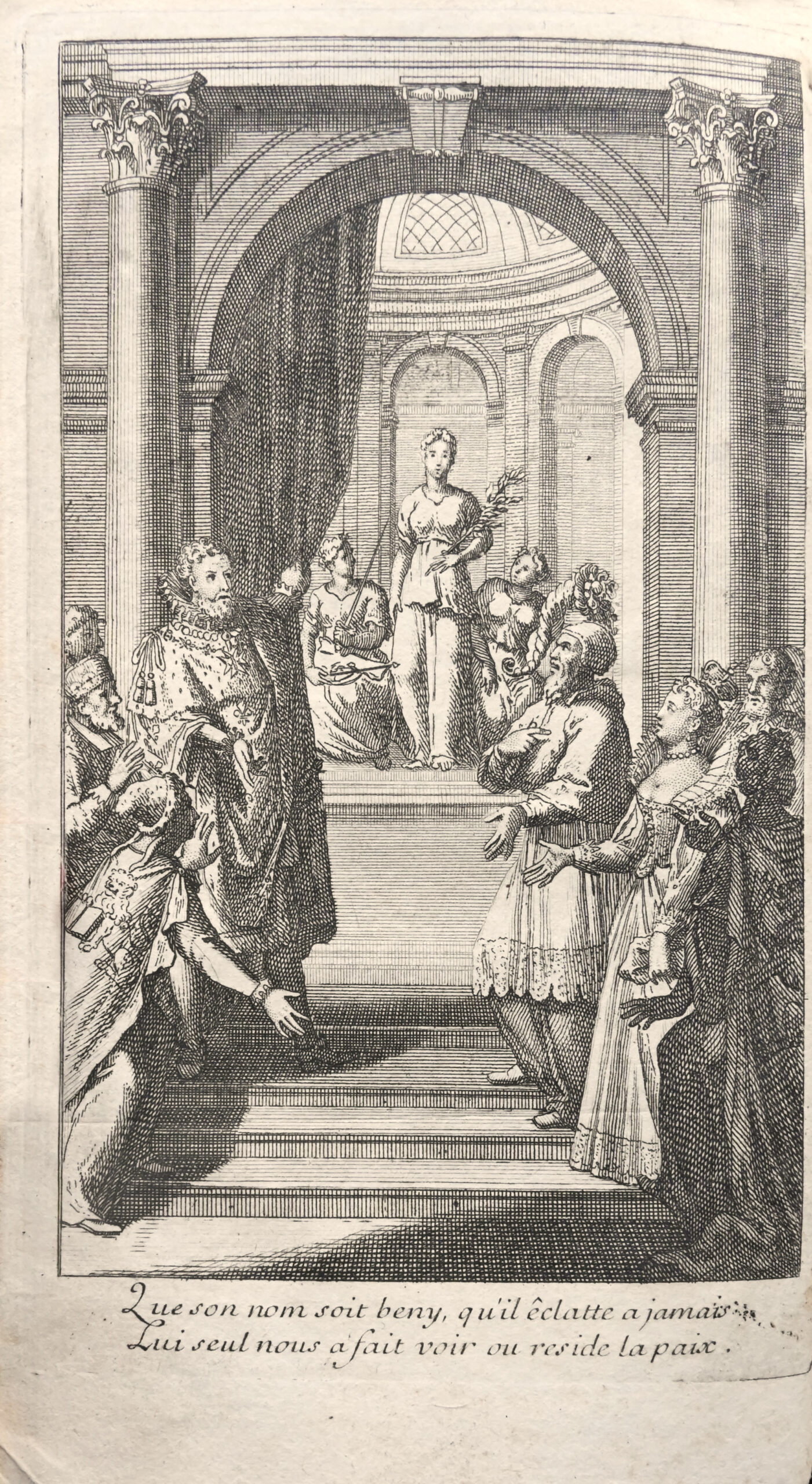
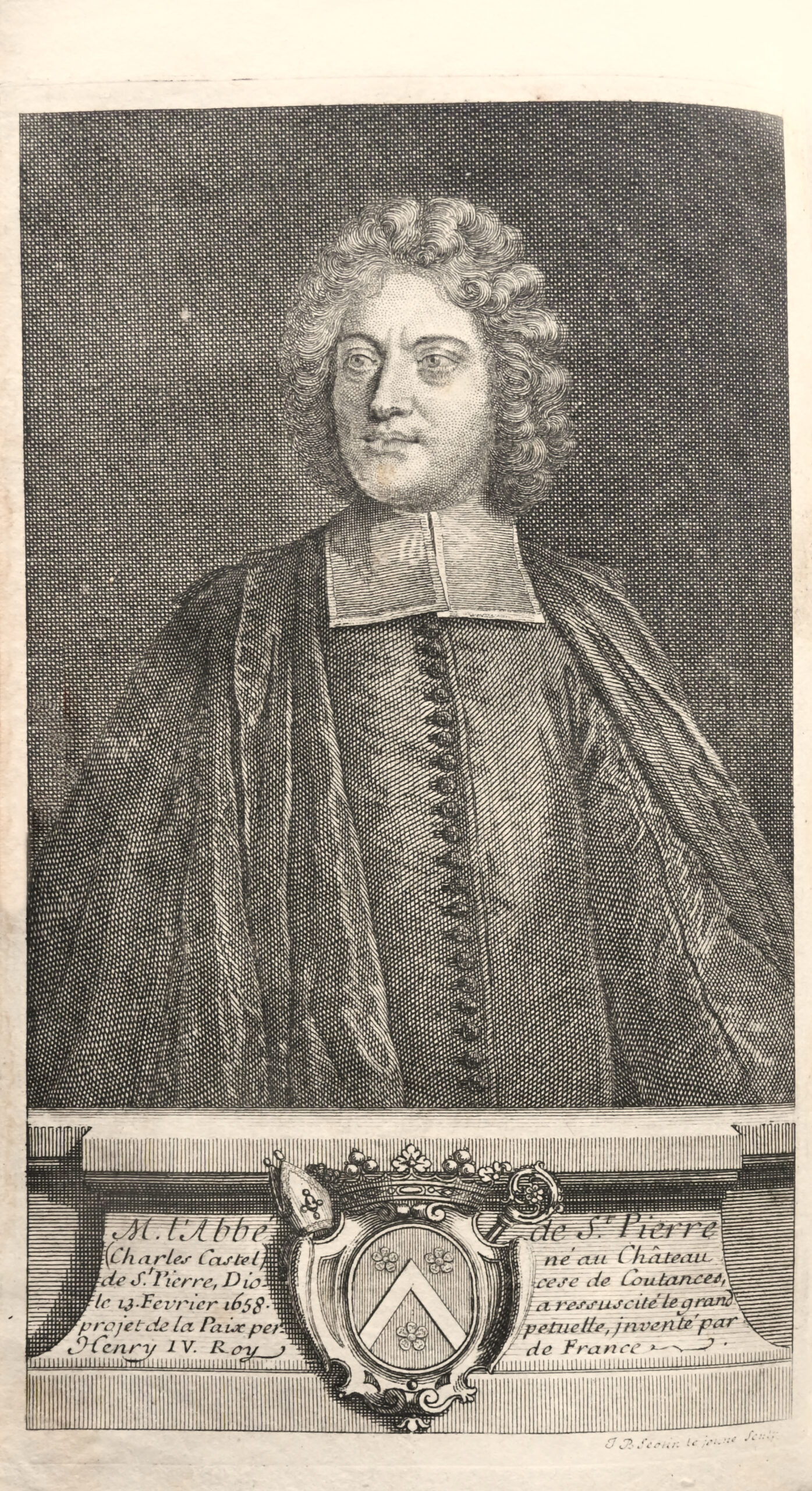
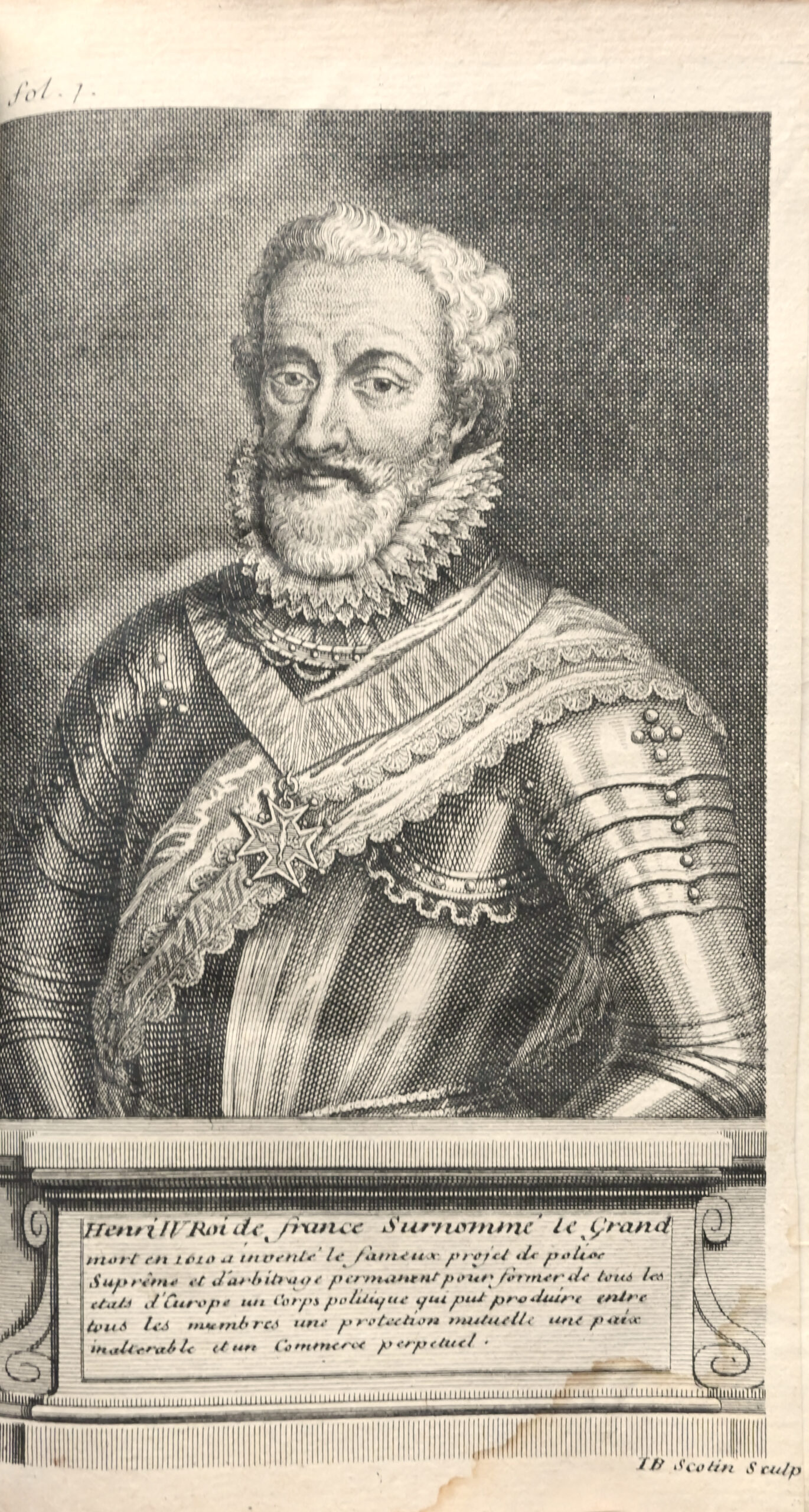
3 volumes in-12, I/ (1) portrait of the author, (3) leaves, xxiv pp., 400, (10) ; II/ (1) full-page engraving, (1) title leaf, 423 pp., (9) pp. ; III/ xxxiv pp., (10) pp., 455 pp., (4) pp., 4 full-page engraved plates outside the text, including one folding plate. Brown calf, blind fillet border around the covers, raised spine richly decorated, decorated edges, marbled edges. Contemporary binding.
165 x 93 mm.
Rare first edition of what would become the Abbé de Saint-Pierre’s most famous work, the Project for Perpetual Peace.
The Abbé de Saint-Pierre (1658-1743) drafted no fewer than four preliminary versions of this text, printed in small runs, before publishing this definitive state, which he therefore had printed anonymously and under a false imprint.
Situated within a long pacifist tradition, the Project proposes geometric means of achieving definitive peace.
The principal of these, anticipating 20th-century attempts in this field, consisted of convening a permanent European congress seated at Utrecht and composed of representatives from each country. Charged with resolving conflicts among members through arbitration and mediation, it would resort to force only in the event of refusal to comply with a ruling.
The present edition, Utrecht, Schouten, 1713, was supplemented in 1717 by a 3rd volume.
Charles Irénée Castel, Abbé de Saint-Pierre (1658-1743), came from a Norman noble family. Having received minor orders (1680), the Abbé de Saint-Pierre, a friend of Fontenelle, became involved quite early in Parisian intellectual life. He would become one of the founders of the Club de l’Entresol, a society of free political reflection. Until the end of his life, he multiplied reform projects concerning taxation, the banking system, roads, armies, assistance to the poor, pedagogy, and orthography.
“The ‘Project for Perpetual Peace,’ conceived around 1708, first had three successive printed drafts in small print runs, one of which, perhaps published without his consent, is dated Cologne, 1712, under the title ‘Memoirs for Establishing Perpetual Peace in Europe.’ The most developed version appeared in 1713 (two volumes), supplemented by a volume of clarifications (1717), followed by an ‘Abstract’ (1729) and a final edition (1747). The ‘Project’ sets forth, in thoroughly Cartesian logic, the means of putting an end to war. Situated within a pacifist tradition going back to Antiquity, it was also the outcry of a conscience revolted by the bellicose policy of Louis XIV. It advocated a European diet seated at Utrecht, composed of representatives from each country. The territorial situation of participating nations being guaranteed, the Diet would settle disputes between states through mediation and arbitration. Armed intervention was provided only against any member of the alliance refusing to comply with the arbitral decision. The modernity and generosity of this project, which also offered states the advantage of ‘procuring a very considerable reduction in their military expenditure,’ are beyond doubt. But the author remained attached to an Ancien Régime ideology: witness his concern to ensure princes within their states, thanks to their alliance, ‘prompt and sufficient assistance (…) against seditious persons and rebels,’ as well as his variations from one version to another regarding the relationship to be established between the confederation of Christian nations and the Ottoman Empire, one of which (in 1717) involved organizing a crusade against the Turks.
Despite its limitations, this peaceful dream inspired Jean-Jacques Rousseau, who published in 1761 an ‘Extract from the Project for Perpetual Peace,’ ensuring the abbé European renown. Kant was one of his followers, as were all those who sought to prepare the ‘League of Nations.’ Roland Desné.
This famous book constitutes one of the very first attempts at the systematic organization of international society. Moved by the suffering generated by the War of the Spanish Succession, the Abbé de Saint-Pierre proposed that states renounce force and settle their disputes before a “European society” possessing a General Assembly and specialized offices (for legal issues, commerce, etc.). With great detail and much optimism, the Abbé explains why states had more interest in adopting his project than rejecting it, using arguments later taken up by liberal theorists, notably that peace favors commerce and discussions on the functioning of a system with two or three actors. Beyond its utopian aspect, already denounced by Rousseau (who, in matters of utopia, understood them better than anyone), the Abbé de Saint-Pierre had a vision that anticipated in several respects the international organizations of the 20th century and offered numerous reflections on international society that make him one of the great founders of international relations theory. (Hervé Coutau-Bégarie. Paris, 1987).
“This major work, published in a very small number of copies, is virtually unobtainable, even in ordinary editions.
It constitutes, two centuries ahead of history, the first attempt at organizing collective security. The ideas developed by the Author, derived from a project attributed to Henri IV and rediscovered in the Memoirs of Sully, were judged at the time both utopian and subversive.
Today, in many respects, they appear prophetic. They earned the author expulsion from the Académie française and immortality through losing it.
The calamities accompanying and following the Wars of Religion in the 16th century had provoked among minds a general aspiration toward definitive peace, an aspiration embodied in what was later called Henri IV’s “Grand Design,” recounted by Sully in the Oeconomies Royales, published in 1638: a plan for establishing a Confederation intended to maintain peace within the Christian world.
In 1623 there appeared a book entitled ‘Le Nouveau Cynée,’ attributed to a writer about whom little is known, Emeric de La Croix, which likewise presented a plan intended to ensure perpetual peace among Christian nations, linked to a project for total freedom of commerce among nations.
Rather vague in their conception, these projects had no impact at the time they were published.
By contrast, the project published by Charles-Irénée Castel, Abbé de Saint-Pierre, immediately achieved considerable influence upon publication, which continued throughout the 18th century, the 19th century, and the beginning of the 20th century.
The Abbé de Saint-Pierre, who had accompanied the Abbé de Polignac to the Congress of Utrecht in 1712, had witnessed the difficulties surrounding the conclusion of peace. He immediately conceived the project of making it perpetual, and at once drafted the articles of the treaty intended to achieve this important result. This project was published in three volumes, the first two appearing in 1713, and the third in 1717.
The good abbé demonstrated therein that treaties of peace and alliance offered no guarantee of permanence, and that the peace they established was in reality only a truce. The only means of rendering peace permanent was to guarantee it through institutions analogous to those preserving within each state the life and property of citizens.
He therefore proposed a plan in five articles, which he commented upon and explained at length, indicating the practical means of implementing them: 1°) a general and perpetual alliance among all sovereigns, based on the latest treaties signed. 2°) a contribution from each ally toward the security and expenses of this great alliance. 3°) the renunciation forever by all of recourse to arms for the settlement of disputes, and the commitment always to resort to conciliation through mediation by the great allies at the place of the General Assembly. The immediate intervention of all the Great Allies against any sovereign refusing to execute the judgments and regulations of the Great Allies. 5°) settlement by majority vote of all necessary and important decisions in order to provide the Great Alliance with greater security and solidity.
This project in fact laid out the moral and political foundations of the institutions that, after the two world wars, attempted the pacification of the world: the League of Nations and the United Nations, both of which claimed inspiration from the ideas of the Abbé de Saint-Pierre.
The Abbé’s project may therefore rightly be considered the most important utopia produced by the Ancien Régime.
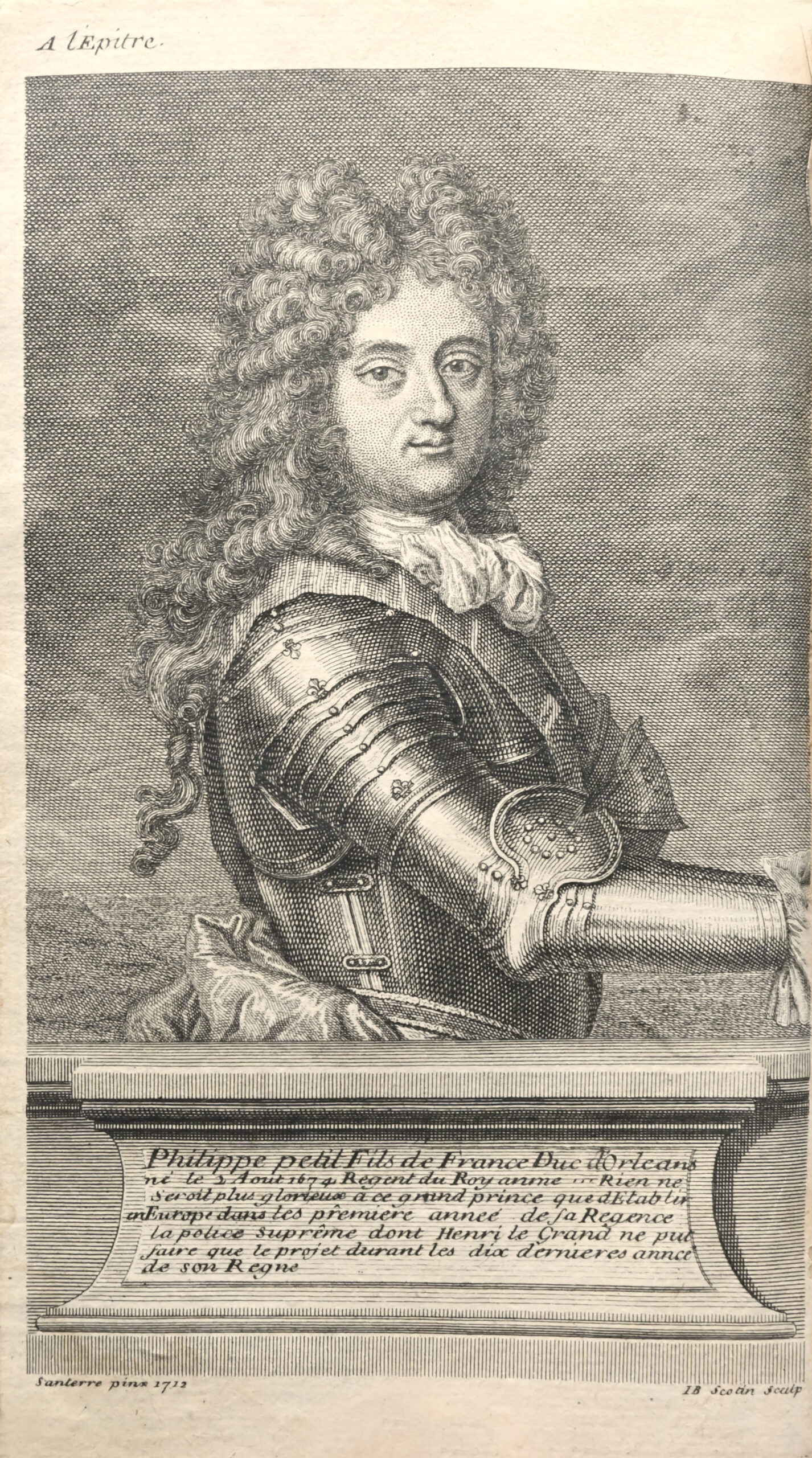
The work appeared in two stages: two volumes in 1713, that is to say at the end of the reign of Louis XIV, whose policy the Abbé de Saint-Pierre had sharply criticized. The third volume, published in 1717, at the beginning of the regency of Philippe d’Orléans, at a time when the latter was striving through wise measures to erase the miseries of the previous reign, is dedicated to the Regent.
Charles-Irénée Castel de Saint-Pierre, known as the Abbé de Saint-Pierre, born on February 18, 1658 at the Château de Saint-Pierre and deceased on April 29, 1743 in Paris, writer and member of the Académie française, was a representative of the political Enlightenment movement favorable to reforms initiated by monarchical authority. He is chiefly known for having envisioned a world without war.
He frequented the circle of Madame de La Fayette and that of the Marquise de Lambert, antechamber of the Académie française and gathering place of the Moderns; he visited Nicole, whom he greatly esteemed, and Malebranche. Thanks to Fontenelle, leader of the Moderns, and Madame de Lambert, he was elected in 1695 to the 8th seat, replacing Bergeret, despite having at that point written almost nothing. In the Quarrel of the Ancients and the Moderns, Fontenelle was thus placing one of his supporters.
He continued to be received in literary salons, at the homes of Mesdames de Tencin, Dupin, d’Avaray, de Coigny, de Matignon, Geoffrin, and d’Aiguillon. Introduced by his disciple and friend, the Marquis d’Argenson, he participated in the work of the Club de l’Entresol founded by the Abbé Alary in 1724 and published memoirs on varied subjects in an effort to persuade monarchical power to initiate reforms benefiting the greatest number. After the cessation in 1731 of the activities of the Entresol, at the request of Minister Fleury, Saint-Pierre gathered and revised most of his writings in order to publish them in Holland in the series Ouvrages de politique et de morale, edited in sixteen volumes in Rotterdam by Jan Daniel Beman between 1733 and 1741. At the end of his life he became close to Madame Dupin, whose mentor he was, while continuing to promote peace, including to Frederick II of Prussia, whom he visited in 1740. He died in Paris on April 29, 1743.
Precious copy preserved in its contemporary binding.