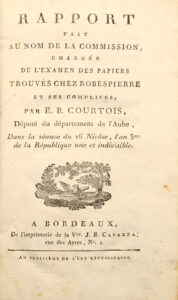
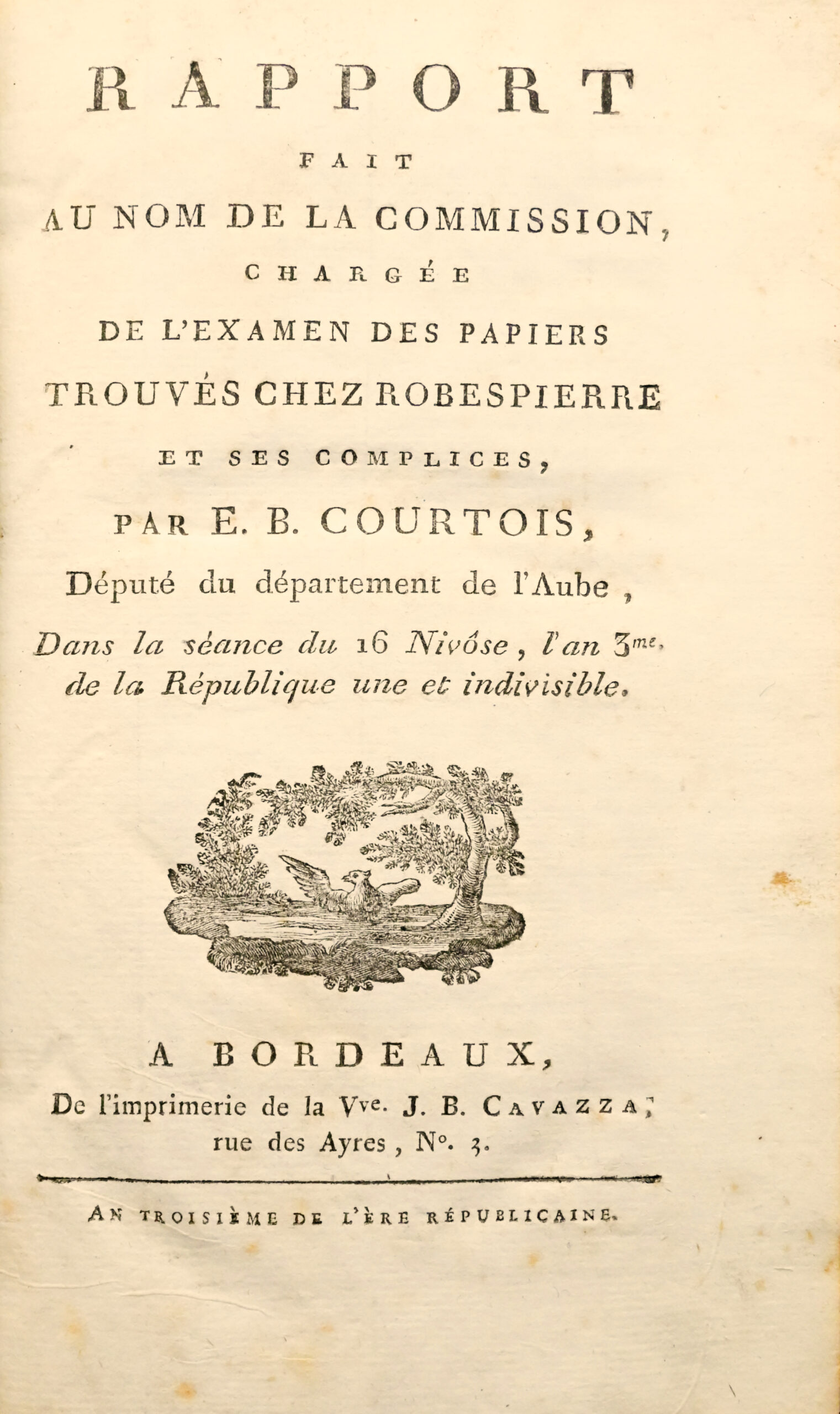
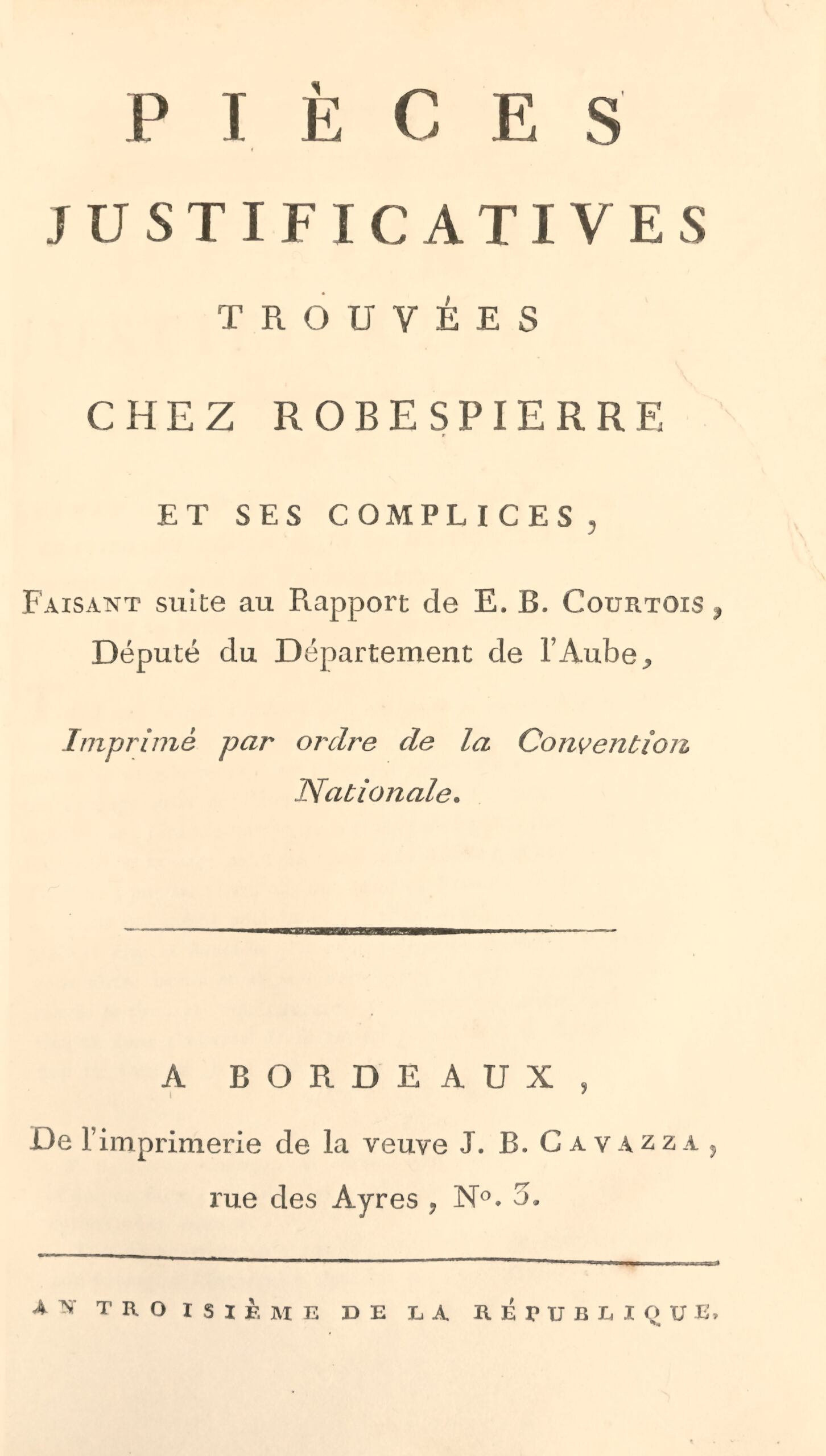
Bordeaux, Veuve J.B. Cavazza, An troisième (1795).
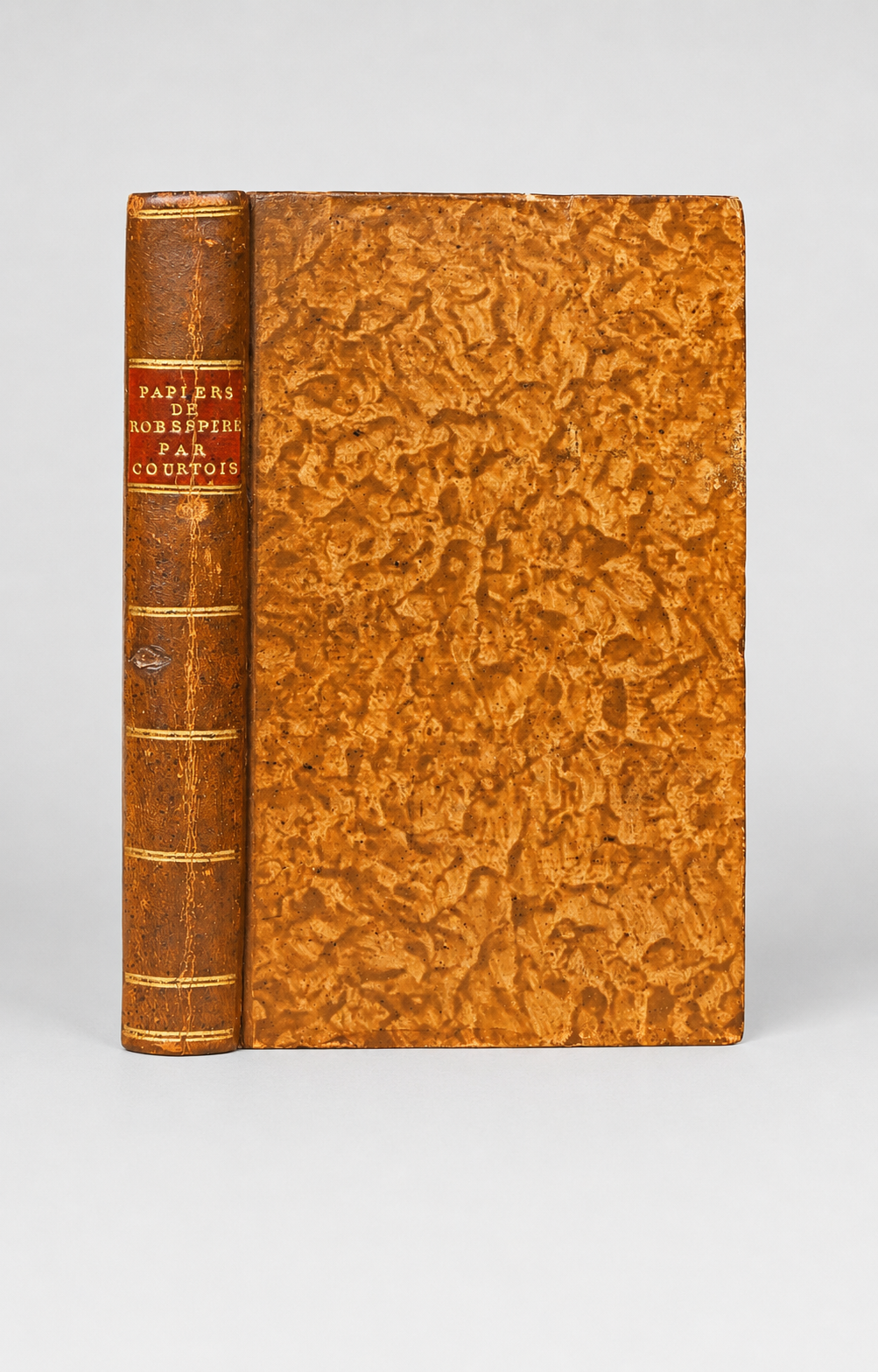
8vo, 101 pp., (2) ff., pp. 103 to 396 incorrectly numbered 386; half brown calf, title label in red morocco, sprinkled edges. Contemporary binding.
180 x 111 mm.
This report constitutes a document of primary importance on the actions of Robespierre and his supporters.
“Courtois (1756–1816), a member of the Convention, embraced the revolutionary cause with great enthusiasm and was, from the beginning, appointed receiver of the district in his native town, then deputy to the Legislative Assembly, where he did not particularly distinguish himself. Elected by the same department (Aube) to the National Convention in 1792, he again spoke very little from the tribune; however, he was closely linked with Danton there, and therefore opposed Robespierre. During the trial of Louis XVI he voted for death, against an appeal to the people and against delay.
It is clear that Courtois must have run great risks when his friend Danton was sent to the scaffold. He increasingly withdrew into silence and only broke it on the famous day of 9 Thermidor, when he contributed as much as he could to the overthrow of Robespierre. Appointed one of the members of the commission tasked with examining the papers seized from Robespierre and his accomplices, he was charged by his colleagues with drafting and reading the report to the Convention; he worked on it for nearly six months. It was only in the session of 16 Nivose year iii (January 1795) that he read this famous report, which has become one of the most curious monuments of the French revolution. The documents it contains are the most truthful part and best characterize this period. After 9 Thermidor, Courtois became in the Convention one of the most active and formidable opponents of the faction known as ‘the tail of Robespierre’; and he rendered considerable service to the victims of the Terror…” (Biographie universelle).
Elected to the Legislative Assembly in 1791, friend of Danton, Courtois took his revenge after 9 Thermidor by requesting to join the commission tasked with inventorying the papers found in Robespierre’s possession.
“In his ‘Report made on behalf of the Commission charged with examining the papers found in Robespierre and his accomplices,’ Courtois allows us to measure, incidentally and without realizing it, the immense popularity enjoyed by Robespierre among patriots. ‘Criminal associations caused him to inhale, from all parts of France, the criminal incense they burned in his honor; it was a competition to intoxicate the idol… and thousands of irreligious fanatics seemed to have driven the gods they had worshipped for so many centuries from their temples only to prostrate themselves before their new god Maximilien. One must read these papers to be convinced…’ (1) ‘…A national agent in turn informs us that it is the Supreme Being whose existence Robespierre proved who (in gratitude, no doubt) watches over his days and that the Republic is saved.’ And Courtois refers us to no. XVIII of the supporting documents (2).
This concerns a letter from citizen D… to Robespierre, which must be transcribed in full in order to follow the sender’s own explanations.
“Carismont, formerly Saint-Aignan, 12 Prairial, Year Two of the French Republic.
The provisional national agent of the district of Carismont (3), formerly Saint-Aignan…”