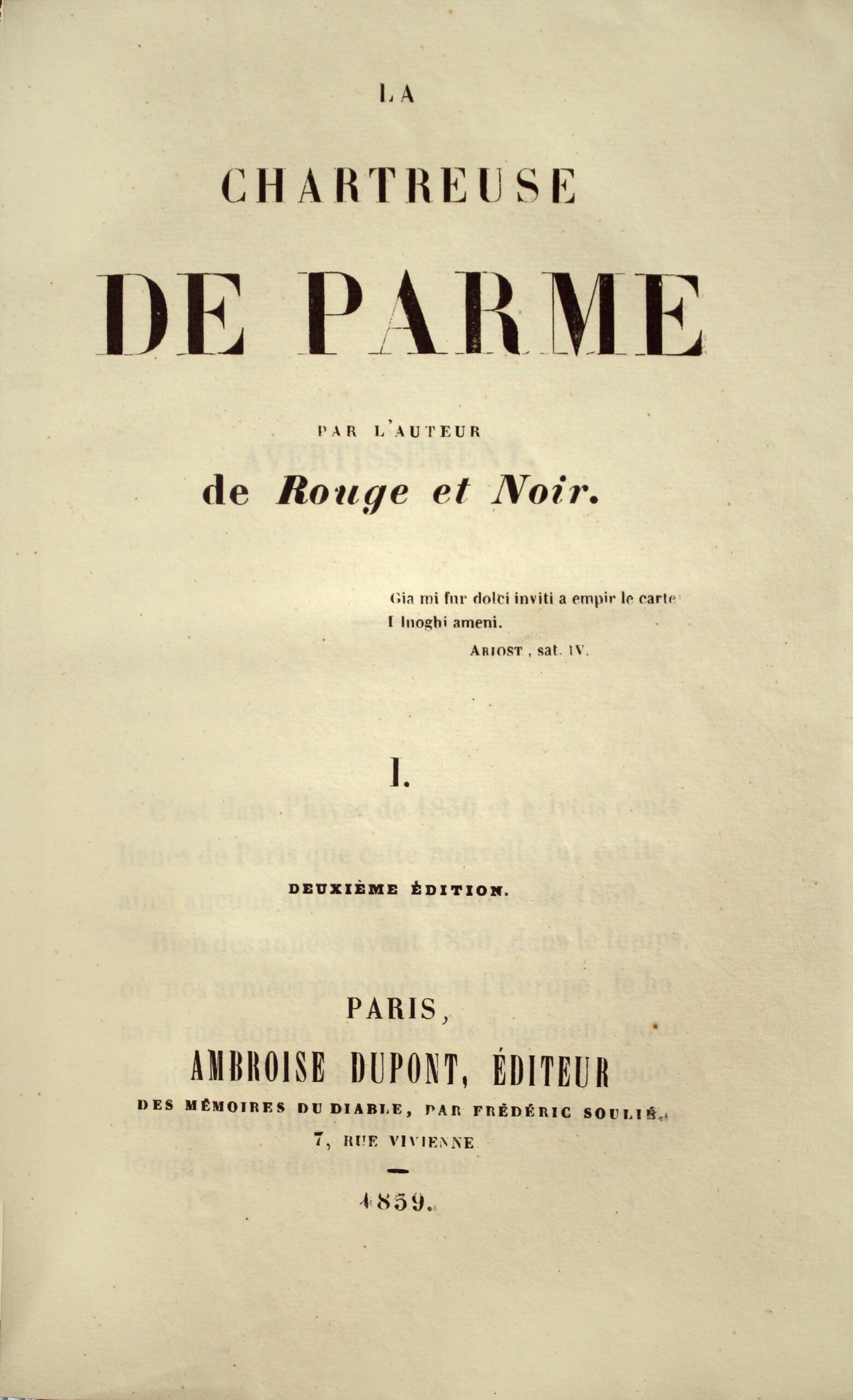
Paris, Ambroise Dupont, 1839.
2 volumes in 2 octavo volumes of: I/ (2) leaves for the half-title and title, 402 pages; II/ (2) leaves for the half-title and title, 445 pages. Complete as such. Some copies contain an unpaginated catalog leaf bound after the text. The copy of Baron Rothschild, described and collated by Picot, does not have this optional advertising leaf. Some foxing and traces of water stains.
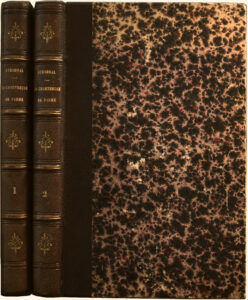
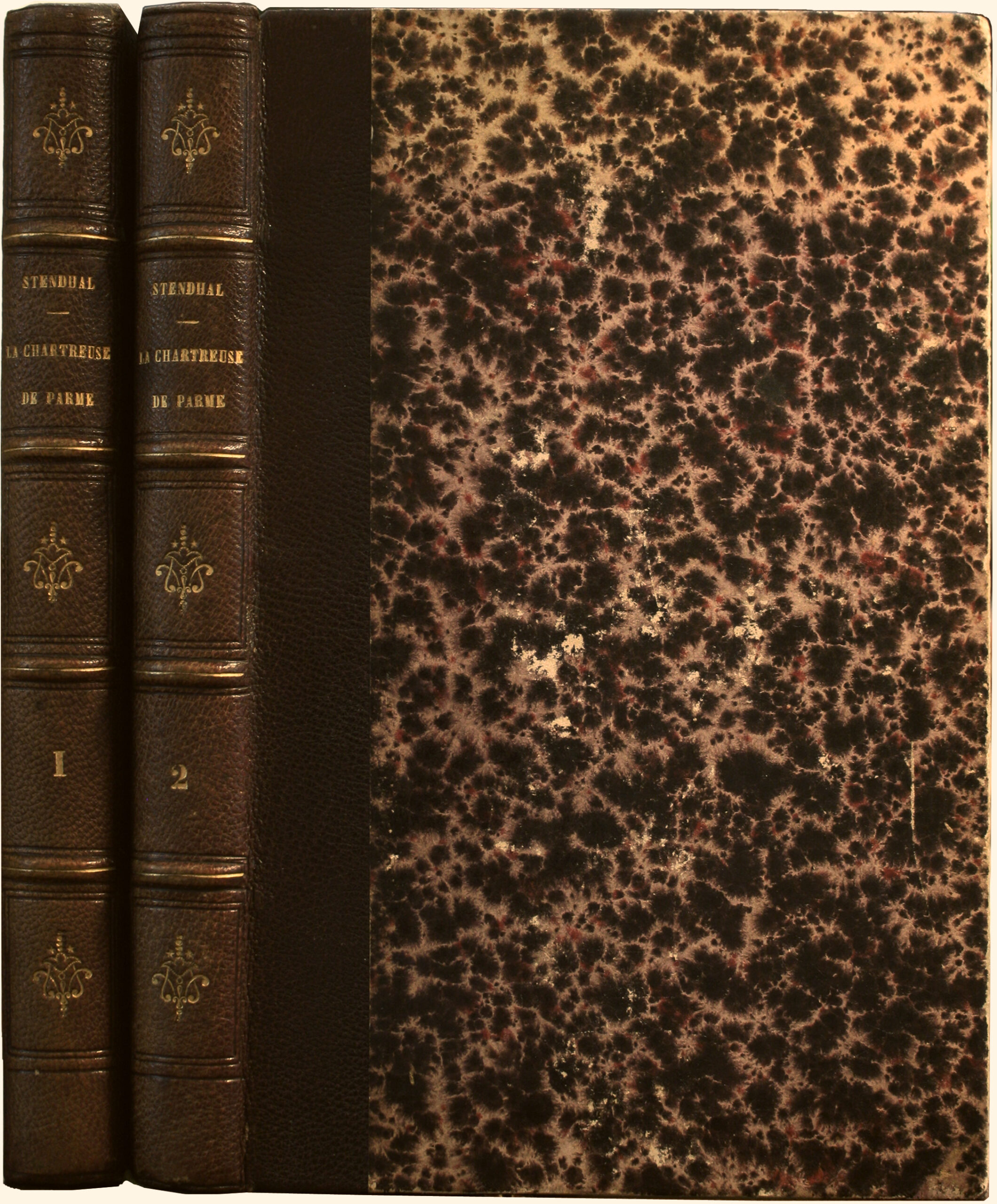
Bound in contemporary half-burgundy morocco, spines with raised bands adorned with blind-stamped panels, gilt fillets, and fleurons, speckled edges. Contemporary binding.
202 x 128 mm.
Original edition of the second printing of one of the most coveted novels of the 19the century.
Carteret 358; Clouzot 257; Vicaire, Guide for the Book Lover of the 19th Century, 458.
“Very rare and extremely sought after. Generally very simply bound at the time. Often speckled. Many copies bear the mention ‘Second edition’, which cannot really be called fictitious. It is indeed a second printing. The paper, different, is laid.” (Clouzot).
“The different copies of the original edition of the Charterhouse of Parma that I have seen are all on vellum paper; there exists, under the same date of 1839, an edition of this work bearing on the titles and on the covers: ‘Second edition’. The copy I have seen is on laid paper. In reality, it is a new printing from the same composition rather than a second edition. The collation of the volumes is identically the same as that of the original edition” (Vicaire, Guide for Book Lovers, 458).
This second printing therefore has exactly the same collation as the first printing, and the copies of both printings are exactly the same size. The only difference between the two printings is the paper used (vellum for the first, laid for the second). The publisher undoubtedly added the mention of “second edition” on the titles to better sell his new printing on laid paper.
Stendhal dreamed of writing a novel about the life of Alexander Farnese (1468-1549); he was also working on a story about the Battle of Waterloo.
His work took shape on September 3, 1838, when he decided to set the events he had discovered in the Italian chronicle in the 19th century, making his hero appear at Waterloo and allowing Stendhal to indulge in a satire of absolutism by depicting a small Italian court around 1820.
The novel was written in 7 weeks in November and December 1838.
“In this ‘Chartreuse de Parme’, Stendhal excels in translating his entire ideal of art and life, the now distant mirage of Napoleonic glory and epic, the passion for adventure, the profound love for contemporary Italy and the so admired Italy of the Renaissance, but above all the love of love.
The refined psychological analyses, the obstinate and precise rigor of the style, the philosophical-moral considerations, everything is transfigured in the rare happiness of a lyrical vision that reaches in the best pages the rhythmic purity of a song.”
This work now holds a place in French literature as one of the landmark books of the 19the century and as the ultimate culmination of the very refined psychology of the 18th century.
Bibliographers are unanimous in highlighting the rarity of this original edition.
Beautiful copy preserved in its contemporary bindings in half morocco.