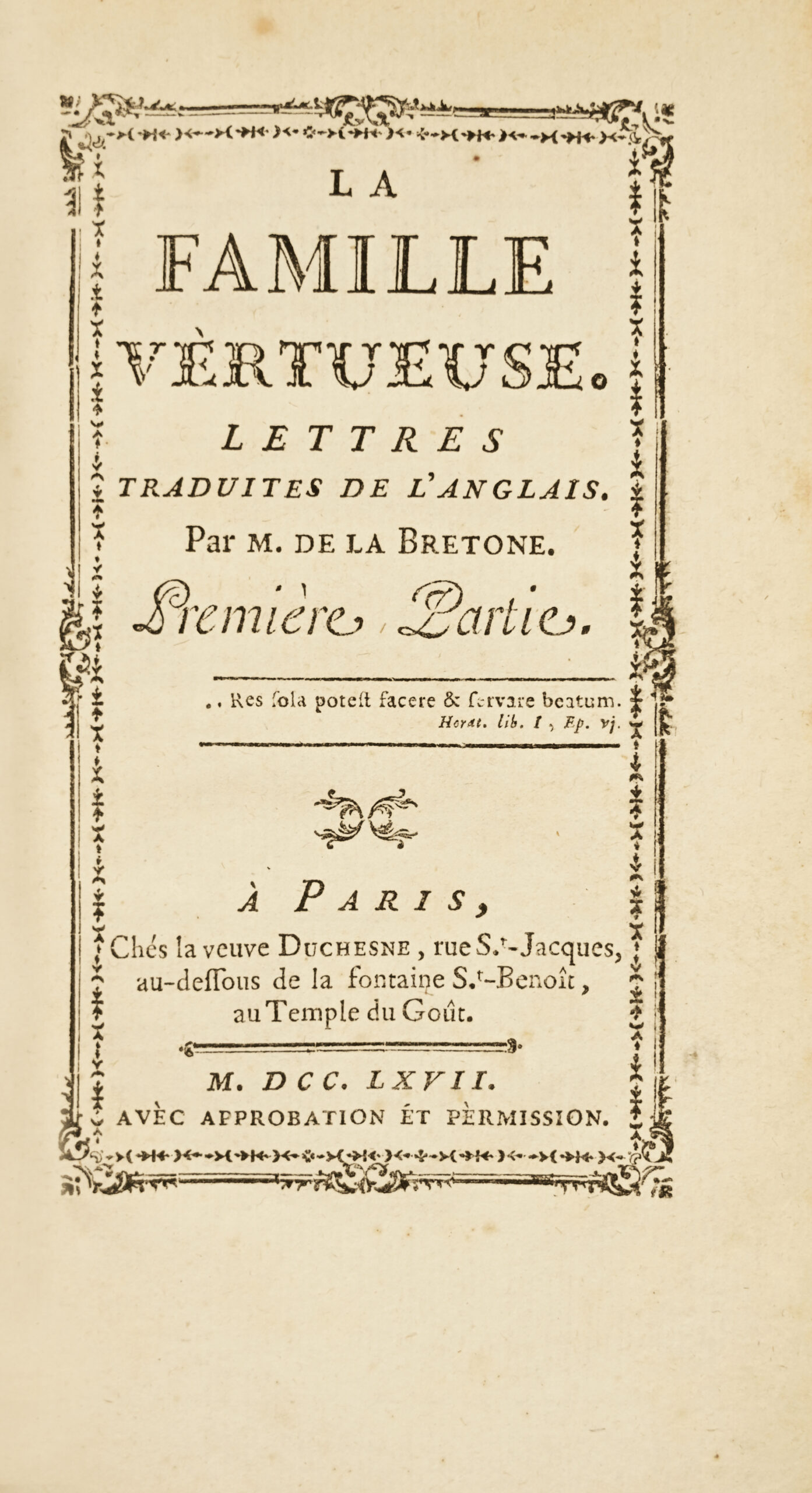
Paris, Veuve Duchesne, 1767.
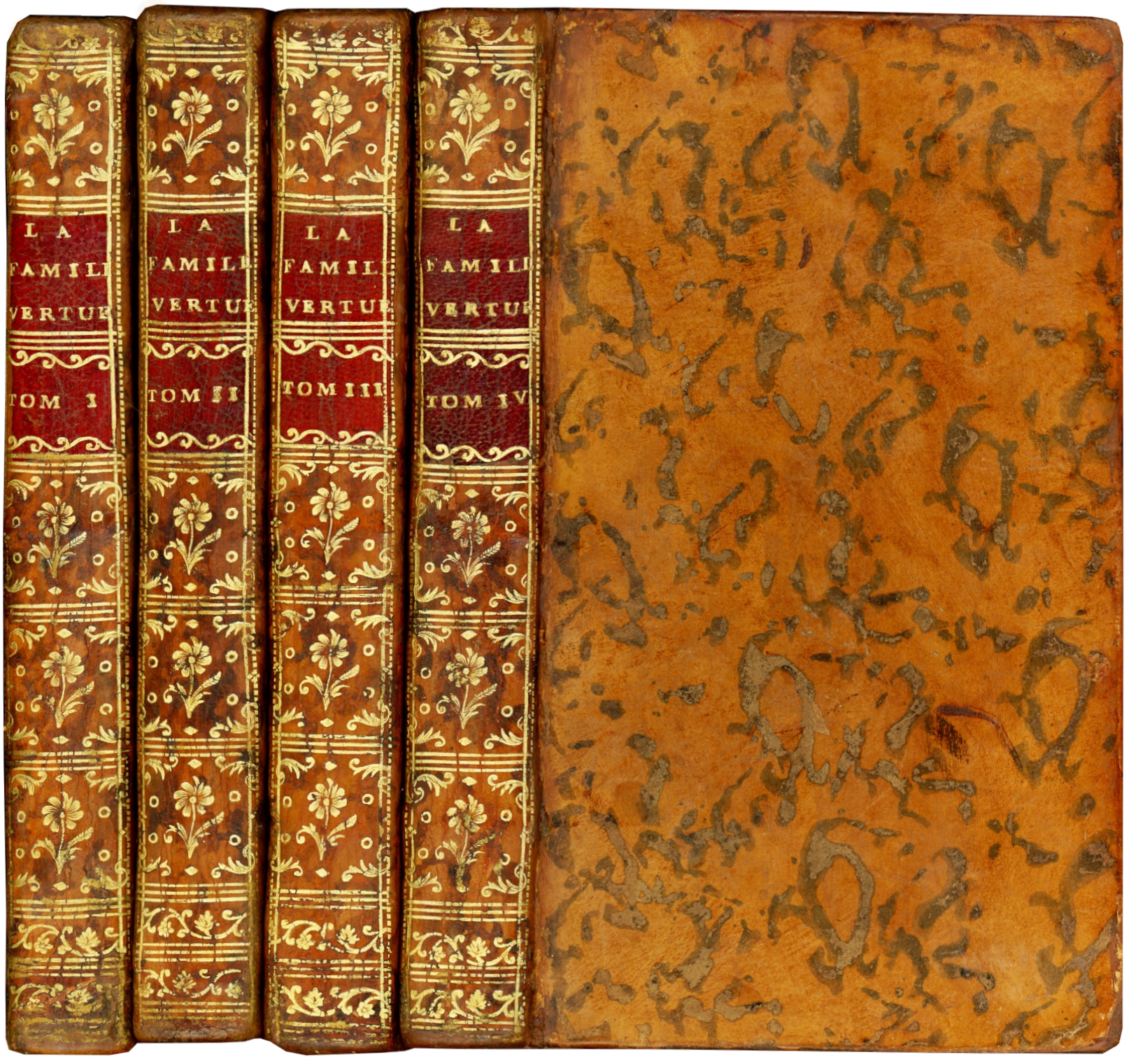
4 parts in 4 volumes in-12: I/ xxxvi preliminary pages, 251 pages; II/ 288 pages; III/ 300 pages; IV/ 299 pages and (13) pages of table. Full marbled havana calf, smooth spines decorated, title and volume labels in red morocco, red edges. Binding of the period.
166 x 95 mm.
” Original edition of Restif’s first work, published without the author’s name. “P.L. Jacob, Bibliography of Restif de la Bretonne, 77 to 81; J. Rives-Child, Restif de la Bretonne, 197-198.
The Virtuous Family, an epistolary novel in four parts set in a Franco-British environment, presents the story of two enemy families. After a family chronicle, the last part reveals the origins of this hatred that has marked the lives of several generations.
At the same time, it is a love story or rather a marriage story; throughout the four parts, we follow the path towards the union of the young Léonor with Sir Blaker. But for the readers, the main characters fade amidst the flurry of characters, improbable events, and unexpected twists. The stories and episodes seemingly unrelated to the main plot make reading the novel difficult. In its deformity, Restif’s first novel possesses almost all the characteristics of the popular novel of the time. The novel Elisabeth by Mme Benoît inspired Restif to become a novelist.
Restif himself recounts, in his Monsieur Nicolas (Vol. VIII, p. 4544) how he composed his first work: ” I was in love with Mlle Bourgeois, and it was she who gave me the necessary energy to write. This energy helped me overcome the initial distaste from the weariness of work that accompanies the beginnings of the art of writing. Finally, I grew to like it, and because some thoughts dazzled me, as happens to many lesser authors, I believed I was producing a masterpiece. I remember that, on feast days, particularly dedicated to my authorship craze, I proudly walked through the streets, saying to myself: ‘Who would believe, seeing me, that I have just written the beautiful things of this morning!’ “.
This novel is the first that Restif composed and published; he took his time to write it, as he made two or three fair copies before giving it for printing. He tells us himself (Monsieur Nicolas, Vol. IX, p, 2662 and following) how he became a novelist and how he gathered the elements of his work: »
” First I had Henriette’s story, which happened in the house of the beautiful Pastry Cook, where I had lived; this event was told to me by Bonne Sellier, thus I had a base. To further encourage myself, I included Rose, as a friend of my Léonore. I inserted a story similar to my epistolary adventure with the two sisters, in the anecdote of the Mounk girls. I had known something related to the tale of Adèle; finally, I knew a very interesting one, which I disguised like the story of Llamas, a Jesuit, who became the father of a girl he married off in California, a country as stupid as in Paraguay. It was with these materials that I built my first edifice. ” I sold The Virtuous Family to Madame Duchesne, 15 livres per sheet; the work made 51; and I thought myself very rich ! Never had such a large sum belonged to me. It was printed, under my double direction as proofreader and author, at F.-A. Quillau, during the first 6 months of 1767, but the work only appeared at Saint-Martin… ” I had finished the manuscript of ‘The Virtuous Family’ at the end of 1766… printing began on January 20, 1767. I was ecstatic to see myself in print. The 4 volumes were completed in May… I resolved to dedicate myself entirely to literature. ” (Monsieur Nicolas, Vol. IX, p. 214-239).
Rare copy in elegant full binding from the period.