From Geneva to Paris through New York, a gastronome named Brillat-Savarin.
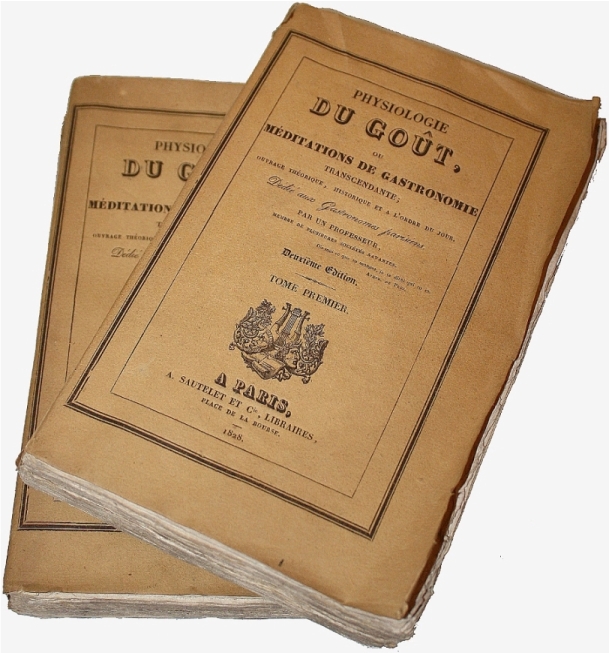
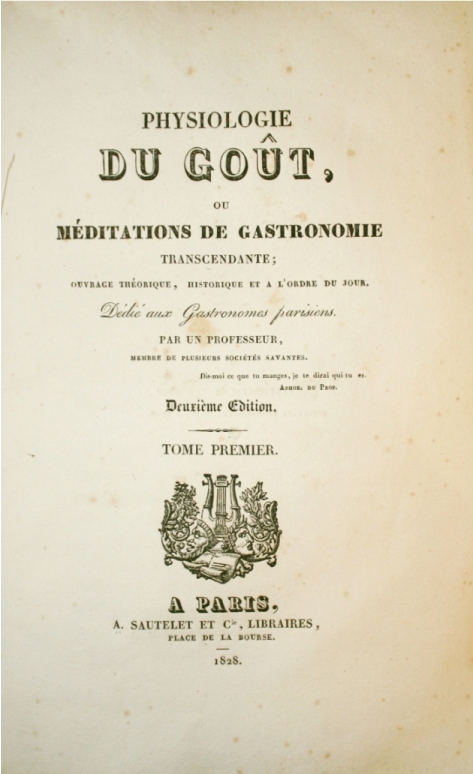
BRILLAT-SAVARIN. Physiologie du goût, ou Méditations de gastronomie transcendante ; ouvrage théorique, historique et à l’ordre du jour, Dédié aux Gastronomes parisiens. Par un professeur, membre de plusieurs sociétés savantes. Deuxième édition. Paris, A. Sautelet et Cie, 1828.
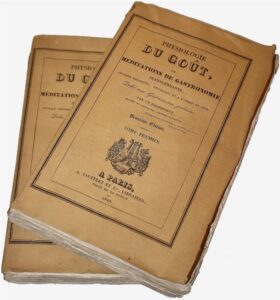
2 parts in 2 volumes 8vo of 412pp. and 440pp. Preserved in the editor’s printed wrappers, untrimmed. Case.
216 x 133 mm.
Second edition of the most famous gastronomic text of all times and of all literatures, preceded here with a note about the author by the baron Richerand in original edition. Vicaire 117 ; Simon 253.
This text, which became a classic cookbook, is full of verve and good mood. Brillat-Savarin owes his celebrity to this very text, the aphorisms of which are known worldwide. The book is a true encyclopaedia: spirit, philosophy, humour, knowledge, aphorisms, psychology and above all, culinary chemistry, still called cooking. This great gastronome was a magistrate and he had to leave France for Geneva, Lausanne and New York during the French Revolution. He then came back to France. Eating a lot out in town, writing this charming book about the physiology of taste started off as a joke. “Its interest comes from the thoughtlessness with which the various culinary questions are cleverly presented and from the constant irony that lightens this small text. The reflexions of the facetious author, about men and things, mingle with a continuous descriptive eloquence, which always remains very precise and evocative: we go from the “Théorie de la friture” to the digressions about culinary delights, from the “Histoire philosophique de la cuisine” to the anecdotes of “Variétés”. The aphorisms, famous for their uniqueness, help to understand how the writer deals with his subject and with what professorial accent he speaks to experts.” (Dictionnaire des Œuvres, V, p. 282). Outstanding copy, completely untrimmed, preserved in the famous editor’s wrappers, the most appreciated condition, as new and preserved in a case.
See less information