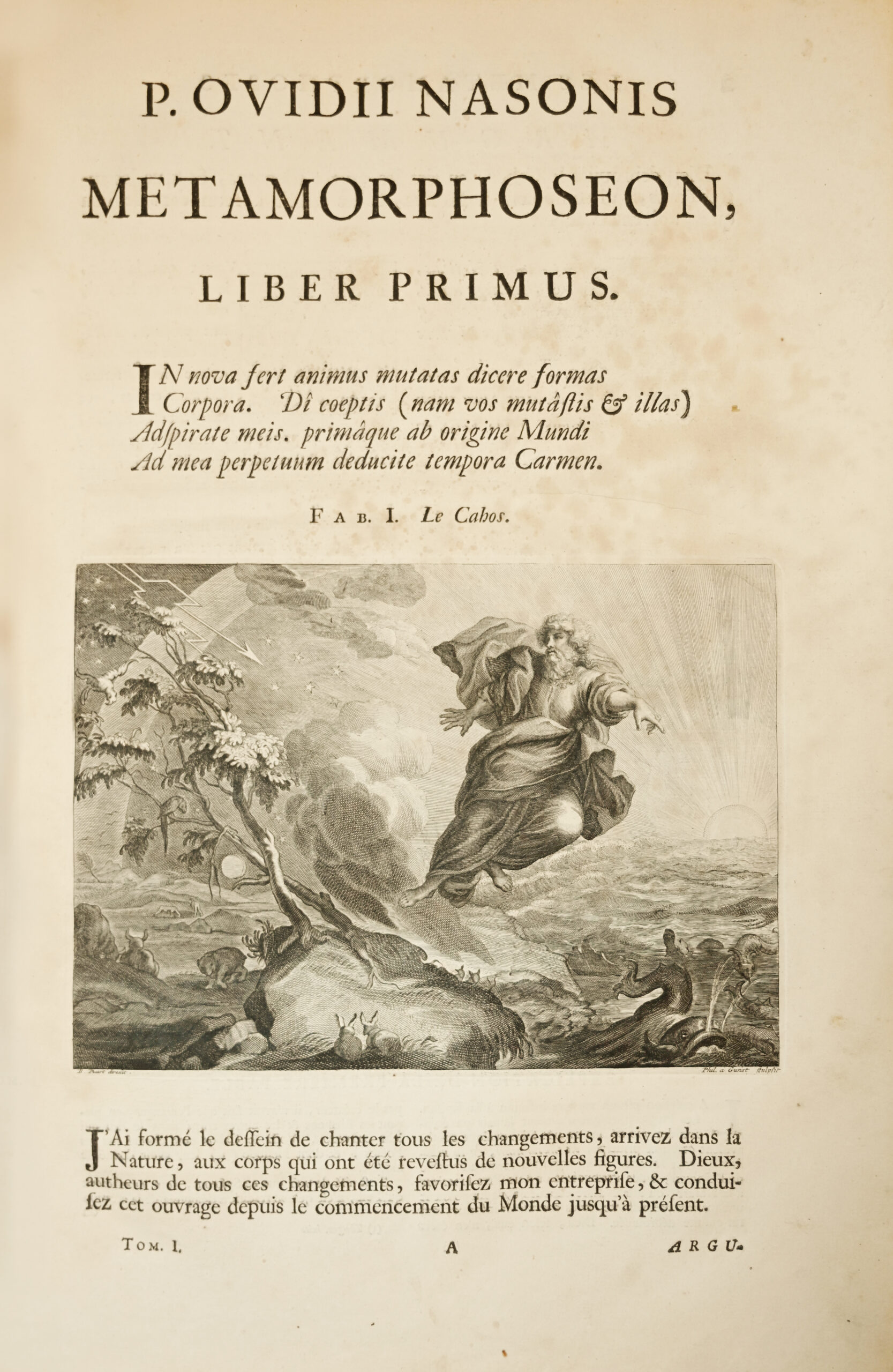
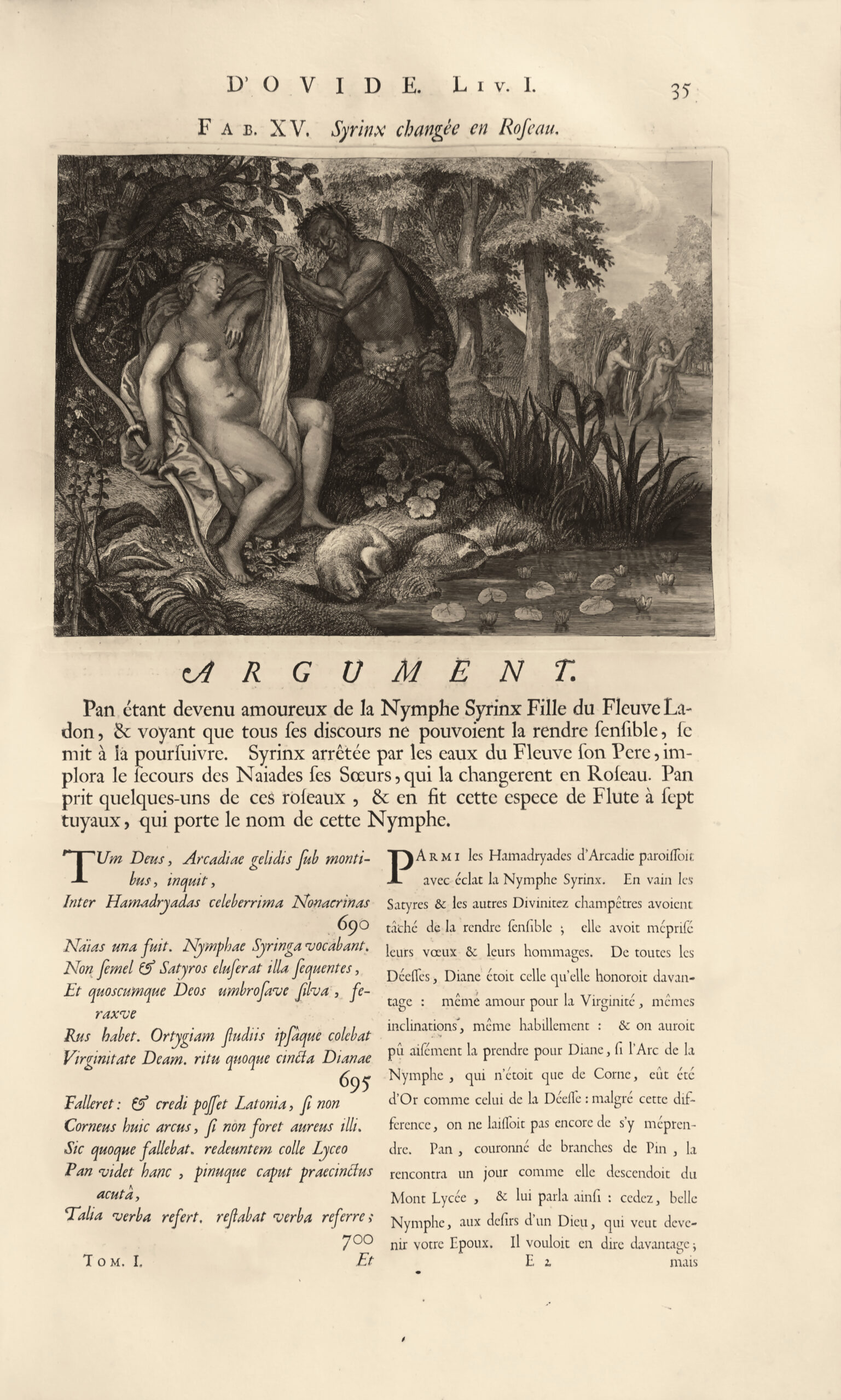
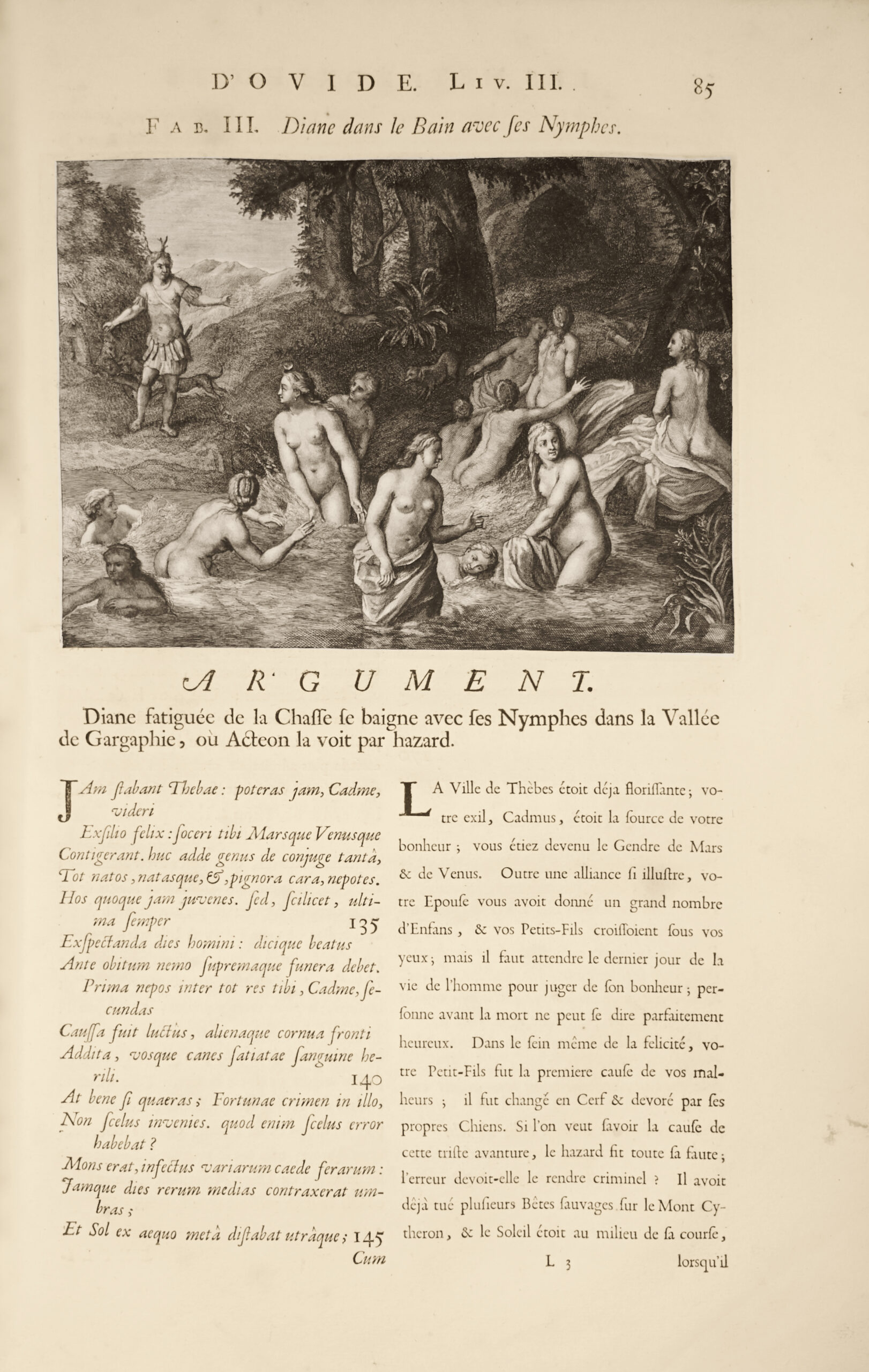
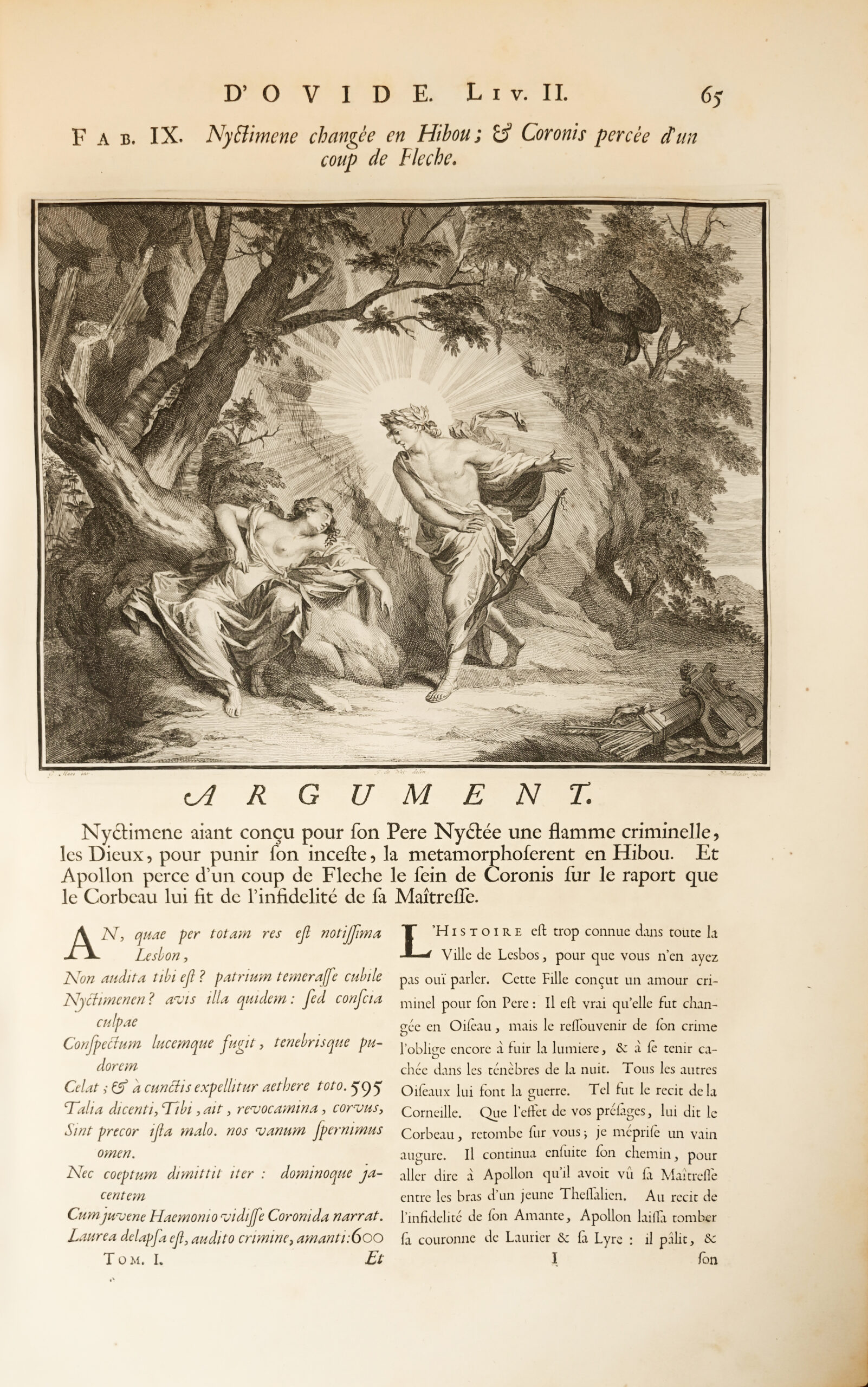
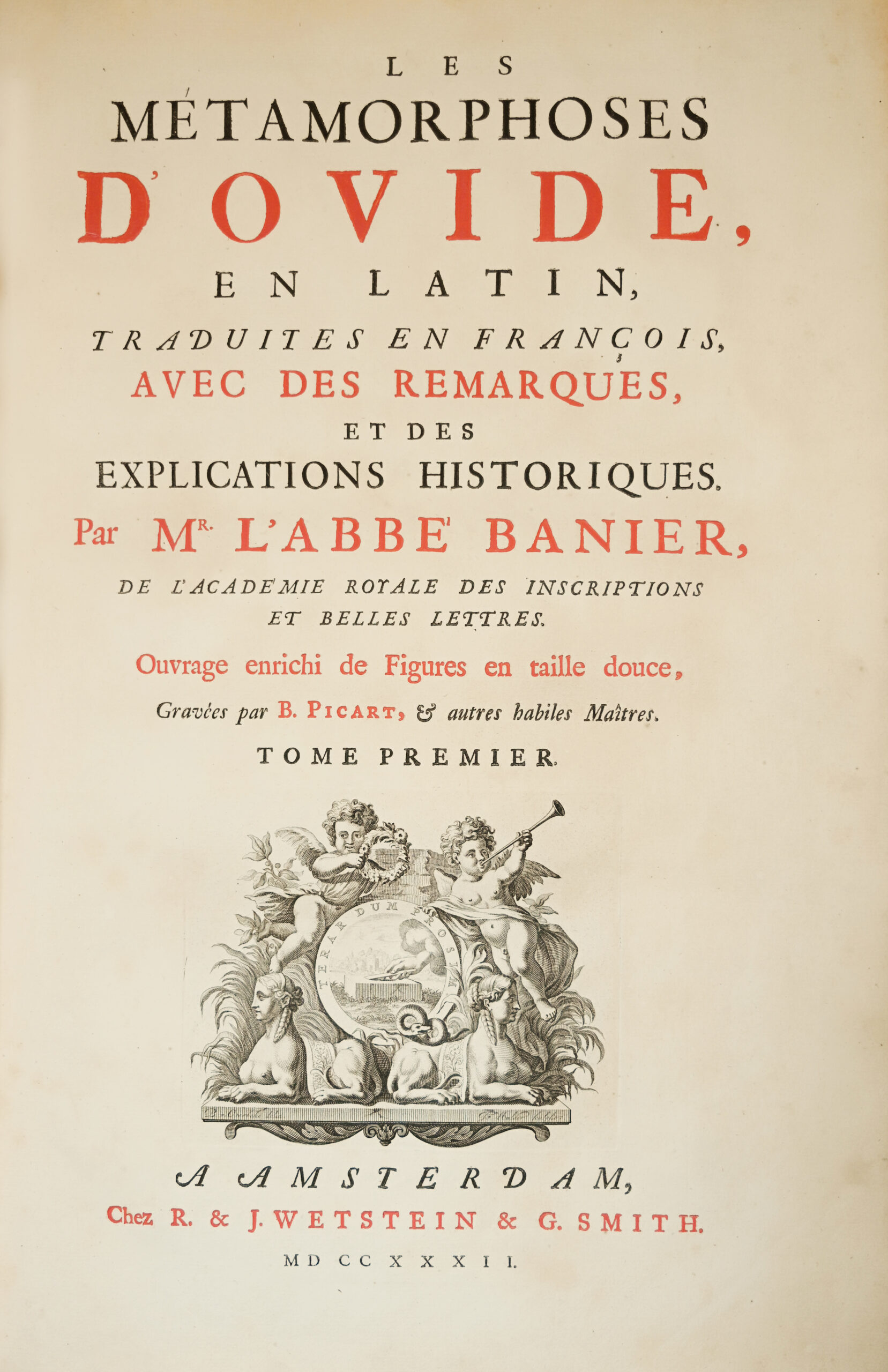
In Amsterdam, At R. and J. Wetstein & G. Smith, 1732.
2 folio volumes of: I/ (4) leaves including the engraved frontispiece, 247 pages, 70 engravings in the text, small tear in the lower margin of 2 leaves without loss; II/ (4) leaves, pages 249 to 524, (2) leaves, 60 engravings in the text.
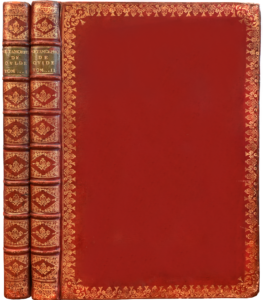
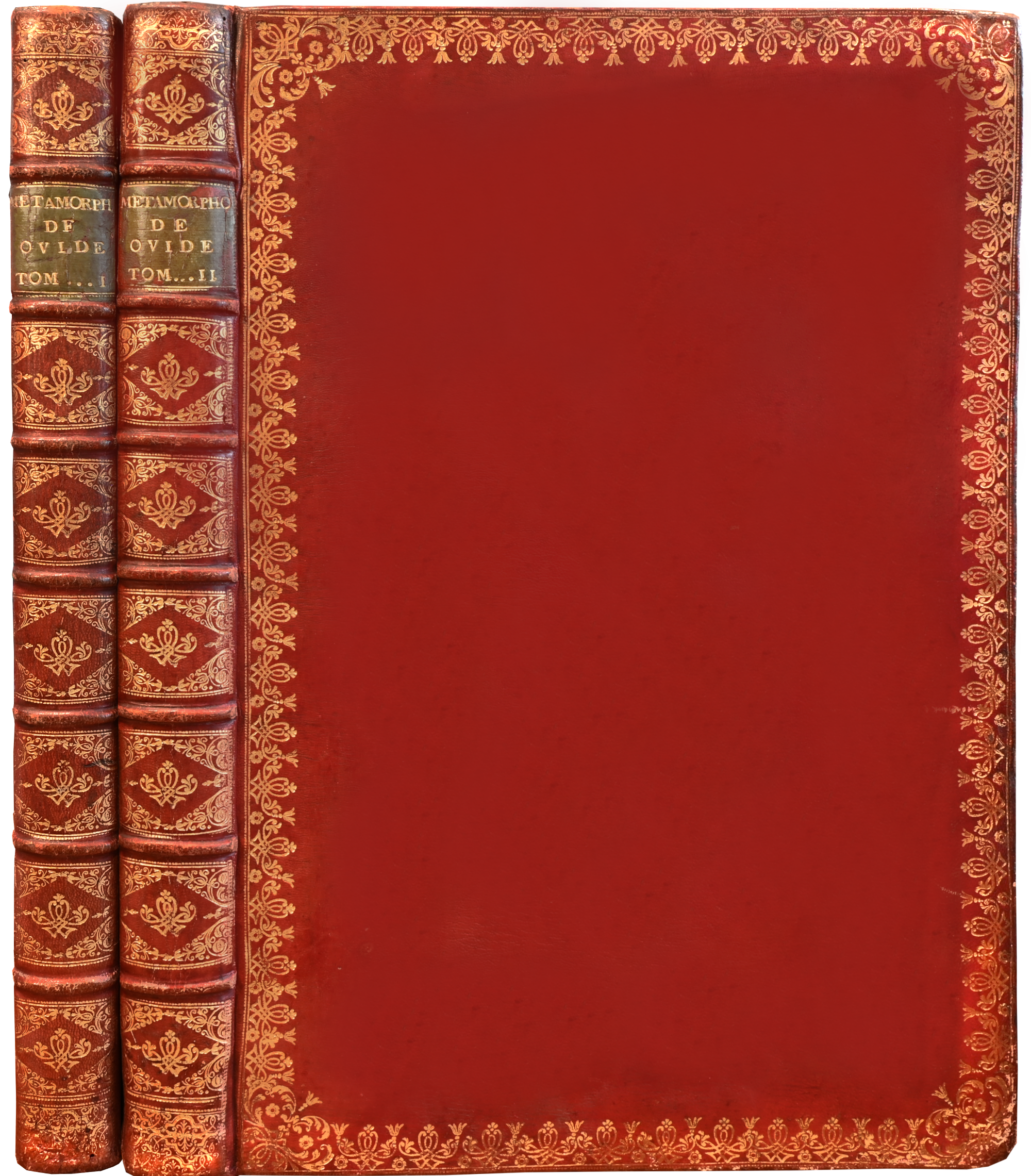
Full red morocco, boards adorned with a wide gold floral lace, spine with raised bands richly decorated, green morocco title labels, decorated edges, gilt edges. *Lace morocco binding of the period.*
452 x 298 mm.
Original edition of Antoine Basnier’s translation, printed on large Holland paper.
“Magnificent work” mentions Cohen. (Guide for lovers of engraved books 768).
This book was printed with French, English, and Dutch translations.
This luxurious work is adorned with 130 admirable first-edition engravings (230 X 165 mm) illustrating each of the metamorphoses.
The text is thus embellished with 130 figures drawn by Picart, Lebrun, Leclerc, Maas, Punt, J. Romain, Tosca, De Wit, and Wandelaar and engraved by Martin Bouche, P.P. Bouche, Bouttats, Folkema, V. Gunst, Jungmann, Schenk, and Wandelaar.
Among these figures, three large plates, pulled apart in the second volume, each contain two beautiful figures by Lebrun, engraved by Folkema.
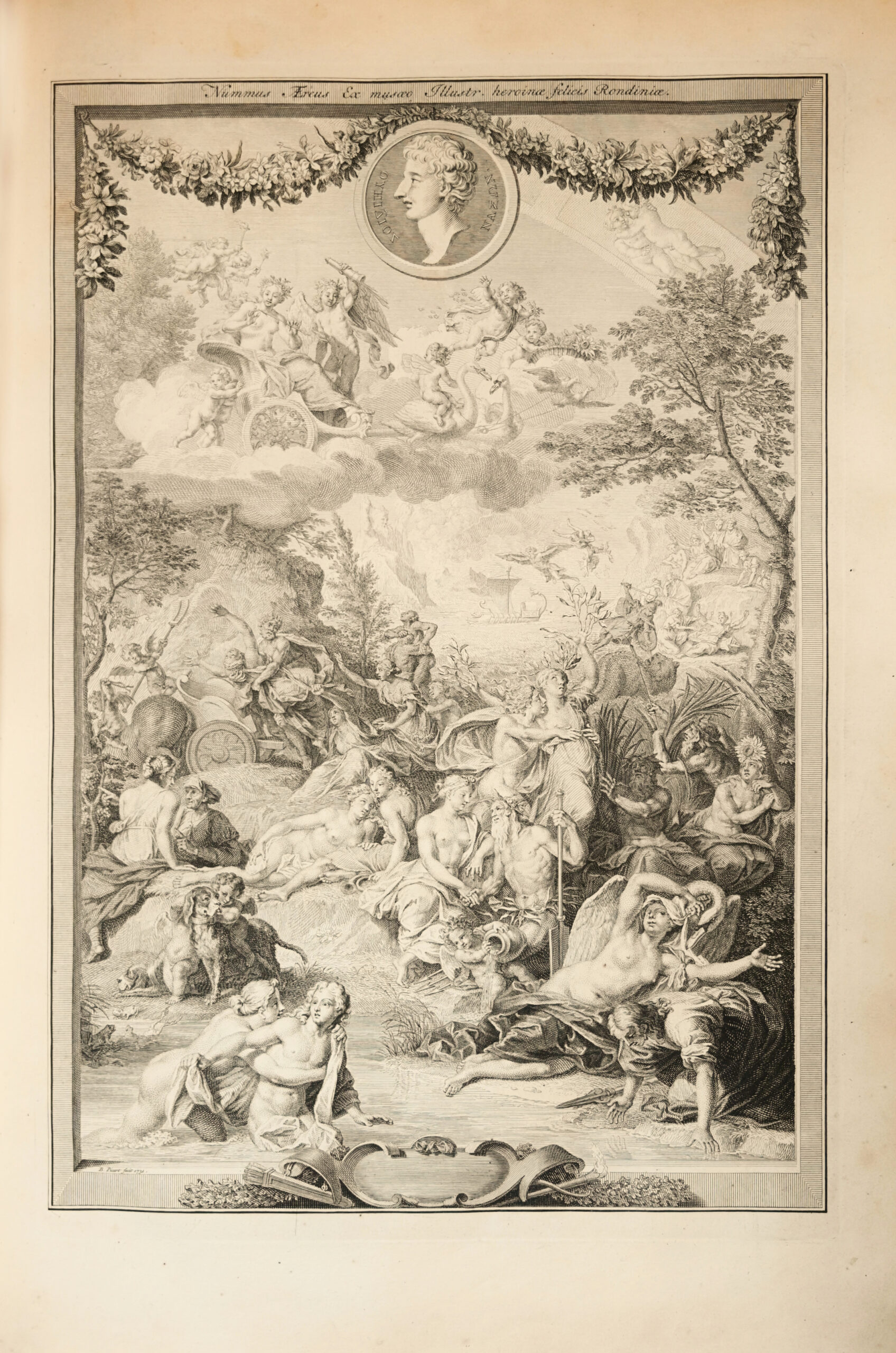
A superb full-page frontispiece drawn by Picart representing the gods of Olympus adorns the edition and symbolizes the whole of the Metamorphoses.
Two devices on the titles by Overbeke, 1 vignette heading the dedication to the King by Louis Fabrice Du Bourg and various tailpieces complete the extremely refined ornamentation of the edition.
This sumptuous original edition thus combines the quality of typography, presenting texts in alternating Roman and italic type, with the elegance of the layout and the beauty of the illustration very evocative of the grand French 18thè century.
“It is in the city of Amsterdam, then an important center of European bookselling, that Bernard Picart prepared the large illustrated works he published, drew their figures, and engraved their prints or directed their execution.” Baron Roger Portalis. The engravers of the 18thè century.
“Very rare, the Latin and French version of the Ovid illustrated by Westein and Smith is much rarer than the Latin/English version. OCLC notes only 15 copies in institutional collections and there are no auction records dating back more than 25 years.” (Budd en brooks Inc).
The Metamorphoses are a collection of Greek and Roman myths, recounting classic stories such as Echo and Narcissus, Jason and Medea and Venus and Adonis. It also includes the Eastern Babylonian tale, Pyramus and Thisbe. This great epic work has been appreciated over the centuries for its inventiveness, charm, and originality.
“As a storyteller and guide of Greek myth and Roman legend, Ovid had a great influence on later Roman writers and was read, quoted, and adapted in the Middle Ages. He was the favored Latin poet of the Renaissance, and there have been many translations of his works into English.” – MCHowatson.
His influence on great writers throughout history, from Chaucer to Marlowe and Shakespeare, is well known.
“In the preface to the luxurious and monumental edition of the Metamorphoses by Ovid, published in Amsterdam in 1732, Abbé Antoine Banier expresses all his admiration for the Latin poet whose vast genius he praises:
It’s from all these collections that Ovid drew the subjects that make up the XV Books of his Metamorphoses, & it appears from what remains of the ancients on this subject, that he surpassed them greatly; instead of a cold, insipid, or simply didactic collection, he made a kind of Poem, whose entire Universe is the scene, & which embraces all the times that had passed since the beginning of the World until the century in which he wrote. What traits, what different colors must he have gathered for so many tableaux! Nevertheless, he completed all these tableaux, & at the end of the work his brush is not weakened […].
The entire universe serves as the stage for the poem, here is its backdrop planted; but the dramatic, fleeting metaphor immediately gives way to a pictorial metaphor: the “traits” and “colors” qualify an art of variety deployed in a profuse sequence of “tableaux”. The praise is usual; since the second half of the XVIIth century, the liveliness and narrative, stylistic, and poetiological variety of Ovid have been the subject of almost unanimous praise. The scholar then underscores, attributing to Ovid a complementary quality: the breadth of his visions goes hand in hand with a consummate art of detail and particularity.
If Banier did not follow all the lessons proposed by Bursman, it is because he yielded to the public’s idea of Ovidian poetry and its taste for “smiling images”. It is precisely this spirit and these images that Picart intends to offer to the view, as energetically indicated by the frontispiece. The figures project the reader’s imagination toward a space other than that of the text: they offer a mythological reverie rather than illustrating or commenting on the poem. A bit like a feedback effect. Stewart emphasized the intrinsic copresence of text and image in history paintings, pointing out that these are always, in a sense, the illustration of a virtual text, implicitly present – without which the image loses its intelligibility. Here, the pictorial tradition, strong in its own tradition, joins Ovid’s text in the book.”
Remarkable and exceptional copy printed on large Dutch paper bound in two volumes preserved in their luxurious contemporary dentelle morocco bindings, in extremely rare condition.